#Product Trends
Best Practices for Instrument Protection: Custom Wire Mesh Baskets vs. Standard Trays
Why top-performing Sterile Processing Departments are ditching standard perforated trays for custom-engineered wire mesh containment
Best Practices for Instrument Protection: Custom Wire Mesh Baskets vs. Standard Trays
Proper instrument protection is an essential part of an effective medical reprocessing workflow. Surgical instruments must be protected not only during sterilization, but throughout cleaning, inspection, transport, handling, and storage.
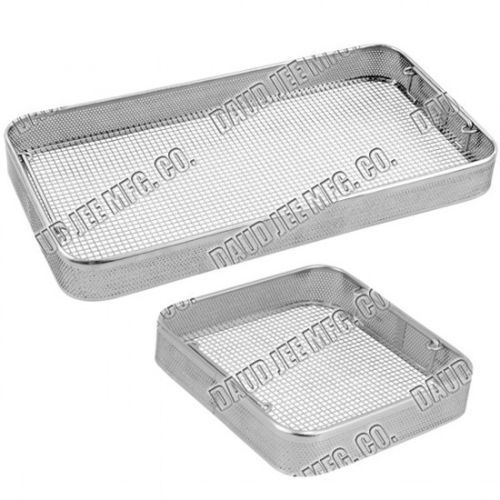
While perforated sterilization trays are widely used for routine instrument sets, custom wire mesh baskets can provide additional advantages when instruments are delicate, complex, unusually shaped, or require specialized positioning.
The right solution depends on the type of instruments, the cleaning and sterilization process, the required workflow, and the level of protection needed.
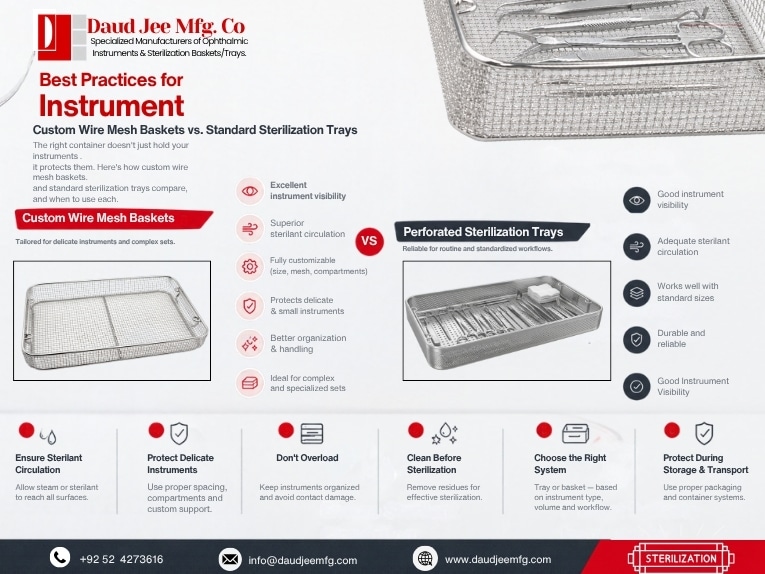
Custom Wire Mesh Baskets vs. Standard Sterilization Trays
Both systems are designed to organize and protect medical instruments, but their construction and applications can be quite different.
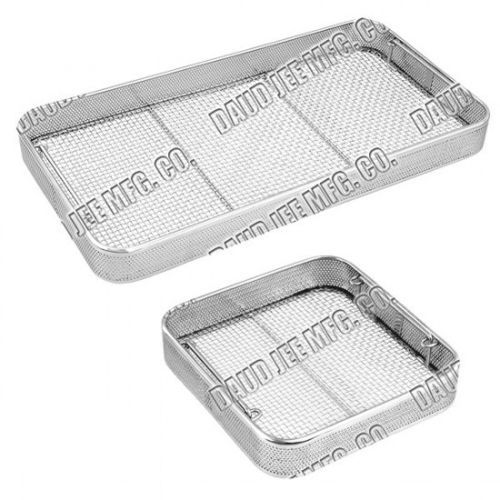
Perforated sterilization trays generally provide a rigid, standardized platform for commonly used instrument sets. They are practical for facilities with established tray sizes and repeatable workflows.
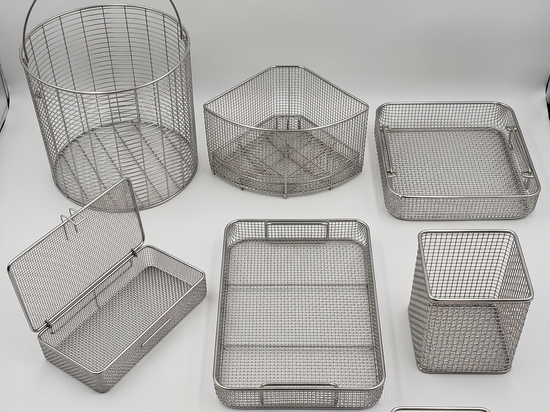
Custom wire mesh baskets, on the other hand, can be engineered around specific instruments or instrument sets. Their dimensions, mesh configuration, supports, compartments, handles, and other features can be adapted to the application.
For specialized surgical instruments, this customization can help improve organization, accessibility, and protection throughout the reprocessing cycle.
1. Ensure Proper Sterilant and Cleaning-Fluid Circulation
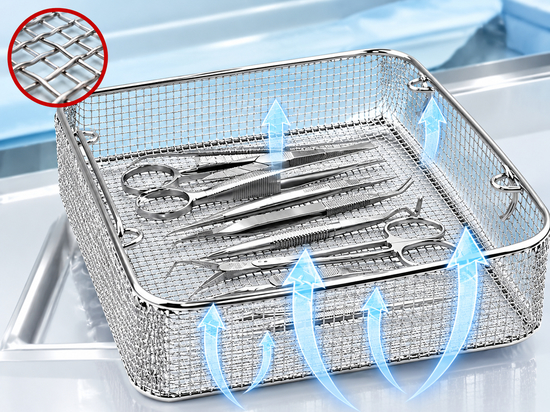
One of the most important considerations when selecting an instrument basket or tray is allowing adequate access to the instrument surfaces.
A properly designed wire mesh basket provides openings around the instruments, helping cleaning fluids and sterilant reach exposed surfaces when the basket is correctly loaded.
However, basket design alone does not guarantee sterilization. Mesh configuration, instrument arrangement, loading density, sterilizer cycle parameters, and the manufacturer's reprocessing instructions all need to be considered.
Best practice:
- Avoid overloading the basket.
- Keep instruments properly separated.
- Arrange instruments to allow adequate access.
- Follow the instrument manufacturer's reprocessing instructions.
- Use the validated sterilization cycle appropriate for the instruments and container system.
2. Protect Delicate Instruments From Impact and Contact Damage
Delicate surgical instruments can be vulnerable to scratches, deformation, tip damage, and unwanted movement during handling and transportation.
A major advantage of custom wire mesh basket design is the ability to incorporate **purpose-built positioning features.
Depending on the application, a custom basket can include:
- Silicone brackets or anchors
- Instrument supports
- Individual compartments
- Separators
- Controlled spacing
- Custom mesh openings
- Rounded or smooth wire construction
- Specialized handles
- Custom internal dimensions
These features help keep instruments organized and reduce unnecessary instrument-to-instrument contact.
Silicone Brackets and Anchors
For particularly delicate instruments, silicone supports can provide cushioning and controlled positioning.
Instead of allowing instruments to move freely inside the basket, dedicated anchors can help hold them securely during:
Cleaning → Sterilization → Transport → Storage
This is especially useful for precision instruments with delicate tips, handles, or specialized geometries.
3. Use Smooth, Burr-Free Wire Construction
The quality of the basket's wire construction is just as important as its overall design.
Poorly finished wire can create sharp edges or burrs that may damage instruments, packaging, or handling gloves.
A properly manufactured basket should therefore feature **smooth, carefully finished wire surfaces**.
For medical applications, attention should be given to:
- Burr-free wire
- Smooth corners and edges
- Consistent welds
- Secure joints
- Proper finishing
- Corrosion resistance
- Appropriate stainless-steel grade
A smooth surface also makes the basket easier to inspect and maintain.
4. Select the Appropriate Stainless-Steel Grade
Material selection plays an important role in the durability and corrosion resistance of sterilization baskets.
The appropriate grade should be selected according to the intended cleaning environment, chemical exposure, sterilization process, and application requirements.
304 Stainless Steel
AISI 304 is widely used for stainless-steel baskets, trays, racks, and laboratory applications because of its corrosion resistance and durability.
The material should always be specified according to the actual application rather than assuming that one stainless-steel grade is appropriate for every workflow.
5. Consider Electropolishing and Surface Finishing
Surface finishing can further improve the quality and usability of a stainless-steel basket.
Electropolishing is an electrochemical finishing process that can remove a very thin layer from the metal surface and improve surface smoothness.
For appropriately processed stainless steel, electropolishing can provide benefits such as:
- A smoother surface
- Reduced microscopic surface irregularities
- Improved cleanability
- Enhanced corrosion resistance
- A clean, professional appearance
For medical and laboratory applications, the finishing process should be controlled and appropriate for the selected stainless-steel material and intended use.
6. Custom Mesh Configuration for Different Instruments
There is no single mesh configuration that is ideal for every instrument.
The mesh should be selected according to the size, shape, weight, and sensitivity of the instruments being handled.
For example:
Fine instruments may require smaller mesh openings or additional supports to prevent movement.
Larger instruments may benefit from stronger wire construction and larger openings.
Delicate microsurgical instruments may require dedicated positioning systems and protective supports.
Complex instrument sets may benefit from multiple compartments or customized internal layouts.
This is where custom manufacturing becomes particularly valuable.
Instead of adapting the instrument set to a generic container, the basket can be **designed around the actual instruments.
7. Avoid Overloading the Basket
Even the most advanced basket design cannot compensate for improper loading.
Overloading can restrict access to instrument surfaces, increase contact between instruments, and make inspection and handling more difficult.
A better approach is to organize instruments according to:
- Instrument type
- Size
- Weight
- Function
- Delicacy
- Cleaning requirements
- Sterilization requirements
The basket should provide enough space for instruments to remain appropriately positioned without unnecessary compression or crowding.
8. Cleaning Comes Before Sterilization
A critical principle of instrument reprocessing is that **sterilization does not replace cleaning**.
Organic and inorganic residues can interfere with effective sterilization. Instruments should therefore be thoroughly cleaned and inspected before entering the sterilization stage.
A well-designed basket can support this workflow by allowing easier access to instrument surfaces during cleaning and inspection.
An effective workflow can be structured as:
Decontamination → Cleaning → Rinsing → Inspection → Basket Loading → Sterilization → Transport → Storage**
The basket becomes part of the workflow rather than simply serving as a container.
9. Custom Baskets for Complex and Specialized Instrument Sets
Standard trays work well when instrument sets are standardized and the instruments fit comfortably within the available dimensions.
However, specialized instruments may not fit efficiently into standard tray configurations.
Custom wire baskets can be designed around:
- Unusual instrument dimensions
- Long instruments
- Narrow instruments
- Delicate tips
- Microsurgical instruments
- Multi-component sets
- Specialized surgical systems
- Laboratory equipment
- Custom OEM requirements
Custom dimensions can also help maximize available sterilizer space while maintaining appropriate instrument organization.
10. Standard Trays Still Have Their Place
Custom baskets should not automatically replace standard trays.
For many facilities, standard trays remain a practical choice because they are:
- Familiar to staff
- Available in established sizes
- Suitable for routine instrument sets
- Easy to integrate into existing workflows
- Appropriate for standardized applications
The important consideration is to match the container to the instrument and workflow.
Choose standard trays when:
The instrument sets are standardized, dimensions are predictable, and the existing tray system provides sufficient protection and organization.
Consider custom wire baskets when:
The instruments are delicate, specialized, unusually shaped, or require customized positioning and protection.
11. Protection During Transport and Storage
Instrument protection doesn't stop once sterilization is complete.
During transportation and storage, instruments can still experience movement, impact, and handling damage.
A properly designed basket can help maintain organization between the sterilization area, storage area, and point of use.
Conclusion:
Effective instrument protection starts with choosing the right container.
Standard sterilization trays remain valuable for routine and standardized applications, while custom wire mesh baskets offer greater flexibility for delicate, complex, and specialized instrument sets.
Features such as smooth burr-free wire, appropriate stainless-steel construction, optimized mesh openings, silicone supports, custom compartments, controlled positioning, and suitable surface finishing can help create a more purpose-built instrument protection system.
At Daud Jee Mfg. Co., custom stainless-steel basket and tray solutions can be developed according to specific dimensions, instrument requirements, mesh configurations, handles, supports, and finishing needs.
Whether you require a standard sterilization basket or a fully customized OEM solution, the objective remains the same:
Protect the instruments. Improve organization. Support efficient reprocessing.
Daud Jee Mfg. Co.
Precision Manufacturing • Quality • Reliability
Custom Sterilization Baskets & Trays | OEM & Private Label Manufacturing