
#Product Trends
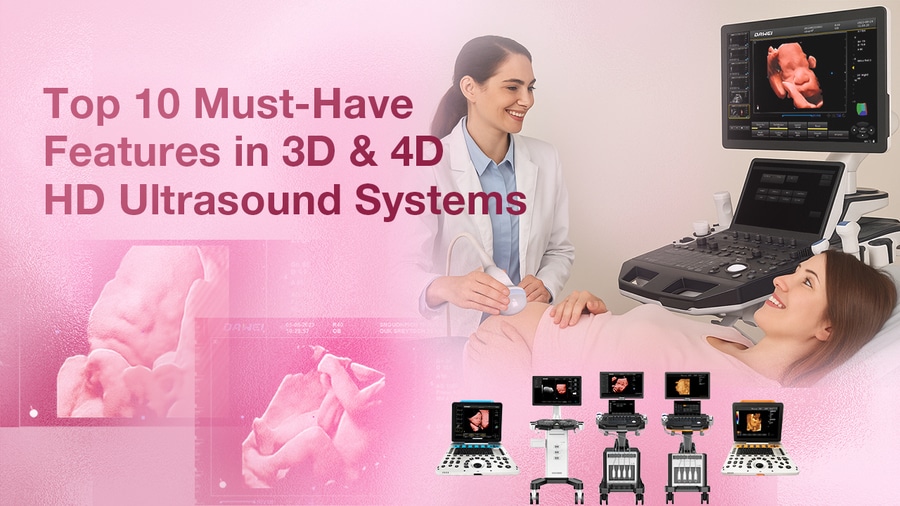
Top 10 Must-Have Features in 3D & 4D HD Ultrasound Systems
— And How DAWEI Delivers
Top 10 Must-Have Features in 3D & 4D HD Ultrasound Systems — And How DAWEI Delivers
High-quality 4D ultrasound is no longer a luxury — it’s a clinical necessity in modern OB/GYN practices. Whether used for fetal assessment or enhancing patient experience, a robust 3D/4D HD ultrasound system must go beyond basic imaging. Here's a breakdown of the 10 most essential features, why they matter
10 Must-Have Features — and Why They Matter
1.High Volume Rate for Smooth 4D Rendering
A high volume acquisition rate (measured in volumes per second) is critical for capturing real-time fetal movements without lag or stuttering. This ensures that the 4D images (which are 3D images in real-time) are smooth and accurate-not just for a better viewing experience, but for capturing transient abnormalities that could be missed with slower systems.
2、Broad Transducer Portfolio
Different obstetric and gynecological examinations require different types of transducers. For example, a convex transducer is used for abdominal scans, an endovaginal probe for early pregnancy or detailed pelvic exams, and a volumetric probe for 3D/4D imaging. Having a broad portfolio of transducers ensures that the ultrasound system can be used for a wide range of examinations, making it versatile and adaptable to various clinical scenarios. Without this, the diagnostic capabilities of the system are limited.
3、Real-Time HD Live Rendering
This feature uses advanced rendering techniques with dynamic lighting to create highly realistic and detailed images of the fetus. The enhanced depth and texture improve the clarity of anatomical structures, which aids in diagnosis.
4.Intelligent Image Optimization Software
Automation tools like auto gain, auto depth adjustment, and speckle reduction algorithms help in maintaining consistent image quality with minimal manual adjustments. This reduces operator dependency and variability, leading to more standardized results and increased efficiency. It also shortens the learning curve for new sonographers and reduces the time taken per scan.
5.Advanced Fetal Measurement & OB Reporting Tools
Specialized OB software packages with automated biometric measurements (BPD, HC, AC, FL, etc.), growth tracking, and customizable reporting are essential for accurate, efficient prenatal care.
6.Ergonomic Touch Interface & Workflow Automation -
A touchscreen interface that is intuitive and customizable (with presets for different exams) can significantly reduce scanning time and operator fatigue. Workflow automation includes features like one-touch measurements and automated reporting. This is especially important in busy practices where sonographers perform many scans per day.
7.Remote Service & Predictive Maintenance
To minimize downtime, modern ultrasound systems should have remote diagnostic capabilities that allow the vendor to identify and sometimes fix issues remotely. Predictive maintenance uses system monitoring to alert service teams before a failure occurs. This ensures continuous uptime, which is critical in a clinical setting.
8.Open Architecture & DICOM Connectivity
Seamless integration with hospital systems (like PACS for image storage and EMR for patient records) is essential for efficient workflow and compliance with data security standards. Open architecture allows the ultrasound system to connect with a variety of third-party systems and devices, ensuring that it fits into the existing clinical ecosystem. -
9.Compact Design & Mobility
A compact and lightweight design makes the system easy to move between departments or to mobile clinics. This is particularly important in space-constrained environments or for providers who offer on-site services. It also allows for flexibility in room setup.|
10. Comprehensive Training & Clinical Support
Comprehensive training and ongoing support ensure that the clinical staff can use the system to its full potential. This includes initial training, updates on new features, and access to clinical experts for advice. Without proper training, even the most advanced system may not be used effectively.
How DAWEI addresses each, and our final recommendations for OB/GYN professionals.
DAWEI's Solution:
1.Equipped with high-speed processing and real-time rendering engines, Dawei's 4D systems ensure silky-smooth imaging even during active fetal motion.
2.Offers a full range of high-frequency, ergonomic probes tailored for OB/GYN use, supporting both routine and advanced applications.
3.HD Live technology with adjustable lighting and surface enhancement brings 3D images to life, improving both diagnostic confidence and patient satisfaction.
4.Smart imaging algorithms optimize clarity in real-time, helping both beginners and experts achieve excellent results quickly.
5.A user-friendly UI with fast-access menus and automation tools makes scanning smoother and more efficient — ideal for high-volume OB clinics.
6.Remote support capabilities and built-in monitoring tools alert service teams early, ensuring reliable system performance.
7.Full DICOM connectivity and an open system architecture allow smooth interoperability with your hospital or clinic IT infrastructure.
8.Sleek, portable designs with durable casters make DAWEI’s 3D/4D systems ideal for both stationary and mobile use.
9.Offers hands-on training, online resources, and direct clinical support to ensure confidence and competence for every user.
Built-in OB/GYN toolkits provide precise fetal biometry, growth curve analysis, and structured reporting to support clinical decisions — from early pregnancy to third trimester.
10.Built-in OB/GYN toolkits provide precise fetal biometry, growth curve analysis, and structured reporting to support clinical decisions — from early pregnancy to third trimester.