#Product Trends
AI Vision Inspection: When 7 Cameras Are Watching One Production Line
Industrial AI Computing Built for Multi-Camera Vision Inspection
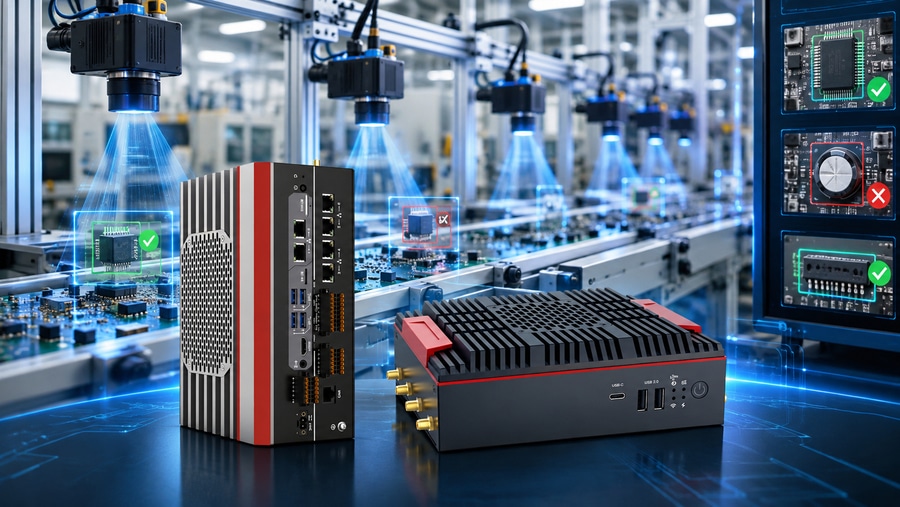
AI vision inspection is moving from single-camera detection to multi-camera inspection across entire production lines. Multiple workstations, viewing angles, and high-resolution cameras now capture image data simultaneously, while AI models inspect defects, verify positioning, and monitor product quality in real time.
For modern vision inspection systems, selecting the right edge AI platform is not only about computing power. Camera interfaces, network bandwidth, local AI inference, memory, installation space, and industrial reliability all directly affect inspection performance.
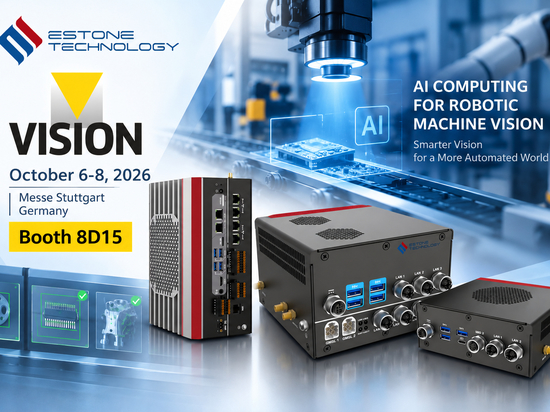
At VISION 2026, Estone Technology will showcase edge AI computing platforms designed for demanding AI machine vision and multi-camera inspection applications.
Multi-Camera AI Vision Inspection on One Production Line
Consider an electronics assembly line covering SMT, component insertion, soldering, assembly, and final inspection. GigE cameras can be installed throughout the line: one performs solder joint inspection, another verifies component positioning, while cameras further downstream handle alignment and final appearance inspection.
Some stations may use two cameras to inspect the same product from different angles. Together, seven or more cameras can operate simultaneously.
For this type of multi-camera AI vision inspection, every image needs to be processed locally within the production cycle. Insufficient network ports require additional switches, while insufficient AI performance can create processing queues and increase inspection latency.
The Estone NPC-7522 provides 7× RJ45, including 5× Gigabit Ethernet and 2× optional 2.5G/5G/10GbE, together with up to 2070 TOPS AI performance and 128GB memory. Multiple GigE cameras can therefore connect directly to one edge AI computer for local vision inference.
For control cabinet installations, the NPC-7312, based on NVIDIA Jetson AGX Orin, provides 6× GbE, up to 275 TOPS, and DIN-rail mounting.For production-line AI vision inspection, the principle is simple: connect the cameras, run the AI models locally, and complete inspection without slowing the production cycle.
High-Resolution AI Vision Inspection Needs More Bandwidth
Camera count is not always the main challenge. In applications such as film, paper, metal strip, and surface inspection, line-scan cameras continuously generate large volumes of image data.
High-resolution area cameras create similar demands. When AI vision inspection needs to identify tiny scratches, cracks, contamination, soldering defects, or other small abnormalities, higher-resolution images and larger AI models can significantly increase bandwidth and computing requirements.
The NPC-7552 combines 2×10GbE, 128GB memory, and up to 2070 TOPS, supporting high-speed line-scan and high-resolution AI visual inspection.
Here, 10GbE addresses camera bandwidth, large memory supports demanding vision models, and high AI computing performance enables real-time local inference. For these applications, the key consideration is not simply the number of cameras, but how much data each camera generates and how complex the AI inspection model is.
GMSL2 for Synchronized AI Machine Vision
Some AI vision inspection stations require several cameras to capture the same workpiece from different angles at synchronized exposure times. At the same time, limited installation space and long camera distances can make conventional network cabling more complicated.
GMSL2 cameras provide an alternative for synchronized multi-camera machine vision, transmitting data and power through coaxial connections.
The NPC-7522 provides 2× mini FAKRA supporting up to 8-channel GMSL2, together with multiple Ethernet interfaces and high AI computing performance.
This allows one edge AI platform to handle synchronized GMSL2 cameras alongside GigE cameras. For production lines using different camera technologies, the AI vision inspection system can therefore integrate camera connectivity, synchronization, and local AI inference within one platform.
Edge AI Computers for Different Vision Inspection Stations
Not every AI inspection station requires seven cameras or more than 2000 TOPS.
For industrial control cabinet integration, the NPC-7312 supports DIN-rail mounting, DC 9–36V wide-voltage input, and an operating temperature range of -25°C to 60°C. These features make it suitable for AI machine vision systems installed directly inside production equipment.
Smaller inspection stations may use only one or two cameras for product classification, positioning, barcode recognition, presence detection, or basic defect inspection.
For these applications, the NPC-7112 and NPC-7212 provide 2× GbE with 20/40 TOPS and 70/100 TOPS respectively, offering compact edge AI options for lightweight AI vision inspection and smart camera applications.
The right edge AI computer should therefore be selected according to the actual inspection task: camera count, camera interface, image resolution, network bandwidth, AI model size, inference speed, and installation environment.
Building Inspection Around the Production Line
Back to our production line: seven cameras are watching simultaneously. Some inspect solder joints, some verify component positioning, and others inspect the final product.
The images cannot wait for cloud processing, and inspection tasks cannot queue because the edge computer lacks network interfaces or AI performance. Each camera stream needs to be processed locally while the production line continues operating at its required cycle time.
Building an effective AI vision inspection system is therefore not simply about replacing an industrial PC with a faster computer. It requires an edge AI platform that can connect multiple cameras, process high-resolution image data, run AI vision models locally, and integrate reliably into the production environment.
Meet Estone Technology at VISION 2026 and explore our latest edge AI computing solutions for AI vision , multi-camera machine vision, automated visual inspection, line-scan inspection, and industrial automation.