


#Product Trends
The Treatment Cart — Structure Determines Nursing Care
The Treatment Cart — Structure Determines Nursing Care
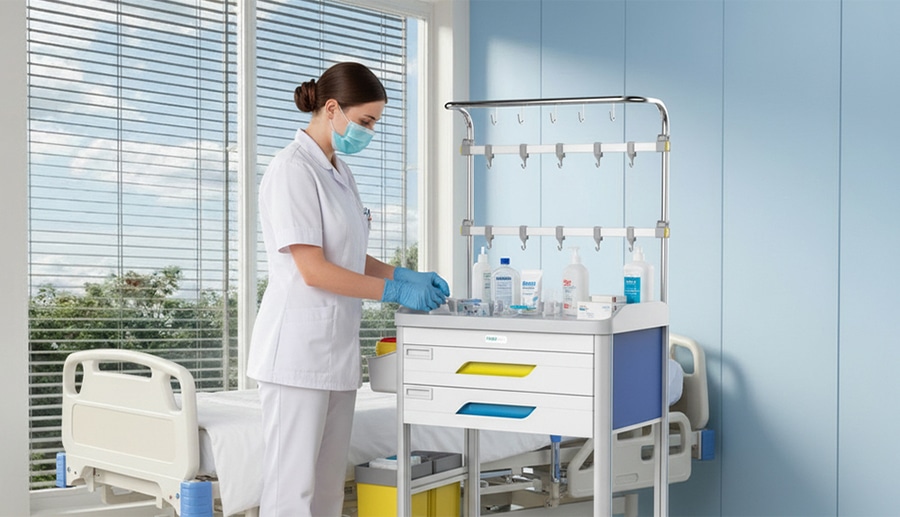
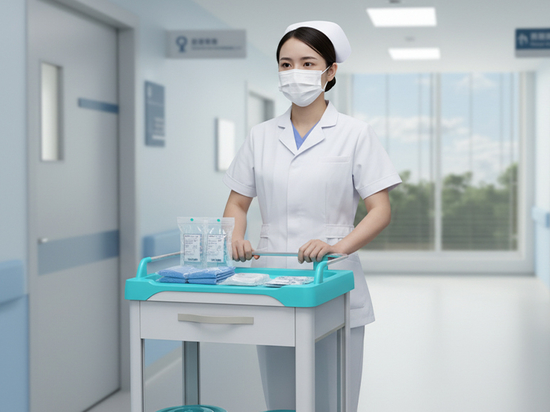
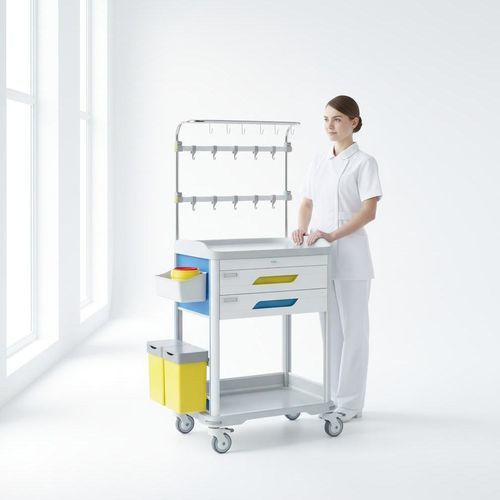
In the hospital system, the treatment cart has long been classified as ancillary equipment — a categorization based on technical complexity yet blind to density of involvement. When a treatment cart enters a care unit at high frequency every day, participating in medication administration, procedures, IV therapy, and documentation, the role it carries is no longer a single function but the physical support of workflow continuity. A care unit, in essence, is the smallest working structure made up of caregivers, patients, and ancillary devices. The treatment cart sits at the center of this structure. Once nursing enters a phase of refinement, the treatment cart ceases to be a question of tools and becomes a question of structure. Based on this judgment, Fangge has distilled it into a structural method — Flow Architecture™. It is not a product definition, but a systemic understanding of stability, order, and the dimension of time.
Structural Integrity: Consistency Across the Dimension of Time
The merits of a structure are rarely apparent at the moment of purchase. Time, not the showroom, is the true test: high-frequency movement, continuous load-bearing, and repeated opening stack the cycles of force dynamically. Deformation, loosening, resistance, noise — these are not incidental problems but the natural consequence of insufficient structural depth. Flow Architecture emphasizes a closed mechanical system. The core frame builds an integrated network of load-bearing through multi-dimensional reinforcement, forming a single, stable support system. Connections are tight, rigidity is sufficient, and resistance to deformation is clearly defined. Force is dispersed rather than concentrated. The caster path-control system and the high-cycle, high-strength slide-rail system serve simply to ensure that the structure maintains its precision over long-term operation. Only when the structure stays stable through time does the rhythm of the care unit gain continuity.
Storage Logic: The Path Must Be Pre-set by Structure
The loss of nursing efficiency often begins with searching. When storage is nothing more than space, order depends on individual memory — and every shift change means that order has to be rebuilt. Flow Architecture treats the storage interface as a cognitive interface. The double label frame inside and outside each drawer establishes a clear hierarchy of identification: the outside locates, the inside classifies. The position of an item becomes part of the language of structure. A modular drawer system allows a care unit to be reconfigured by scenario, forming reproducible path patterns. Efficiency is not about accelerating movements, but about eliminating ineffective ones.
Material Judgment: Safety Over Expression
Infection control and overall safety are the preconditions for a nursing system to function. At high-frequency touch interfaces, the material itself is the protective boundary. Only when antimicrobial capability derives from the structure of the material itself — rather than from a surface coating — does safety become sustainable. Critical contact surfaces receive reinforced deployment rather than blanket coverage. Precision is a form of respect for risk. For a care unit, reducing latent risk is, in itself, an increase in efficiency.
Structural Expression: Restraint Is the Form of Long-Termism
The medical space is already highly systemized; overexpression only creates distraction. Structural expression should serve order, not emotion. Proportions are derived through rational reasoning, lines follow the logic of load-bearing, and interfaces stay clear and uncluttered. At the design level, Fangge treatment carts do not chase trends; they seek validation by time. Fangge holds that being still rational, restrained, and never dated after ten years is the goal of a mature structure. In a long-term, high-intensity environment, the sense of stability brought by visual order directly affects the emotional rhythm and concentration of caregivers. When the structure is clear, the psychological burden is eased. Restraint is a capability. Sustained restraint is a judgment.
Adaptation and Expansion: Change Happens On Top of Stability
Nursing scenarios change; the structure should not waver because of it. Expansion interfaces allow attachments to be added in stages while supporting quick removal and easy cleaning. The cleaning path itself is part of the infection-control system. Expandability is built on a stable main frame, not as a replacement for it. Stability is the precondition; change happens on top of it.
The Closed Loop of the Method
Flow Architecture is not a collection of functions. It begins with structural integrity, forms path order through storage logic, establishes safety boundaries through material judgment, stabilizes the emotional environment through restrained expression, and responds to change through adaptation and expansion. Stability → Order → Safety → Emotion → Adaptation. Five layers form a closed loop. Once the loop holds, the flow of nursing runs naturally.
Closing
The treatment cart may not be the most technically complex device in the hospital system. But within the care unit, it is one of the most frequently involved structural nodes. Once the nursing system enters a phase of refinement, what truly sets the ceiling on efficiency is structural depth. Flow Architecture is not a strengthening of a concept but a re-judgment of how the system operates. When the structure is correctly established, the workflow happens naturally — and a mature system, as a rule, runs quietly.
 鄂公网安备42018502009510号