


#Product Trends
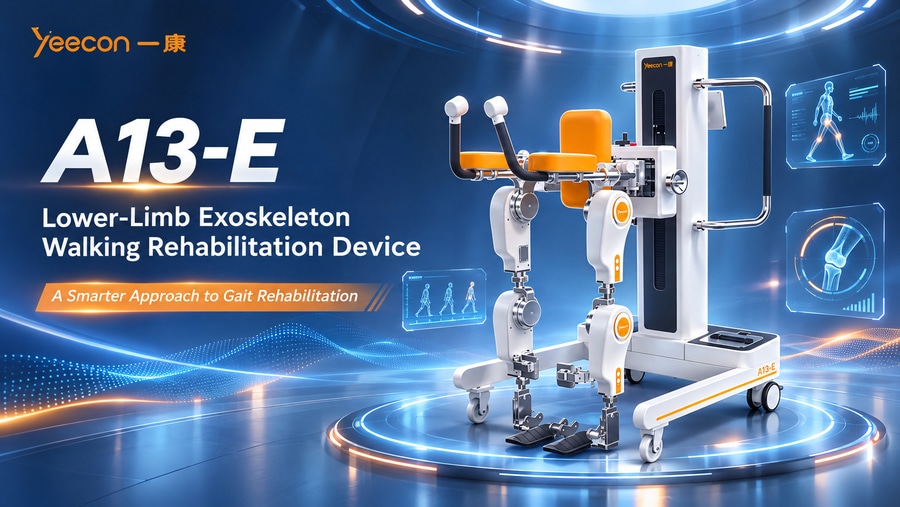
Meet the A13-E: A Smarter Approach to Lower-Limb Gait Rehabilitation
Regaining the ability to walk is one of the most important goals in lower-limb rehabilitation, but it is rarely a simple process.
Regaining the ability to walk is one of the most important goals in lower-limb rehabilitation, but it is rarely a simple process.
Walking requires coordinated movement across the hips, knees, ankles, trunk, and sensory systems. After neurological injury, surgery, or other conditions affecting lower-limb function, patients may need repeated and carefully guided practice to rebuild a more stable and efficient gait pattern.
This is where intelligent rehabilitation technology can make a meaningful difference.
The Yeecon A13-E Lower-Limb Exoskeleton Walking Rehabilitation Device is designed to support progressive gait rehabilitation through structured training, adjustable assistance, real-time monitoring, and multiple safety mechanisms.
Rather than using one fixed training approach, the A13-E provides rehabilitation professionals with a more flexible way to adapt gait training to different stages of recovery.
Supporting Different Stages of Gait Rehabilitation
Patients do not enter rehabilitation with the same level of mobility or motor control.
Some may initially require a high level of assistance, while others may already be able to initiate movement but still need support with coordination, balance, or gait quality.
The A13-E addresses this difference through multiple training options.
The system supports passive training and active-assisted training, together with single-step walking, continuous walking, and single-joint training. Different assistance strategies, including guided force and torque-threshold assistance, allow the training intensity to be adjusted according to the patient’s current ability.
This progressive approach is important because rehabilitation needs can change over time.
In early stages, the focus may be on helping the patient experience a more structured walking pattern. As motor control improves, the therapist may gradually reduce assistance and encourage greater participation.
The goal is not simply to create movement, but to support more purposeful and repeatable gait practice.
More Precise Gait Adjustment
One of the main challenges in gait rehabilitation is that every patient presents differently.
Step length, walking rhythm, lower-limb range of motion, body proportions, and muscle control can all vary significantly from one person to another.
The A13-E allows rehabilitation professionals to adjust multiple gait-related parameters, including step length, walking frequency, and joint movement angles.
The system also supports leg-length adjustment, making it easier to configure the device according to individual body dimensions.
These settings allow therapists to move away from a one-size-fits-all approach and build a more personalized training program around the patient’s actual needs.
For rehabilitation teams, this means that training can be adjusted gradually as the patient progresses rather than remaining fixed throughout the rehabilitation process.
Turning Gait Training Into Measurable Information
Traditional gait training relies heavily on therapist observation.
Visual assessment remains important, but intelligent rehabilitation systems can provide additional data that helps clinicians understand what is happening during training.
The A13-E can monitor information such as foot pressure, motor position, and torque curves during rehabilitation sessions.
This gives rehabilitation professionals another way to observe movement performance and make more informed adjustments.
Training information such as accumulated step count, selected walking mode, training time, and gait settings can also be viewed through the system.
This creates a more structured rehabilitation cycle:
train, observe, adjust, and reassess.
Instead of looking only at whether a patient can complete a movement, therapists can also evaluate how the movement is being performed and whether the level of assistance should change.
For modern rehabilitation departments, this type of measurable training process can help make gait rehabilitation more consistent and easier to track.
Designed for Practical Rehabilitation Workflows
A rehabilitation device also needs to fit into daily clinical practice.
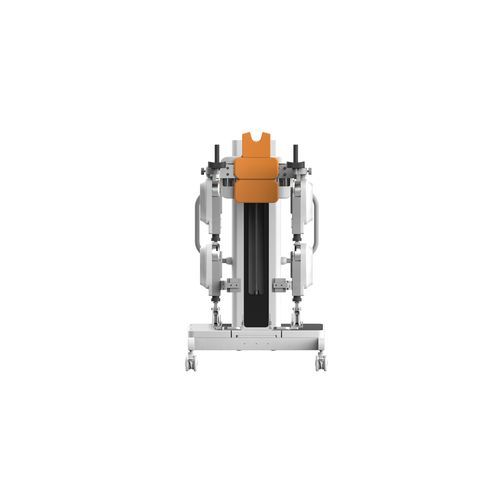
The A13-E supports both sitting and standing access, allowing therapists to select a more suitable setup according to the patient’s functional condition.
Its movable arm supports and adjustable structure are designed to make patient positioning and device entry more convenient.
The system also integrates multiple safety mechanisms, including emergency stop functions and protective control features, helping provide additional safeguards during supervised training.
These features are especially important in lower-limb rehabilitation, where patients may have different levels of balance, strength, motor control, and tolerance.
By combining training assistance, adjustable parameters, monitoring, and safety functions in one system, the A13-E is designed to support a more practical and flexible rehabilitation workflow.
Who Is the A13-E Designed For?
The A13-E is intended for lower-limb gait rehabilitation in patients with impaired walking function.
According to the product materials, the system can be used in rehabilitation programs for people experiencing lower-limb motor dysfunction associated with neurological or related functional impairments.
Its role is to support structured walking practice under professional supervision rather than replace the rehabilitation therapist.
This distinction matters.
Robot-assisted gait rehabilitation is most valuable when technology is integrated into a broader rehabilitation program that includes clinical assessment, therapist guidance, strength training, balance training, and functional practice.
The device provides the training platform, while the rehabilitation team determines how and when that technology should be used.
A More Intelligent Way to Support Walking Recovery
Lower-limb rehabilitation is not simply about repeating steps.
Effective gait training requires the right amount of assistance, appropriate movement parameters, consistent repetition, and continuous adjustment as the patient progresses.
The Yeecon A13-E Lower-Limb Exoskeleton Walking Rehabilitation Device brings these elements together within one intelligent rehabilitation platform.
With multiple training modes, adjustable gait parameters, real-time monitoring, personalized setup, and integrated safety protection, the A13-E is designed to help rehabilitation professionals deliver more structured and adaptable gait training.
Because every patient’s rehabilitation journey is different.
And every step forward should be supported by the right training strategy.
Discover the Yeecon A13-E and explore a more intelligent approach to lower-limb gait rehabilitation.

 鄂公网安备42018502009510号