


#Industry News
Toxoplasma Gondii in Dogs & Cats: Clinical Guide & Rapid Antibody Testing
Our latest research demonstrates that precision manufacturing at the antibody synthesis level can reduce false negatives by up to 23% compared to industry standards.
What Is Toxoplasma gondii?
Toxoplasma gondii is an obligate intracellular coccidian parasite with a worldwide distribution. It is capable of infecting virtually all warm-blooded vertebrates, including dogs, cats, humans, livestock, and wild animals. Felids — especially domestic cats — are the definitive hosts in which the sexual stage of the parasite occurs and oocysts are shed in faeces.
Dogs, humans and other mammals serve as intermediate hosts. Infection occurs through three principal routes:
Ingestion of sporulated oocysts shed by infected cats (environmental contamination)
Consumption of tissue cysts in raw or undercooked meat containing bradyzoites
Vertical (transplacental) transmission from dam to offspring during acute infection
Zoonotic Significance
Toxoplasmosis is one of the most prevalent zoonoses globally. Serological surveys indicate that 30–50% of the human population carries latent T. gondii infection. Immunocompromised patients and pregnant women face the greatest risk of severe clinical disease. Accurate diagnosis in companion animals therefore also carries a direct public health dimension.
Life Cycle and Transmission Pathways
The life cycle of T. gondii alternates between definitive and intermediate hosts. In cats, the enteroepithelial cycle produces oocysts that are excreted unsporulated and become infectious after 1–5 days of environmental sporulation. A single infected cat can shed millions of oocysts per day during primary infection.
In intermediate hosts — including dogs — tachyzoites disseminate widely during acute infection before converting to bradyzoites within tissue cysts, predominantly in neural and muscular tissue. This cyst stage may persist for the life of the host and represents the source of reactivation in immunosuppression.
Toxoplasmosis in Dogs — Clinical Presentation
Most immunocompetent dogs mount effective immune responses and remain subclinically infected. Clinical disease is more likely in puppies, immunosuppressed dogs, or those co-infected with Canine Distemper Virus (CDV), which profoundly impairs cell-mediated immunity and can reactivate latent toxoplasmosis.
Systemic Signs
Fever, lethargy, anorexia and weight loss
Pneumonia with dyspnoea, tachypnoea (pulmonary toxoplasmosis)
Hepatitis — jaundice, elevated liver enzymes
Myocarditis, cardiac arrhythmias
Lymphadenopathy
Neurological & Neuromuscular Signs
CNS involvement is a hallmark of severe toxoplasmosis and may present as:
Ataxia, paresis, or ascending paralysis
Seizures, behavioural changes, dementia
Myositis — muscle pain, stiffness, gait abnormalities
Polymyositis resembling immune-mediated disease
Ocular Signs
Anterior uveitis, chorioretinitis
Retinal detachment in severe cases
Clinical Alert: CDV Co-infection
Dogs with concurrent Canine Distemper Virus infection are at markedly elevated risk of clinical toxoplasmosis. CDV suppresses T-cell immunity, allowing rapid tachyzoite proliferation. Always consider T. gondii serology when CDV is suspected, particularly in dogs with concurrent neurological and respiratory signs.
Toxoplasmosis in Cats — Clinical Presentation
Cats are the definitive host and typically remain healthy despite infection. Clinical toxoplasmosis in cats occurs most commonly following primary infection in immunologically naïve animals or in FIV/FeLV-positive cats with compromised immunity.
Key Clinical Features in Cats
Ocular disease: Anterior uveitis, chorioretinitis — among the most common presentations; may be the only presenting sign
Respiratory: Interstitial pneumonia, dyspnoea
Gastrointestinal: Anorexia, vomiting, diarrhoea, weight loss
Neurological: Ataxia, paresis, cranial nerve deficits
Hepatic: Icterus, elevated liver enzymes (AST, ALT, ALP)
Immunosuppressed Cats at High Risk
Cats positive for Feline Immunodeficiency Virus (FIV) or Feline Leukaemia Virus (FeLV) are at significantly elevated risk of fatal toxoplasmosis due to impaired cell-mediated immunity. Serological screening is strongly advised in all FIV/FeLV-positive cats presenting with uveitis, neurological or respiratory signs.
Diagnosis of Toxoplasmosis — How to Test
Definitive diagnosis of toxoplasmosis combines serology, clinical signs, haematological and biochemical findings, and response to treatment. Serology — the detection of anti-T. gondii antibodies — remains the cornerstone of ante-mortem diagnosis in companion animals.
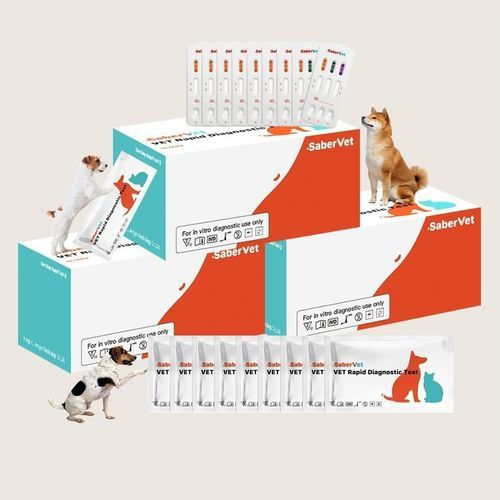
Sabervet TOXO Ab Rapid Test — Product Overview
Sabervet Toxoplasma Antibody Rapid Test
Lateral flow immunochromatographic assay for rapid detection of anti-Toxoplasma gondii IgG and IgM antibodies in canine and feline whole blood, serum or plasma.
Result in 10 minutes
Detects IgG (chronic) and IgM (acute) antibodies
10 µL whole blood, serum or plasma
No instrument required
CE-marked · ISO 13485 manufacturing
Sensitivity ≥93% · Specificity ≥97%
Storage 2–30 °C · 24-month shelf life
Order the TOXO Ab Test →
Request a free sample
How to Perform the TOXO Ab Rapid Test
The test procedure is simple and requires no specialised training or equipment. Each test kit contains: test cassette, dropper, buffer solution, and package insert.
Prepare the Sample
Collect 10 µL of whole blood (EDTA or heparin anticoagulant), serum, or plasma. Allow refrigerated samples to reach room temperature before testing. Do not use haemolysed or grossly lipaemic samples.
Add Sample to Cassette
Remove the test cassette from its sealed foil pouch. Place it on a flat, dry surface. Using the dropper provided, add 1 drop (~10 µL) of sample to the sample well (S) on the cassette.
Add Buffer Solution
Immediately add 2 drops of buffer solution to the sample well. The chromatographic migration will begin within seconds.
Read the Result at 10 Minutes
Positive: Two coloured lines appear (control line C and test line T).
Negative: Only the control line C appears.
Invalid: No control line — repeat with a new cassette.
Do not read results after 15 minutes.
Clinical Tip
A faint T line should always be interpreted as positive regardless of colour intensity. The control line must appear for the test to be valid. If the C line is absent, the result is invalid and the test must be repeated.
Treatment of Toxoplasmosis in Dogs and Cats
Clindamycin is the treatment of choice for clinical toxoplasmosis in both dogs and cats. Alternative or combination protocols include trimethoprim-sulphonamide (TMP-SMZ) and pyrimethamine plus sulphonamide, the latter being the most efficacious combination but requiring monitoring for bone marrow suppression.
Drug Dose (Dog) Dose (Cat) Duration Notes
Clindamycin 10–20 mg/kg PO q12h 25–50 mg/cat PO q12h 4 weeks minimum Drug of choice; monitor for GI side effects
TMP-SMZ 15 mg/kg PO q12h 15 mg/kg PO q12h 4 weeks Avoid in animals with folate deficiency
Pyrimethamine + Sulphonamide 0.25–0.5 mg/kg q24h (pyrimeth.) 0.25–0.5 mg/kg q24h 4 weeks Most efficacious; monitor CBC for myelosuppression; supplement folinic acid
Clinical improvement is typically seen within 24–48 hours of initiating appropriate therapy. Neurological signs may take longer to resolve or may persist if CNS damage is established.
Frequently Asked Questions
How accurate is the Sabervet Toxoplasma Antibody Rapid Test?
The Sabervet TOXO Ab test demonstrates sensitivity ≥93% and specificity ≥97% when validated against reference ELISA and IFA methods. These performance characteristics meet the requirements for CE certification and provide reliable results for clinical decision-making in veterinary practice.
What sample types can be used?
Can the test distinguish between acute and chronic infection?
Is the test valid for both dogs and cats?
What does a positive result mean clinically?
What certifications does the test carry?
How should the test be stored?
Why Choose Sabervet Rapid Tests?
Sabervet is a veterinary diagnostic brand developed by Hangzhou Antigenne Technology Co., Ltd — a specialist manufacturer of rapid immunochromatographic assays for companion animal and livestock medicine. Sabervet tests are used by veterinary practices, diagnostic laboratories, and distributors in over 40 countries.
Point-of-care design: No laboratory equipment, no training required — results in 10 minutes
Dual-species validation: All canine tests validated for feline use where applicable
CE-marked & ISO 13485: International quality certification for professional use
Complete diagnostic portfolio: CHW, CPV, CDV, FPV, FeLV, FIV, FIPV, EHR, ANA, Brucella, Bovine Pregnancy and more
Global distribution: Competitive MOQ, reliable supply chain, export to 40+ countries




 鄂公网安备42018502009510号