#Product Trends
Why Early Vestibular Assessment in Children with SYNAPSYS VHIT is Crucial
New Clinical Videos
Vestibular dysfunction is an increasingly recognized issue in children with balance or developmental disorders, with prevalence rates reported up to 36%, and even higher in those with sensorineural hearing loss. Because children frequently compensate without showing obvious postural symptoms, even mild deficits often go undetected, leading to delays in neurotological evaluation.
▶ The Critical Role of Vestibular Input in Early Development
Vestibular input is not just essential for balance and spatial orientation; it is fundamental for higher cognitive abilities, including spatial navigation, body schema formation, and temporal perception. Impairment during early development can significantly hinder motor milestones, self-awareness, literacy, and numeracy skills.
▶ Advancing Pediatric Vestibular Testing
Every child with suspected balance or developmental issues should receive a complete ENT and audiological screening. Vestibular assessment must be tailored to the child’s age and cooperation level, utilizing tools validated for pediatric populations.
Thanks to technological breakthroughs, non-invasive methods like cVEMPs and, crucially, the remote-camera Video Head Impulse Test (vHIT) now allow for accurate evaluation even in very young children.
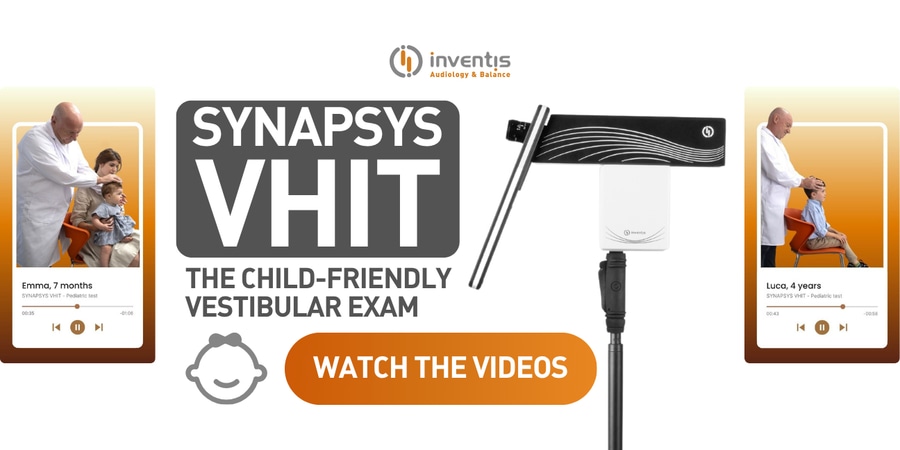
The Inventis SYNAPSYS vHIT with its remote camera system is uniquely suited for infants and toddlers, as demonstrated in the accompanying clinical videos.
▶ Practical Protocol: Tailoring vHIT for Children
The procedure adapts the standard adult protocol with specific adjustments for a child’s cooperation level:
‣ Create a Welcoming Environment - Start by building trust; use toys, dolls, or engaging items to help the child relax.
‣ Optimal Seating - Seat the infant or toddler securely on the lap of a parent or trusted relative, facing the remote camera.
‣ Testing Infants (3 months to 3 years) - The parent ensures secure positioning. An assistant, positioned behind the vHIT camera, uses a toy or video to capture the child’s attention. The operator then delivers the head impulses while the child is focused.
‣ Testing Older Children (Ages 3+) - The procedure can generally be performed using the standard adult protocol.
A minimum of five valid impulses per side is required, often necessitating repetitions due to blinks, distraction, or spontaneous movements. Vestibular hypofunction (lateral or vertical canals) is indicated when the VOR gain falls below 0.8 or 0.7, respectively.
▶ Watch the Clinical Demonstrations Now
In these two new videos, an experienced clinician provides essential real-life demonstrations on how SYNAPSYS vHIT enables reliable vestibular assessment in pediatric patients, including an infant as young as seven months.
These videos offer valuable insights into practical strategies for child testing and emphasize the essential role of early vestibular evaluation in supporting healthy motor and cognitive development.
‣ Video Example 1: Luca (4 years old) - https://youtu.be/lWa3lrhzm2s
‣ Video Example 2: Emma (7 months old) - https://youtu.be/9sEM5LYHrik
Watch them now to learn how early, child-friendly vestibular testing can make a definitive difference!
▶ References:
‣ S. R. Wiener-Vacher, S. I. Wiener – “Video Head Impulse Tests with a Remote Camera System: Normative Values of semicircular canal Vestibulo-Ocular reflex gain in infants and children”
‣ V. Marcelli – “Video Head Impulse Test in Pediatric Age: Clinical Relevance and Practical Applications”