#Industry News
Periodic sanitization is no longer enough
continuous protection for indoor environments is essential
Indoor environments are sanitized using different types of treatments… But what happens in the hours that follow?
In hospitals, dental practices, pharmaceutical laboratories, food processing facilities, and all high-traffic environments, microbiological contamination never stops.
People move around.
Air circulates.
Surfaces are constantly touched.
Yet, many biological risk control strategies still rely on an intermittent approach:
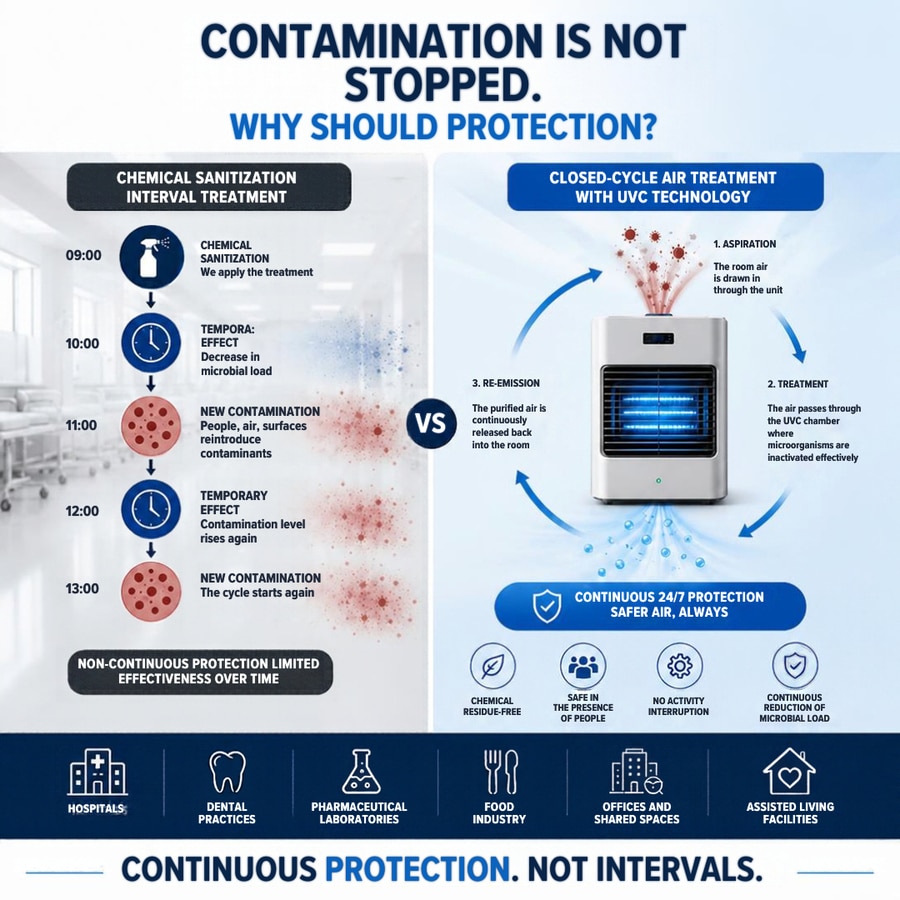
→ Treatment
→ Temporary reduction in microbial load
→ Return to normal operations
Until the next treatment.
The problem is that bacteria, viruses, and other microorganisms don't follow a sanitization schedule.
Their spread is continuous.
That is why a different approach to indoor environmental protection is gaining attention: rather than addressing contamination periodically, the goal is to continuously help control it.
Closed-cycle air treatment systems using UVC technology work according to this principle.
Air is drawn into the device, treated inside the unit, and continuously released back into the environment, helping reduce the airborne microbial load throughout the working day.
No nebulization.
No chemical residues.
No interruption of activities.
No need to vacate the premises.
The challenge is no longer simply asking whether a room has been sanitized.
The real question is: How long does effective protection actually last after sanitization?
In the most sensitive environments, the difference lies not only in the effectiveness of the treatment.
It lies in the continuity of protection.
#UVCTechnology #UVCLed #AirQuality #InfectionControl #BiologicalRisk #AntimicrobialResistance #HealthcareInnovation #FacilityManagement #Sanitization #IndoorAirQuality #WorkplaceSafety #Prevention