#Industry News
How to interpret a pulmonary function test report
Pulmonary function tests are important tools for the diagnosis, differential diagnosis, severity assessment, therapeutic effect evaluation and disease follow-up of respiratory system diseases.
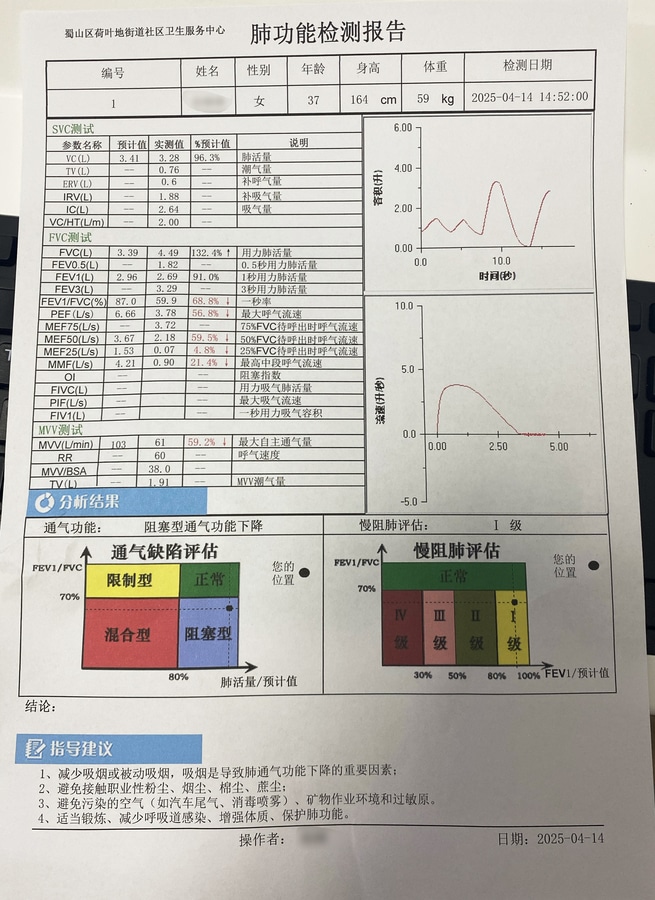
Pulmonary function tests are important tools for the diagnosis, differential diagnosis, severity assessment, therapeutic effect evaluation and disease follow-up of respiratory system diseases. How should a pulmonary function test report be interpreted? How can pulmonary function tests be applied in the diagnosis and management of chronic airway diseases?
A commonly used concept in pulmonary function diagnosis: A spirometer indicator ≥ the lower limit of normal (LLN) is considered normal. If the pulmonary function report does not have LLN, the predicted values of the main indicators vital capacity (FVC) and forced expiratory volume in one second (FEV₁) ≥ 80% are considered normal, and the predicted value of FEV₁/FVC> 92% is considered normal. Normal pulmonary ventilation function refers to all lung volume parameters and ventilation function parameters being within the normal range.
Types of pulmonary ventilation dysfunction
It is divided into obstructive ventilatory dysfunction, restrictive ventilatory dysfunction and mixed ventilatory dysfunction. Small airway dysfunction is a type of ventilation dysfunction that lies between normal and obstructive. The type of ventilation dysfunction can be determined through ventilation, volume parameters and the shape of the flow-volume (F-V) curve.
Obstructive ventilatory dysfunction: It refers to ventilatory dysfunction caused by restricted inhalation and/or exhalation of airflow. Its characteristic is a decrease in FEV/FVC. (2) Restrictive ventilation dysfunction: It refers to ventilation dysfunction caused by restricted lung expansion and/or restricted retraction. The diagnostic criteria are that FVC(VC)