
#Product Trends
How to remove urinary stones effectively?
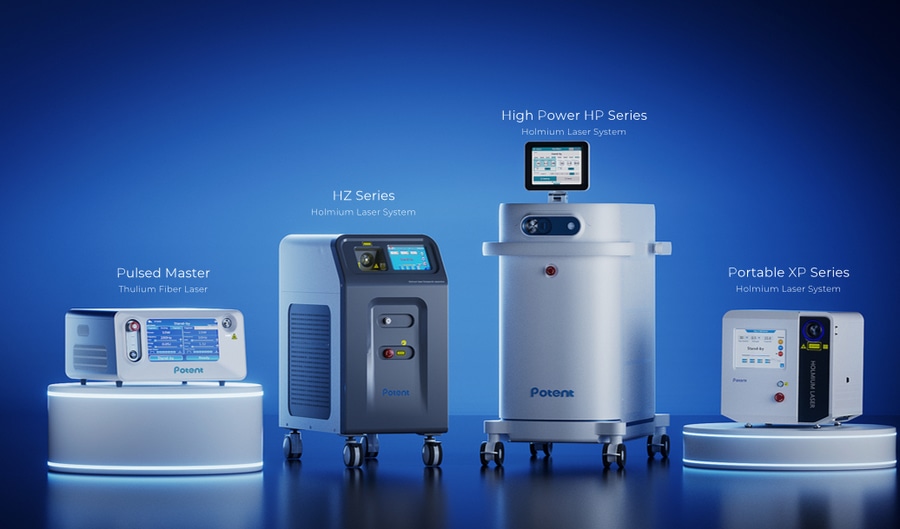
By using a holmium laser or a thulium fiber laser (TFL) to break the stones into tiny pieces, this treatment is minimally invasive, allowing for the removal of urinary stones without any incisions.
Urinary stones result from diet, metabolic disorders, infections, etc., commonly forming in the kidneys, ureters, bladder, or urethra.
There are four major types of urinary stones: calcium oxalate stones, cystine stones, infectious stones, and uric acid stones. Different types of stones vary in composition, appearance, and treatment. The appropriate lithotripsy should be selected based on stone hardness.
Laser lithotripsy is an effective way to treat urinary stones. By using a holmium laser or a thulium fiber laser (TFL) to break the stones into tiny pieces, this treatment is minimally invasive, allowing for the removal of urinary stones without any incisions. Let’s take a close look at these treatments:
Ureteroscopy (URS)
A rigid ureteroscope is inserted into the ureter to fragment and extract stones using a fiber laser. It is widely used for ureteral stones at different levels, especially distal ureteral stones.
Retrograde Intrarenal Surgery (RIRS)
A flexible ureteroscope is passed through the urethra and ureter into the renal pelvis and calyces. Using a holmium laser or athulium fiber laser, stones are fragmented and removed. It is effective for small to medium-sized renal stones, with minimal trauma and fast recovery.
Percutaneous Nephrolithotomy (PCNL)
It is suitable for complex or multiple stones. A nephroscope is inserted through the back skin with a small incision, then breaks and removes the stones via fiber laser and stone basket.
Transurethral Cystolithotripsy (TUCL)
An endoscope is passed into the bladder through the urethra. A fiber laser is used under direct vision to break and remove bladder stones, or the patient expels the stones on their own.