#Product Trends
Diff Quick vs MGG: When to Use Rapid Staining in Haematology and Cytology
Diff Quick and May-Grünwald-Giemsa (MGG) are both Romanowsky-type stains for haematology and cytology: compare staining time, morphological quality and when to choose each method.
In haematology and cytology laboratories, the choice of staining method has a direct impact on turnaround time. The two most common techniques for the morphological evaluation of blood smears and cytological preparations are May-Grünwald-Giemsa (MGG) staining, considered the reference method, and rapid Romanowsky-type stains (Diff Quick), designed to deliver a result within minutes.
The May-Grünwald-Giemsa technique consists of two sequential steps: an initial staining with May-Grünwald (methylene blue eosinate in methanol) followed by Giemsa (a mixture of azure II, eosin and methylene blue). The full procedure typically takes 20-30 minutes, including staining, washing and differentiation steps. The result provides excellent definition of nuclear chromatin and cytoplasmic granules, particularly basophilic granules, making it the preferred choice for reporting complex cases (suspected leukaemia, parasite detection, atypical morphology).
The Diff Quick (or Diff-Quik®) method is a rapid panoptic Romanowsky-type stain that reproduces the azure-eosin principle of MGG, but with ready-to-use reagents and much shorter immersion times.
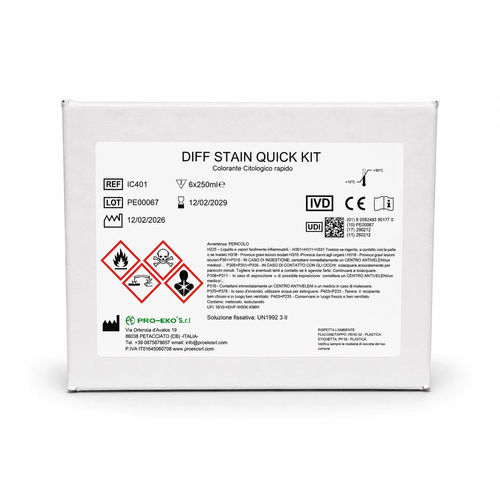
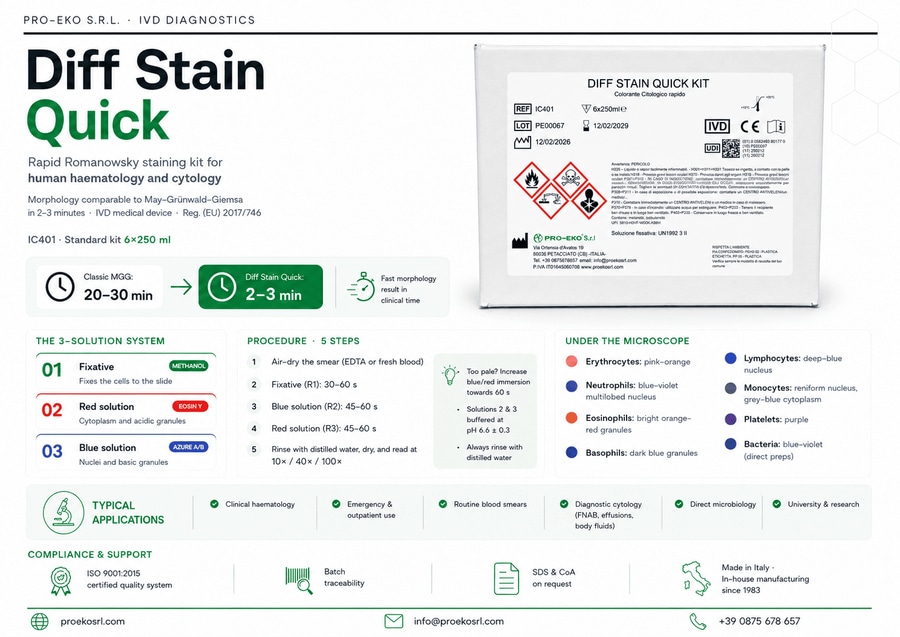
The kit consists of 3 solutions:
Fixative (anhydrous methanol): fixes the cells on the slide
Blue Solution (Azure A/B in phosphate buffer pH 6.6): stains nuclei and basophilic granules
Red Solution (Eosin Y in phosphate buffer pH 6.6): stains cytoplasm and eosinophilic granules
The typical procedure involves dipping the slide in the fixative for 30-60 seconds, then in the blue solution and red solution for 45-60 seconds each, followed by a brief rinse with distilled water. The result is ready for microscopic observation in 2-3 minutes total, compared to 20-30 minutes for classic MGG.
When to choose Diff Quick
Rapid Romanowsky-type stains such as Diff-Quik are widely used in haematology practice and considered suitable for the routine morphological evaluation of peripheral blood smears.
Diff Quick is particularly suited for:
Emergency departments: rapid leukocyte differential when MGG turnaround is not compatible with clinical urgency
Fine-needle aspiration cytology (FNAB): immediate on-site assessment of sample adequacy
Clinics and facilities without a centralised laboratory: morphological results within clinically useful timeframes
Microbiology: rapid visualisation of bacteria (blue-violet) on direct smears
For reporting complex cases (suspected leukaemia, parasitology, atypical morphology requiring further evaluation), classic MGG remains preferable, offering superior definition of basophilic granules and chromatin.