#Product Trends
Why manual disinfection is not enough - and why cold fogging makes the difference
Disinfection that reaches where hands don't.
Manual surface disinfection remains essential, but its effectiveness depends on consistent human execution. Automated 3D disinfection can complement this work by treating exposed surfaces throughout the room in a controlled, repeatable process.
This article is written by Steinemann Disinfection | CleanService Group AG
Cleaning and disinfection in hospitals, medical practices and other hygiene-sensitive environments still begin with manual work. Visible contamination and organic material must be removed, and frequently touched surfaces need direct attention. Yet manual surface disinfection is also a process carried out by people, and that means its quality can vary from one room, shift or situation to another. The purpose of 3D disinfection is not to replace this foundation, but to complement it with an automated treatment step. [4]
Where Manual Surface Disinfection Reaches Its Limits
One of the clearest demonstrations of this variability comes from a multicenter study by Carling and colleagues. In 23 acute-care hospitals, frequently touched surfaces were marked with an invisible fluorescent marker before terminal cleaning. After cleaning, the marker had been removed from only 49% of the marked surfaces overall, with individual hospitals ranging from 35% to 81%.[1] The study did not measure microbiological kill; instead, it showed something more basic: whether a surface had actually been physically addressed during cleaning.
A later study by the same research group showed that performance can improve substantially when cleaning is supported by structured procedures, monitoring and feedback. Across 36 acute-care hospitals, the proportion of cleaned standardized surfaces increased from 48% before the intervention to 77% afterwards.[2] This is an important result because it shows that manual cleaning is not inherently ineffective. Training and feedback work - but they do not remove the human factor from the process.
In everyday practice, the quality of manual cleaning depends on defined target surfaces being addressed consistently and on cleaning standards being applied reliably. Reviews of the healthcare environment therefore emphasize structured cleaning processes and verifiable implementation, because the actual execution of cleaning is central to the contribution environmental hygiene can make to infection prevention.[3]
Why 3D Disinfection Is a Useful Complement
Manual cleaning remains essential for removing visible contamination and organic material, but it depends on each target surface being treated individually and consistently. 3D disinfection adds a spatial treatment step by dispersing disinfectant throughout the room, allowing exposed surfaces to be included in a broader and more standardized process.
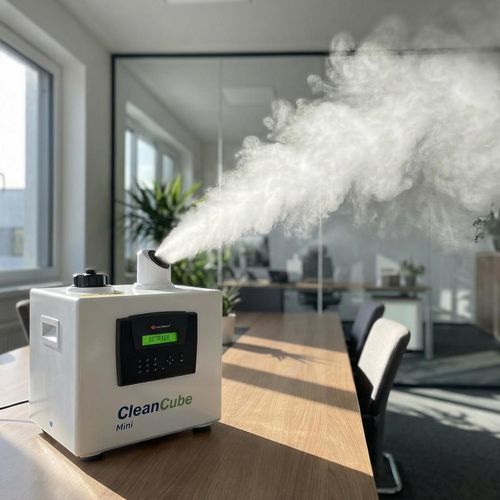
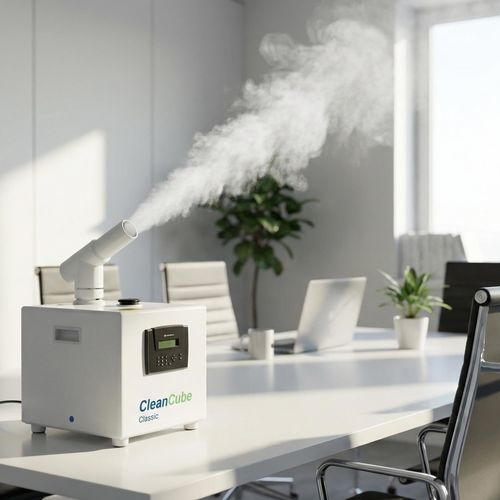
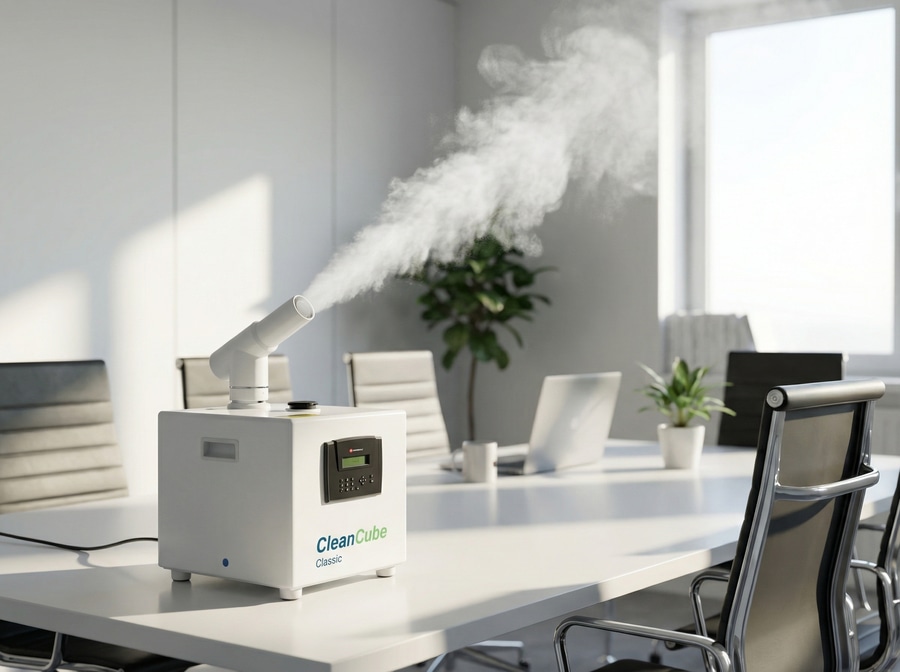
The CleanCube is designed to support this approach. After the required manual preparation, it carries out the selected 3D disinfection cycle automatically, helping make the additional room treatment more consistent and repeatable. Areas that are more difficult to address reliably by hand, such as backs, undersides or surfaces around equipment, may also be included when they are sufficiently exposed to the aerosol.
Two Approaches, One Hygiene Strategy
The most useful comparison is therefore not manual disinfection versus 3D disinfection as if one had to replace the other. They address different parts of the same hygiene process. Manual cleaning is necessary to remove visible soil, organic material and contamination from surfaces. Manual disinfection also allows targeted treatment of high-touch areas during routine work. Automated 3D disinfection can then complement these measures when a broader, standardized room treatment is appropriate.
A 3D process should be understood as an additional tool, not as a shortcut around cleaning. Its role is strongest when the two approaches are deliberately combined: good manual preparation followed by a controlled automated disinfection step.
For healthcare and other contamination-sensitive environments, that combination creates a simple principle: keep the strengths of manual surface cleaning where direct physical removal is essential, and use automated 3D disinfection where a repeatable room-wide treatment can add another layer of control. The result is not less attention to cleaning, but a more complete process built around complementary methods.
Sources
[1] Carling PC, Parry MF, Von Beheren SM; Healthcare Environmental Hygiene Study Group. Identifying opportunities to enhance environmental cleaning in 23 acute care hospitals. Infect Control Hosp Epidemiol. 2008;29(1):1-7. DOI: 10.1086/524329. PMID: 18171180. PubMed
[2] Carling PC, Parry MM, Rupp ME, Po JL, Dick B, Von Beheren S; Healthcare Environmental Hygiene Study Group. Improving cleaning of the environment surrounding patients in 36 acute care hospitals. Infect Control Hosp Epidemiol. 2008;29(11):1035-1041. DOI: 10.1086/591940. PMID: 18851687. PubMed
[3] Dancer SJ. The role of environmental cleaning in the control of hospital-acquired infection. J Hosp Infect. 2009;73(4):378-385. DOI: 10.1016/j.jhin.2009.03.030. PMID: 19726106. PubMed
[4] Steinemann Disinfection. Warum die manuelle Desinfektion nicht ausreicht - und warum Kaltvernebelung den Unterschied macht. Whitepaper. CleanService Group AG, 2026. [German-language company whitepaper].
Steinemann Disinfection | CleanService Group AG · Wilerstrasse 2180, 9230 Flawil, Switzerland · +41 71 555 11 30 · [email protected] · steinemann-disinfection.ch