#Industry News
Occupational Safety in Everyday Dermatology Practice: Effectively Capturing Laser Fumes
Ablative CO₂ laser treatments can produce fine particles and gaseous substances, which should be captured as directly as possible within the treatment room.
Ablative CO₂ laser therapies are part of daily practice in many dermatology and aesthetic clinics. In these procedures, tissue is vaporized through thermal action. This process is specifically utilized for treatment. However, this raises an important occupational safety question: What happens to the emissions released into the air during the procedure?
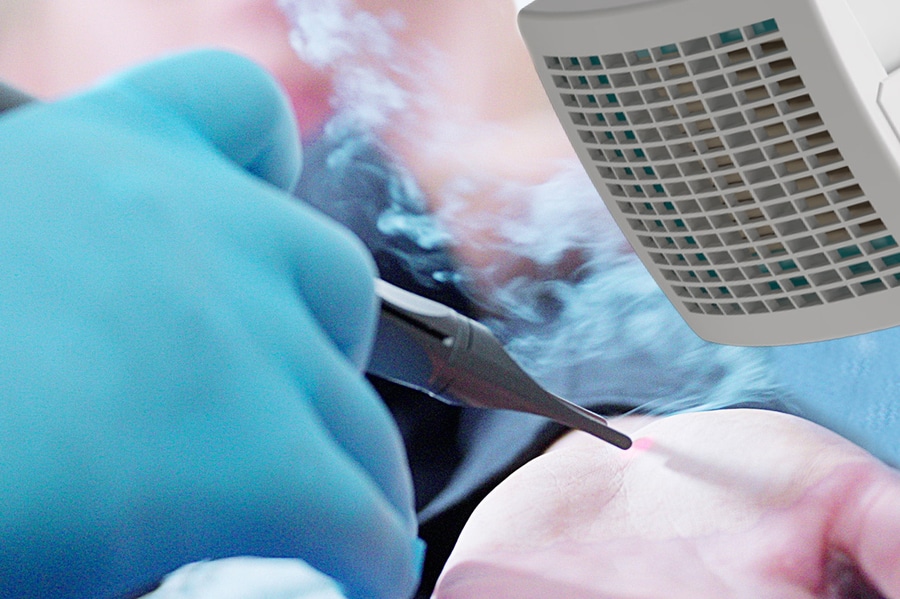
Laser treatment can generate what is known as surgical smoke, also called a laser plume. It consists of a mixture of fine and ultrafine, respirable particles, biological components, and gaseous substances. Not all of this is always visible. This is precisely why a technical assessment is important.
For physicians and medical professionals, repeated exposure can occur in daily practice. Therefore, it is not only the laser technology itself that is crucial, but also the airflow in the treatment room. Emissions should be captured as close as possible to the source before they spread throughout the room.
Occupational safety requirements vary by country, but they generally require a risk assessment and appropriate technical measures to reduce exposure to laser-generated emissions.
Depending on their design, positioning, and maintenance, local exhaust systems can help reduce particle concentrations in the immediate work environment. Key factors include collection directly at the point of application, appropriate filter technology, regular maintenance, and proper integration into the treatment process.
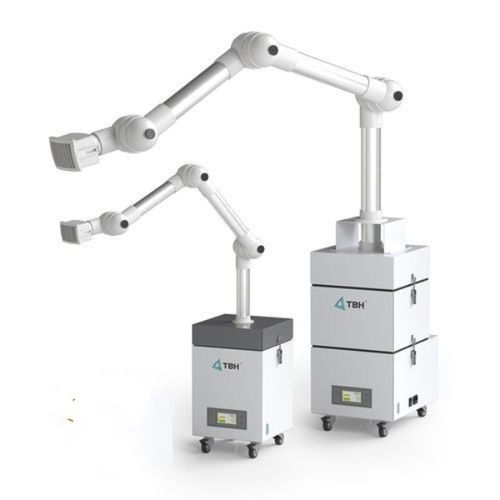
The TBH Health Series was developed for use in dermatological and aesthetic treatment rooms. It is designed for the targeted capture of laser smoke at the point of origin and can be integrated into existing practice structures. A clear classification is important here: In the medical setting, the systems are not used as medical devices, but as accessories for extracting air directly during laser treatment. There is no patient contact.
Occupational safety in the daily routine of a dermatology practice is therefore not an isolated issue. It connects the treatment situation, technical safety measures, indoor air quality, and organizational processes. Anyone who regularly uses laser applications should therefore plan for extraction early on and tailor it to the specific practice workflow.