#Product Trends
Expand your Neuroregenerative Toolkit with Brain Photobiomodulation
Why the Weber Brain® Deserves a Place in Your Practice
For clinicians looking to expand their neuroregenerative toolkit with a non-pharmacological, mechanistically grounded, and patient-friendly intervention for brain health, brain PBM deserves serious consideration. Here is why and a product recommendation.
Brain decline is multifactorial
Sustained brain health and neurodegeneration on the other end are multifactorial processes. They emerge from the interplay of lifestyle factors, hormonal and nutritional influences, metabolic and cardiovascular health, immune dysregulation, environmental toxins, and the biology of aging itself. These forces converge at the level of the brain and express themselves through four critical domains: energy metabolism (mitochondrial function), communication (intra- and inter-cellular communication, neural network integrity, neurotransmitter balance, synaptic function), structural and state integrity (vascular architecture, blood-brain barrier, myelination, inflammation levels, oxidative stress), and the clearance and maintenance systems of the brain — most notably the glymphatic system and microglial immune surveillance.
What is striking is that all four of these domains are mechanistically targetable by brain PBM. This is not a coincidence — it reflects the upstream nature of what brain PBM actually does.
Diving deeper into three main hallmarks that drive neurodegeneration
Before understanding what brain PBM can offer, it helps to understand what it is working against.
One crucial hallmark of brain degeneration is chronic neuroinflammation. What was once considered a byproduct of neurodegeneration is now understood to be a primary driver. When microglial immune cells enter a chronically activated state — what researchers call a “primed glia phenotype” — they lose their ability to restore homeostasis. The result is a self-amplifying cascade: impaired perfusion, mitochondrial dysfunction, oxidative stress, protein aggregate buildup, and progressive BBB disruption. Neuroinflammation and protein aggregation (e.g. amyloid-beta, tau) are now known to fuel each other in a mutual-promotion loop (Zhang et al., Nature Signal Transduction and Targeted Therapy, 2023).
Another hallmark is mitochondrial dysfunction. Mitochondria are not mere energy factories — they are sophisticated signal-processing systems that sense both internal and environmental inputs and generate outputs that regulate cellular physiology system-wide. When mitochondrial function fails, so does everything downstream: ATP supply to neurons, ROS balance, synaptic transmission, and regenerative processes. Mitochondrial dysfunction is implicated not only in Alzheimer’s and Parkinson’s, but in depression, ASD, schizophrenia, and TBI.
A third hallmark is cerebral hypoperfusion. A landmark population study (Circulation, 2017) followed nearly 5,000 individuals and found that lower cerebral perfusion was independently associated with a 31% higher risk of developing dementia. Hypoperfusion drives neurodegeneration through oxidative stress, amyloid accumulation, tau hyperphosphorylation, synaptic dysfunction, and — completing the circle — neuroinflammation.
These three hallmarks are deeply interconnected. And all three are directly addressed by brain PBM.
How Brain PBM Works: Three Layers of Action
Layer 1 — Mitochondrial stimulation and restored perfusion. When near-infrared light penetrates the skull and reaches cortical neurons, it is absorbed by cytochrome C oxidase (CCO), Complex IV of the mitochondrial respiratory chain. This triggers a cascade: CCO releases inhibitory nitric oxide from its catalytic site, freeing electrons that enhance ATP synthesis. Simultaneously, released NO acts as a vasodilator, increasing cerebral blood flow, blood volume, and oxygenation. This has been directly confirmed in human studies using near-infrared spectroscopy (Wang et al., Journal of Cerebral Blood Flow and Metabolism, 2017) and validated by a 2025 systematic review covering 18 animal and 27 human studies (Lasers Med Sci, 2025), which recommends brain PBM specifically for improving cerebral metabolism and hemodynamics.
Layer 2 — Neuroinflammation modulation and glymphatic support. A 2022 systematic review of 27 animal studies (Frontiers in Neuroscience) found that PBM consistently upregulates anti-inflammatory cytokines (IL-10) while downregulating pro-inflammatory mediators (IL-1β, IL-18, interferon-γ). In addition, PBM shifts microglial polarization from the pro-inflammatory M1 phenotype to the neuroprotective M2 phenotype — directly addressing the “primed glia” problem. Brain PBM has also been shown to enhance glymphatic function through multiple proposed mechanisms: increased CSF outflow pressure due to increased cerebral blood volume, vasodilation of meningeal lymphatic vessels via NO, improved aquaporin-4 channel permeability, and reduced cerebrospinal fluid viscosity. This matters enormously for toxin and protein clearance and the prevention of amyloid and tau accumulation.
Layer 3 — Cascading downstream effects. Beyond the primary mitochondrial and vascular actions, brain PBM triggers a broad range of downstream effects: increased neuroplasticity (supported by BDNF upregulation), activation of neural progenitor cells, antioxidant effects via SOD upregulation, and modulation of brain oscillations which is now considered one of PBM’s key neurological mechanisms.
What the Research Shows
The clinical evidence for brain PBM, while still maturing, is consistently encouraging across multiple conditions:
In Alzheimer’s and dementia, a 2021 systematic review (Journal of Alzheimer’s Disease) covering 36 studies — spanning in vitro, animal models, and human clinical trials — reported positive results across all included studies, with no adverse effects and remarkable ease of use. Mechanistically, brain PBM has been shown to simultaneously increase ATP production, reduce amyloid-beta plaques, decrease tau tangles, lower neuroinflammation, improve synaptic connectivity, and enhance neuronal protection.
In Parkinson’s Disease, a prospective study (BMC Neurology, 2021) found significant improvements in mobility, cognition, dynamic balance, and fine motor skills after 12 weeks of PBM — improvements that were maintained for up to one year in a disease where decline is typically expected. A five-year follow-up (BMC Neurology, 2024) confirmed that patients who continued home-based PBM maintained significant improvements in mobility and cognition.
In cognitive enhancement, a 2023 systematic review of 35 human studies (Ageing Research Reviews) found that 82.9% reported positive cognitive outcomes after transcranial PBM, with the strongest results seen in participants with mild cognitive impairment and dementia. Noticeably however, improvements were also reported in healthy subjects. They included enhanced attention, faster reaction time, and better memory performance.
In depression and anxiety, a 2024 meta-analysis of 11 randomized controlled trials (Frontiers in Psychiatry) concluded that PBM effectively reduces depressive symptoms, with the best outcomes achieved using 808–823nm wavelengths and sufficient energy delivery. For anxiety, a double-blind sham-controlled trial (Brain Research Bulletin, 2023) showed that targeting the left dorsolateral prefrontal cortex with 820nm light produced significant reductions in generalized anxiety that lasted at least two months.
In traumatic brain injury, a 2024 review (Cells) found that brain PBM consistently improved cerebral blood flow, functional outcomes, and cognition while reducing markers of apoptosis and microglial activation — with no significant adverse effects across all studies.
In ASD, both adult and pediatric studies have shown reductions in symptom severity, improvements in social awareness and communication, better sleep quality, and reduced behavioral rigidity.
A Word on Where We Stand
Brain PBM is not yet a first-line treatment for any neurological condition. It must be mentioned that not all Brain PBM-studies reported positive outcomes. Under- or overdosing is possible. However, the evidence base is substantial and growing, but most trials have been small, and larger randomized controlled studies are needed. What we can say with confidence is that the mechanistic rationale is solid, the safety profile is excellent across hundreds of studies, the ease of use is high, and the breadth of potential clinical applications — from prevention to rehabilitation to integrative neurology — is remarkable.
Our product solution
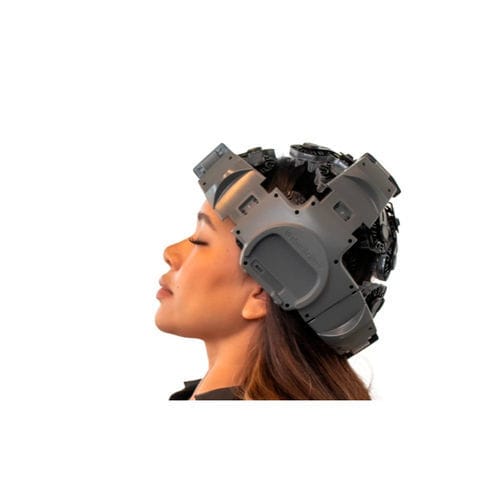
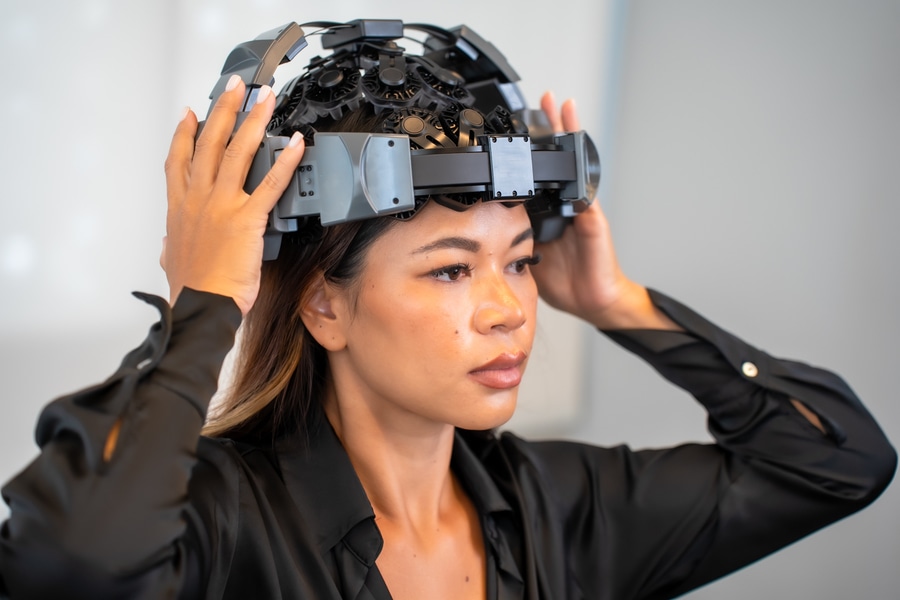
It took more than three years to develop the Weber Brain®. Three years of solving one fundamental problem: how do you actually get sufficient light energy into the human brain to trigger meaningful biological effects?
What distinguishes it technically from other devices on the market is the exclusive use of laser technology — there are no LEDs built in. Coherent laser light penetrates tissue significantly deeper than incoherent LED light (5–10x higher local intensity at depth via laser speckle patterns), making it far more suitable for reaching cortical brain structures through the skull and hair. To further enhance the penetration properties of the light, a sophisticated lens system focusses the light beam even more.
Related to this, a proprietary “light finger technology” is used to bypass hair and thus minimize its light absorption. Quite a few technological advancements to deliver the light more efficiently to the depth of the brain.
On top of that comes that the Weber Brain® simultaneously delivers three wavelengths — 680nm, 808nm, and 1064nm — to activate different chromophores and healing cascades at the same time.
Two versions are available:
The Weber Brain Pro (clinical version) houses 684 laser diodes with a total output of 13.68W and allows independent programming of different brain regions with different power densities, treatment times, and frequencies — ideal for clinical use. Priced at €12,500 plus VAT and transport.
The Weber Brain Home version uses 228 diodes with a total output of 4.56W, is simple to operate, and is designed for patient self-use at home — supporting the kind of consistent, long-term application that the literature suggests is necessary for sustained results. Priced at €4,500 plus VAT and transport.
If you’re interested in learning more or getting a quote, feel free to DM me — I also have a limited promo code available (mail to [email protected]).
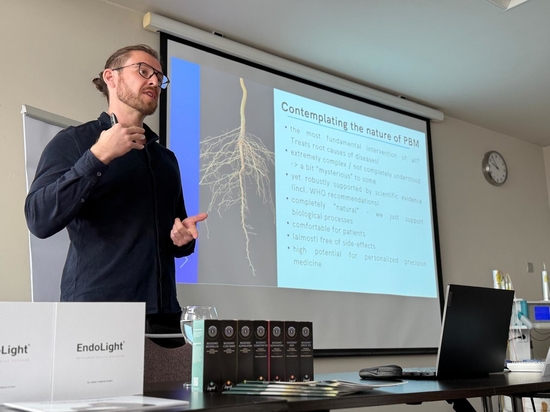
If you want to dive even deeper into all this - I just put a webinar online in which I talk about the basic of photobiomodulation and brain health, and then dive deeper into the mechanisms of brain PBM and its clinical evidence:
https://www.youtube.com/watch?v=CkHGbjYx6uQ