#Product Trends
Inside the Technology of Red Light Therapy Equipment: Why Quality Differs Across Manufacturers
Learn how LED chips, PMMA lenses, heat management, and strict QC determine the performance and safety of commercial red light therapy devices.
Red light therapy devices on the market may look similar, but their internal structure, materials, and manufacturing standards vary dramatically. For B2B buyers—wellness centers, clinics, gyms, and retail brands—understanding what’s inside the device is crucial for evaluating performance, safety, and long-term reliability.
This article breaks down the core technologies behind a high-quality red light therapy device, explaining how components such as LED chips, lens materials, heat management, and quality controls directly impact therapeutic effectiveness.
1. The True Core of a Red Light Device: LED Chips
The LED chip determines the device’s energy output, penetration depth, stability, heat tolerance, and lifespan. That’s why two devices listed with the same wattage can deliver entirely different therapeutic results.
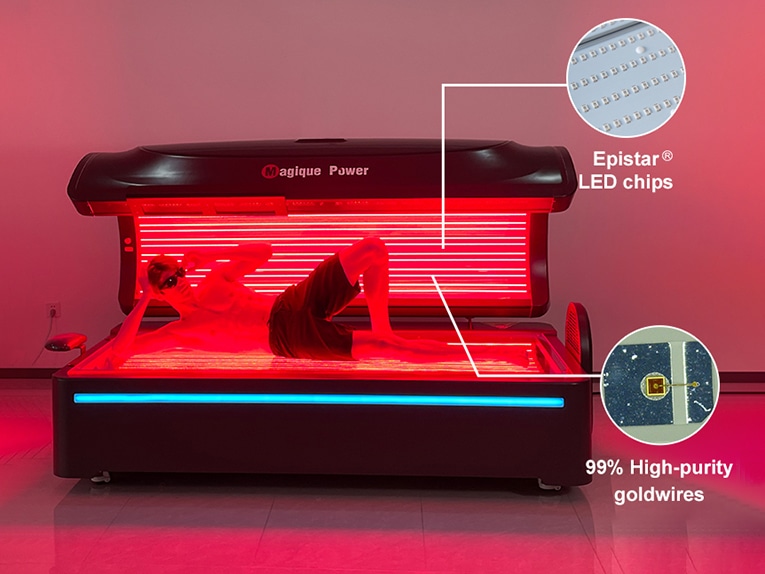
1.1 Why We Use 99% Pure Gold Wire Bonding
We apply 99% pure gold wire in our LED bonding process—a standard used in high-end light-therapy and medical-grade devices.
Advantages of pure gold wire include:
Lower electrical resistance → higher optical efficiency
Better ductility → resistant to breakage under continuous high-load
Stronger thermal endurance → stable output and slower light decay
Superior consistency → each treatment delivers predictable results
Many low-cost manufacturers use gold-plated silver wire to reduce cost by 30–50%.
These materials often lead to:
Faster degradation
Inconsistent brightness
Unstable energy output
Shorter lifespan
Light-decay stability is one of the most critical factors in red light therapy—and pure gold wire is the most reliable solution.
2. PMMA Optical Lens: Higher Transmission, Better Results
We use PMMA (acrylic) optical lenses with carefully engineered beam angles (60° for uniform full-body coverage and 30° for intensified targeted treatment).
Why PMMA lenses outperform common PC lenses:
Higher optical transmission
Better color stability over time
Greater heat resistance
Clearer and more uniform light distribution
Low-end manufacturers often use PC lenses, which:
Yellow faster
Can warp under heat
Reduce overall irradiance
3. Commercial-Grade Safety Starts Inside the Device
A professional red light therapy device must remain stable and safe during long sessions, especially in high-traffic wellness environments.
3.1 Thermal Stability: Continuous Use Without Overheating
Our devices maintain a stable temperature of around 50°C after 1–2 hours of continuous operation, achieved through:
High-efficiency cooling fans
Vibration-reducing isolation pillars
Optimized airflow pathways
Aluminum PCB for improved heat transfer
This ensures:
Longer LED lifespan
Reduced noise
Stable irradiance output
Better user comfort
Many low-cost devices:
Overheat in 30–40 minutes
Produce loud fan noise
Suffer from LED burnout
Show significant brightness drop
3.2 Triple Grounding for Electrical Safety
We use a three-line grounding system on the aluminum PCB:
Prevents electrical leakage
Improves system stability
Meets CE and UL-level standards
Reduces long-term failure risk
This is especially important for medical, commercial, and unattended spa environments.
4. Manufacturing Strength: Full Control From Chip to Final Assembly
4.1 16 Years of Production Experience in the Health & Wellness Industry
Our team has decades of accumulated knowledge, enabling us to design devices that:
Prevent early-stage component failure
Reduce solder-point fatigue
Improve thermal balance
Maintain consistent irradiance
Achieve higher overall reliability
This level of expertise cannot be replicated by new or small factories.
4.2 Multi-Stage Quality Control (QC) and Testing
Every device goes through:
✔ LED chip optical testing
✔ Semi-finished functional inspection
✔ 48-hour full-load aging test
✔ Final assembly inspection
✔ Shock-resistant protective packaging (thickened foam + custom cartons)
Why 48-hour aging matters:
Early failures—fan stalling, loose connections, unstable drivers—usually appear in the first few hours of heavy use. We identify and eliminate them before shipping.
5. Exterior Durability: Designed for Commercial Environments
High-temperature baked coating that resists wear and discoloration
Eco-friendly fan materials with longer endurance
Reinforced frame structure for better transport safety
Modular assembly for easier maintenance
These details matter when a device is used 5–12 times per day in professional settings.
6. Why Our Pricing Is More Competitive for the Same Configuration
Because we control the entire supply chain:
✔ Long-term chip supplier partnerships
✔ Independent factory production
✔ Bulk procurement of critical components
✔ In-house mold and structural design
✔ Streamlined processes that reduce labor cost
This allows us to deliver higher performance at the same price—or the same performance at a better price.
7. OEM/ODM: Built for Brands That Need Unique Solutions
We offer complete customization:
Exterior design
Lens angle & optical configuration
Wavelength combination (633nm / 660nm / 810nm / 850nm / 940nm)
Irradiance priority settings
Custom UI, screen, control logic
Branding logo & packaging
Form factor for gyms, clinics, spas, or home use
For companies building their own red light therapy brand, differentiation + quality consistency is everything—and we specialize in both.
Conclusion: The Invisible Parts Define the Real Value
What truly determines the performance of a red light therapy device is not the wattage, the LED count, or how bright it looks.
It is:
Materials
Chip technology
Thermal design
Electrical safety
Quality control
Manufacturing experience
Reliability under continuous use
This is where professional manufacturers stand out—and where long-term brand success is built.