#Industry News
How to Choose a Reliable Diode Laser Handpiece: 6 Key Factors
EosICE®
A diode laser handpiece is more than an accessory for a hair removal machine. It is the component that delivers laser energy to the treatment area, manages skin-contact cooling, and determines how easily practitioners can control the treatment.
For aesthetic clinics and professional equipment buyers, evaluating a diode laser handpiece requires more than checking laser power or wavelength. Cooling performance, optical design, spot size, ergonomics, durability, and maintenance can all affect the practical performance of a diode laser system.
Here are six factors worth considering before choosing a professional diode laser handpiece.
1. Cooling Performance
Cooling is one of the most important features of a diode laser handpiece.
During laser hair removal, the treatment area receives controlled laser energy while the skin surface needs appropriate thermal management. A stable cooling system can improve treatment comfort and help maintain a consistent treatment workflow.
When comparing cooling systems, do not focus only on the lowest temperature advertised. Consider:
How quickly the handpiece reaches the target temperature
Whether cooling remains stable during repeated treatments
How effectively the cooling surface contacts the skin
Whether the system is suitable for high treatment volumes
Different technologies, including sapphire contact cooling, Peltier/TEC cooling, and water-based cooling, may be used in professional diode laser systems.
2. Optical System and Energy Distribution
Laser power is easy to compare because manufacturers usually provide a numerical specification. However, the optical system inside the handpiece also deserves attention.
A professional handpiece may use components such as collimating lenses, focusing elements, and light guides to control how laser energy reaches the treatment surface.
For buyers, an important question is:
Is the energy distributed consistently across the treatment spot?
A well-designed optical system can help maintain more uniform energy distribution. Therefore, laser source, optical components, cooling, and treatment window should be evaluated as one integrated system rather than as separate specifications.
3. Spot Size and Treatment Window
Different body areas require different levels of coverage and precision.
A larger treatment spot can be useful for areas such as:
1. Legs
2. Arms
3. Back
4. Chest
Smaller treatment windows can provide greater flexibility when treating areas such as:
1. Upper lip
2. Chin
3. Cheeks
4. Bikini area
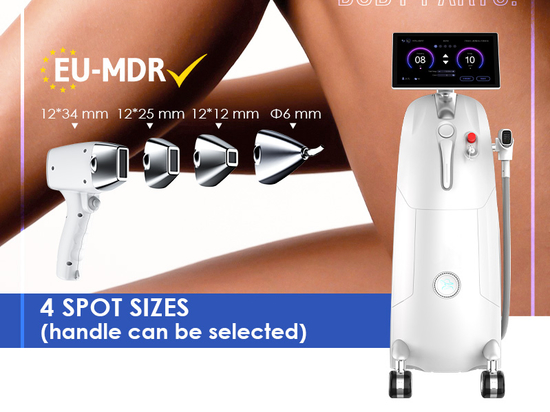
For clinics that provide both facial and body hair removal, a handpiece with multiple spot-size options can simplify treatment workflows.
4. Ergonomics and Handpiece Weight
Laser hair removal can involve repetitive movements and extended treatment sessions. As a result, handpiece ergonomics can directly influence the operator's daily experience.
When evaluating a handpiece, consider:
1. Overall weight
2. Weight distribution
3. Grip design
4. Cable flexibility
5. Button placement
6. Ease of movement
A well-balanced handpiece can make it easier for practitioners to work across large treatment areas and perform repeated procedures.
This factor is particularly relevant for clinics with high daily treatment volumes.
5. Integrated Controls and Workflow
Some modern diode laser handpieces include integrated controls or display screens.
Traditional systems may require practitioners to return to the main console to check or adjust treatment parameters. Integrated controls can reduce unnecessary movement between the handpiece and console.
From a workflow perspective, small interface improvements can become meaningful when practitioners perform multiple treatments throughout the day.
However, buyers should evaluate these features together with the overall user interface, treatment controls, and safety design of the complete laser system.
6. Durability and Maintenance
A professional diode laser handpiece needs to withstand repeated use. Therefore, long-term serviceability should be part of the purchasing decision.
Before selecting a system, buyers should ask about:
1. Expected handpiece lifespan
2. Cooling-system maintenance
3. Replacement handpieces
4. Spare parts availability
5. Warranty coverage
6. Technical support
7. Installation and operator training
For distributors, these factors can also affect after-sales service and long-term customer support.
A lower initial purchase price does not necessarily represent lower overall ownership costs if replacement parts or technical support are difficult to obtain.
How Does the Handpiece Affect the Overall Diode Laser?
The handpiece should not be evaluated independently from the main laser system.
A practical evaluation should consider:
Laser Source + Optical System + Cooling + Treatment Window + Handpiece Design + Service Support
For example, a high-power laser source does not automatically mean that the complete system will provide an efficient treatment experience. The optical system must deliver the energy appropriately, the cooling system must manage the treatment interface, and the handpiece must remain practical for the operator.
This is why professional buyers should evaluate the complete system architecture, rather than focusing on maximum power alone.
PZLASER EosICE®: A Handpiece-Centered Design Approach
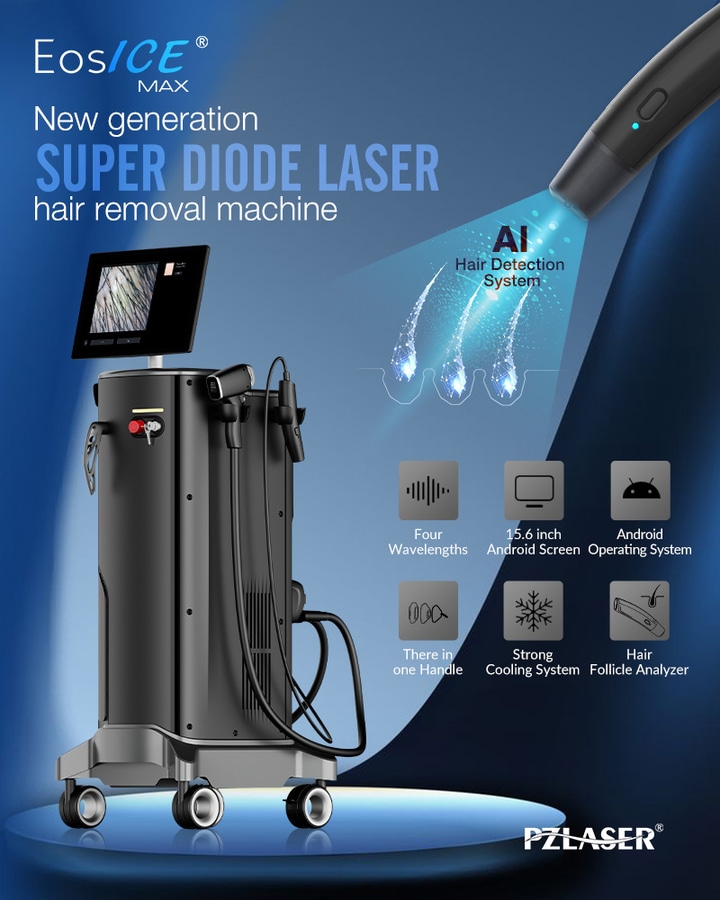
PZLASER's EosICE® diode laser platform incorporates several of the factors discussed above, including cooling, optical components, interchangeable spot sizes, ergonomic design, and integrated controls.
The upgraded handpiece offers three interchangeable spot sizes: 15 × 15 mm, 15 × 30 mm, and 8 × 8 mm. PZLASER also describes the system as using LIMO optical components and 360° Peltier cooling. Buyers should confirm the exact specifications and configuration of the model supplied for their market.
The broader takeaway is that handpiece design should be considered as part of the complete diode laser system—not simply as a replaceable accessory.
Frequently Asked Questions
1. What is a diode laser handpiece?
A diode laser handpiece is the applicator that delivers laser energy to the treatment area. It can include optical components, cooling elements, a treatment window, and control interfaces.
2. Why is cooling important in a diode laser handpiece?
Cooling helps manage heat at the skin-contact surface during treatment. Buyers should evaluate both cooling temperature and the system's ability to maintain stable cooling during repeated treatments.
3. Does a larger spot size mean a better handpiece?
Not necessarily. Larger spots can be useful for larger treatment areas, while smaller spots can provide greater flexibility for smaller or difficult-to-reach areas. The appropriate configuration depends on the clinic's treatment applications.
4. What should clinics consider besides laser power?
Clinics should also evaluate cooling, optical design, spot size, ergonomics, durability, maintenance, warranty, and technical support.
5. Why does handpiece ergonomics matter?
Laser hair removal can involve repetitive movements and long treatment sessions. Weight, balance, grip design, and cable flexibility can therefore affect daily operator comfort and workflow.