#Product Trends
5 Key Factors to Consider When Choosing a 4K Surgical Monitor
5 Key Factors for 4K Surgical Monitor
Choosing the right 4K surgical monitor is about more than simply selecting a screen with a 3840 × 2160 resolution. So, what should hospitals, medical device manufacturers, distributors, and system integrators consider when choosing a 4K surgical display?
1. 4K Resolution: Is the Display Detailed Enough for Surgical Visualization?
The first factor to consider is resolution. A true 4K UHD surgical monitor provides a resolution of 3840 × 2160 pixels, delivering four times as many pixels as a Full HD display. For surgical visualization, this additional image information can be particularly valuable when displaying high-resolution endoscopic or surgical camera feeds.
A 4K surgical monitor can provide:
More visible image detail
Sharper presentation of fine anatomical structures
A larger viewing area without sacrificing resolution
Better compatibility with modern 4K surgical cameras and endoscopy systems
A more immersive viewing experience for surgical teams
For applications such as endoscopy and microsurgery, where visualization plays a central role, high-resolution image presentation is especially important.
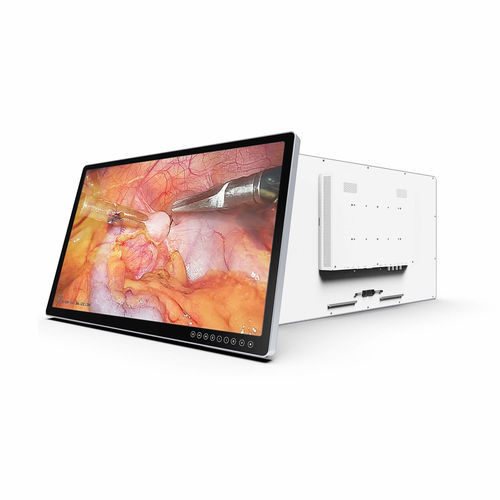
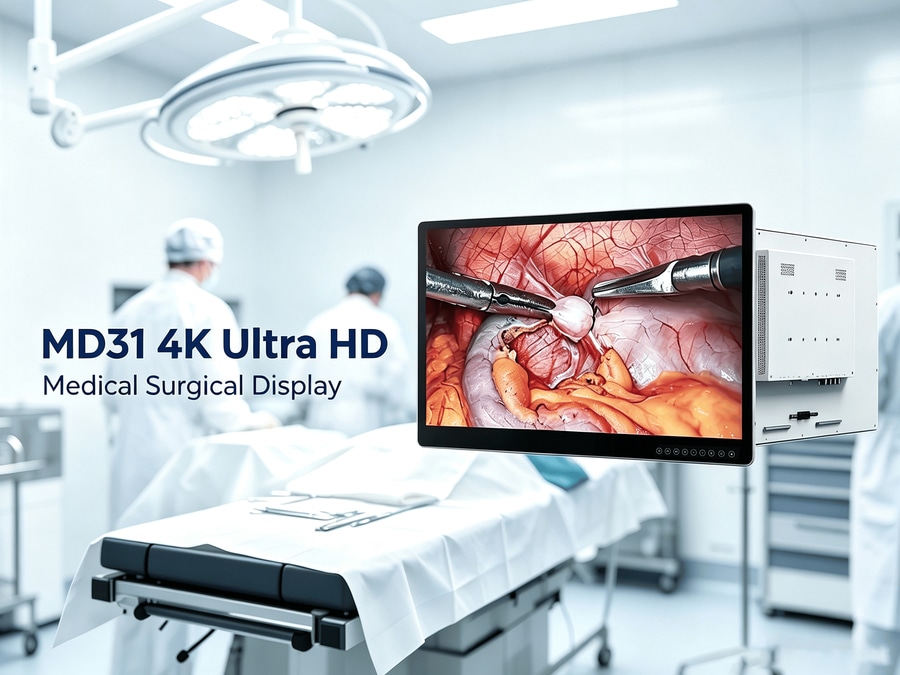
The AIMEDIK MD31 features a 31.5-inch 4K UHD panel with a 3840 × 2160 physical resolution, providing a large viewing area for surgical visualization.
2. Color Accuracy and Calibration: Can You Trust What You See?
Color reproduction can have a significant impact on the visualization experience, particularly in image-intensive procedures where clinicians need to distinguish subtle differences in tissue and anatomical structures.
When evaluating a 4K medical monitor, look beyond resolution and ask:
What is the display's color depth?
Does it support a wide color gamut?
What calibration options are available?
Does it support DICOM or Gamma presets?
Can color settings be adjusted according to the application?
Why 10-bit color matters?
The AIMEDIK MD31 uses a 10-bit color-depth panel capable of displaying approximately 1.07 billion colors.The MD31 supports multiple Gamma settings, including: Native / 1.8 / 2.0 / 2.2 / 2.4 / 2.6 / DICOM, It also supports BT.709 and BT.2020 color calibration, providing additional flexibility for different video and medical imaging workflows.
3. Connectivity: Can It Integrate with Your Existing Surgical System?
In a modern OR, the display may need to connect to: Surgical cameras, Endoscopy systems, Laparoscopy systems, Video processors, Medical image routers, Recording systems, OR integration platforms, Other surgical displays.This makes connectivity one of the most important considerations when choosing a medical surgical monitor.
The AIMEDIK MD31 provides:
2 × 12G-SDI inputs
1 × DisplayPort input
1 × HDMI 2.0 input
1 × DVI input
2 × 12G-SDI outputs
1 × DisplayPort MST output
This combination provides flexibility for different surgical video configurations and system integration requirements.The MD31 also supports automatic input selection. If the active input signal is interrupted because of a system error or external interference, the monitor can automatically switch to another available input signal.
4. Multiview Capability: Do You Need to See More Than One Image?
Today's surgical procedures can involve multiple sources of visual information. For example, a surgical team may need to monitor a primary endoscopic image while simultaneously viewing another video source. Switching between sources can be inconvenient, particularly when multiple images need to be compared. This is where multiview functionality becomes useful.
The AIMEDIK MD31 supports dual screen, quad-split, PIP, and PBP modes. It also allows image settings to be adjusted for the selected signal source, including Gamma and DICOM preset modes.
Why does multiview matter? For hospitals and OR system integrators, multiview capability can help consolidate multiple video sources into one display.
5. Operating Room Design: Is the Monitor Built for a Medical Environment?
Medical displays may be exposed to:
Frequent cleaning and disinfection
Water or cleaning solutions
Dust
Fingerprints
Strong ambient lighting
Complex cable configurations
Continuous operation
For this reason, the physical design of a surgical monitor should receive as much attention as its image specifications. The MD31 features an anti-reflective and anti-fingerprint coating, helping reduce reflections and fingerprints during use.The MD31 uses an optical bonding process that removes the air gap between the LCD panel and protective glass. The MD31 also features an IP54-rated front panel, providing water and dust resistance and making the front surface easier to clean with water or alcohol.
For modern operating rooms, the right display should provide a combination of:
High-resolution imaging + accurate color + flexible connectivity + multiview functionality + OR-ready design.
When evaluating different surgical displays, look beyond the headline specification and consider how the monitor will perform as part of your entire surgical visualization workflow.
For hospitals, medical device manufacturers, distributors, and system integrators looking for a flexible 4K surgical display, the AIMEDIK MD31 offers a comprehensive combination of image quality, connectivity, visualization flexibility, and medical-environment-oriented design.