#Product Trends
Innovations in IV Cannula Technology: Precision Silicone Cut Piece Tubes for Reliable Fluid Control
Discover how medical-grade silicone cut piece tubing enhances IV cannula performance through precision manufacturing, superior backflow prevention, and uncompromising quality standards.
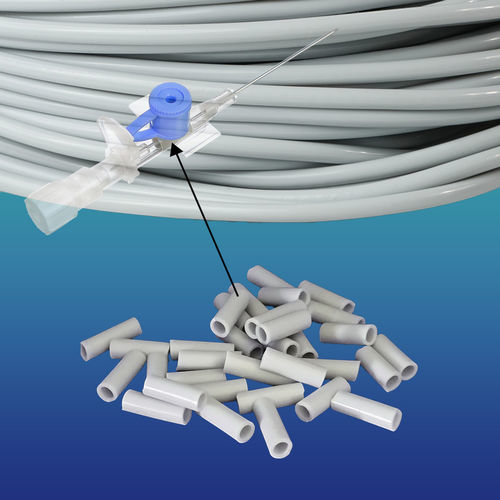
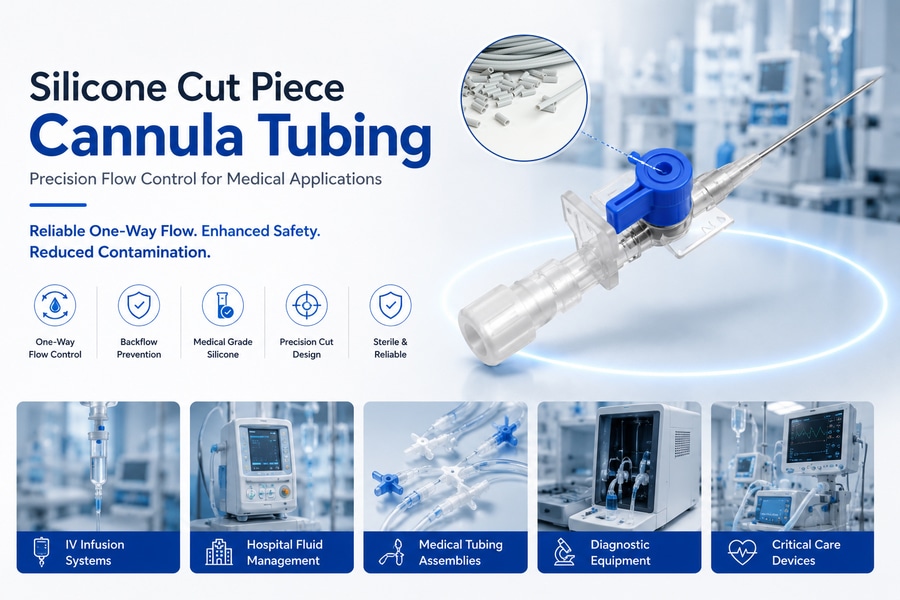
Silicone cut piece tubes are essential components in modern medical tubing applications, particularly as non-returnable valves (NRVs) in fluid management systems. These precision-cut silicone tubes ensure one-way fluid flow, preventing backflow and contamination in critical medical and industrial applications. This article explores the manufacturing process, quality control measures, and machinery used in the production of high-quality silicone cut piece cannula tubing.
Manufacturing Process of Silicone Cut Piece Cannula Tubing
The production of silicone cut piece tubing involves several precise steps to ensure uniformity, durability, and biocompatibility:
1. Raw Material Selection & Preparation
- Medical-grade silicone elastomer is used as the base material, ensuring compliance with USP Class VI and ISO 10993 standards.
- The raw silicone is compounded with additives to enhance elasticity, strength, and biocompatibility.
- The silicone mixture undergoes vacuum de-airing to remove trapped air bubbles, ensuring a uniform consistency.
2. Extrusion Process
- The prepared silicone is fed into an extrusion machine, where it is shaped into tubes of the required diameter and wall thickness.
- A precision-controlled extrusion die determines the tubing dimensions.
- The tubing undergoes a continuous curing process (heat or UV curing) to achieve the desired mechanical properties.
3. Cutting & Sizing
- Once the extruded tubing is ready, it is cut into specific lengths using automated cutting machines.
- The cut pieces are carefully measured to ensure tight tolerances and uniformity.
4. Surface Treatment & Finishing
- The cut pieces may undergo plasma treatment or chemical treatment to enhance surface properties, such as adhesion and biocompatibility.
- Post-treatment, the tubing is cleaned using ultrasonic washing to remove any residues or particles.
5. Curing & Sterilization
- The tubing undergoes an additional heat-curing process to enhance durability and flexibility.
- Sterilization methods like gamma irradiation or autoclaving ensure medical safety.
- Final packaging ensures sterility.
Quality Control & Identification of the Final Product
Ensuring the highest quality standards is crucial in medical-grade silicone tubing. The following quality checks and identification processes are implemented:
1. Dimensional Accuracy & Visual Inspection
- Automated laser measurement systems verify the tube's inner and outer diameters.
- Each batch is visually inspected for defects, inconsistencies, or contamination.
2. Biocompatibility & Material Testing
- The final product undergoes cytotoxicity, hemocompatibility, and extractables testing to confirm patient safety.
- Tensile strength, elongation, and elasticity tests ensure that the silicone tubing meets industry standards.
3. Flow & Seal Integrity Testing
- The self-sealing functionality of the silicone cut piece tube is tested using pressure and fluid flow analysis.
- The tubes are tested under different pressure conditions to confirm their effectiveness as non-returnable valves.
4. Batch Coding & Traceability
- Each batch of silicone cut pieces is marked with traceability codes, allowing tracking of production date, material lot number, and compliance certifications.
- Final products are packaged in sterile, airtight pouches to maintain their integrity during storage and transportation.
Manufacturing Machines Used in Production
The production of silicone cut piece cannula tubing involves specialized machinery designed for precision and efficiency:
1. Silicone Extrusion Machines: Used for shaping raw silicone into tubing with precise diameter, thickness, and elasticity. Equipped with real-time monitoring to ensure consistent output.
2. Automated Cutting Machines: High-speed automated slicers ensure that tubing is cut to uniform lengths with tight tolerances. Equipped with laser-guided cutting for extreme precision.
3. Curing Ovens: Used to vulcanize and solidify silicone tubing, ensuring durability and flexibility. Provides uniform heat distribution to prevent defects.
Why Choose Ami Polymer Silicone Cut Piece Cannula Tubing?
At Ami Polymer Pvt. Ltd., we specialize in manufacturing high-precision silicone tubing tailored for medical and industrial applications. Our expertise ensures:
- Compliance with Global Standards: We adhere to USP Class VI, ISO 10993, and FDA guidelines.
- Customizable Solutions: Available in various sizes, hardness levels, and wall thicknesses.
- State-of-the-Art Manufacturing: Precision extrusion, cutting, and quality control ensure consistent performance.
- Sterility & Safety: All products undergo rigorous testing and sterilization to guarantee patient safety.
- End-to-End Quality Assurance: Each batch is subjected to dimensional, material, and functional testing.
Certifications & Compliances:
USP CLASS VI
ISO 13485:2016
FDA 21 CFR 177.2600
REACH Compliant
BPA Free
Phthalate Free
TSE / BSE Free
Conclusion
The use of silicone cut piece tubes as non-returnable valves represents a major advancement in fluid management systems. Their ability to prevent backflow, enhance sterility, and ensure reliable fluid flow makes them essential in medical, pharmaceutical, and industrial applications.
At Ami Polymer Pvt. Ltd., we are committed to delivering superior-quality silicone tubing solutions that meet the highest safety and performance standards. For customized solutions or technical inquiries, reach out to our team today!