
#Product Trends
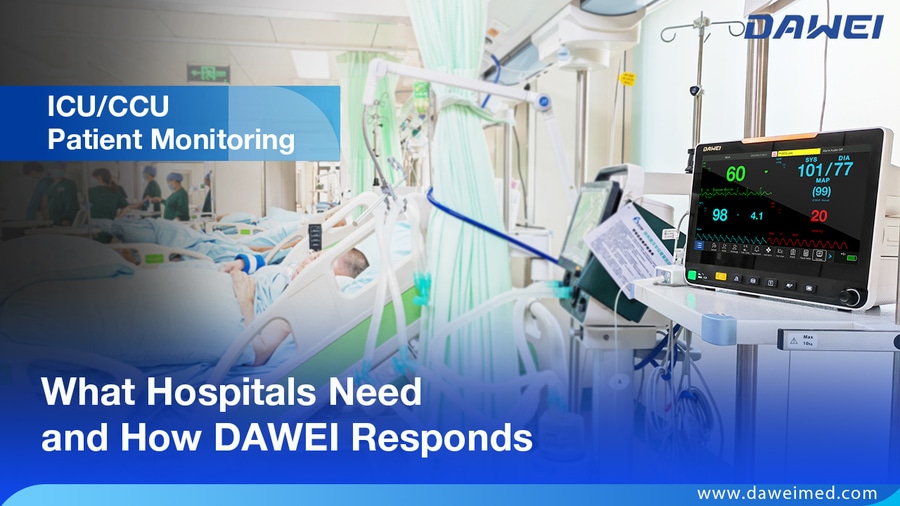
ICU/CCU Patient Monitoring
What Hospitals Need and How DAWEI Responds
1、Why ICU/CCU Monitors Matter
In the ICU or CCU, every second counts. Patients are often in unstable or life-threatening conditions, requiring continuous, real-time monitoring of critical vital signs. Compared to standard ward monitors, ICU/CCU monitors are designed to handle complex, high-acuity cases, offering:
Multi-parameter monitoring (ECG, SpO₂, IBP, EtCO₂, CO, etc.)
Advanced alarm management
Long-term data review (up to 160 hours)
Seamless integration with central monitoring systems and hospital IT platforms (via HL7, LAN, etc.)
Hospitals expect these monitors to be accurate, reliable, scalable, and intuitive to operate—especially in high-pressure environments.
2. Essential Features Every ICU/CCU Monitor Must Include
To meet the demands of high-dependency care, an ICU/CCU monitor must be equipped with:
(Table 1)
These parameters allow clinicians to intervene early, adjust medications or ventilation settings, and track patient recovery or deterioration in real-time.
DAWEI's Response: HD12 & HD11 Monitors
HD12 – Flagship ICU/CCU Monitor
13.3" full-touchscreen HD display
Supports full suite of parameters: ECG, NIBP, SpO₂, TEMP, RESP, IBP, EtCO₂, and CO
Up to 160 hours of waveform review
Advanced alarm system and central monitoring integration
deal for high-dependency environments: ICU, CCU, ER, OR
Strong value: Delivers 90% of premium brand functionality at 60–70% of the cost
HD11 – Reliable Mid-High Level Monitor
12.1" bright display
Core parameters with optional EtCO₂ module
Designed for general ICUs, recovery rooms, chest pain centers
Network-ready with central monitoring connectivity
Ideal for: Secondary hospitals or departments upgrading from basic monitors
(Picture 2)
DAWEI offers a cost-effective alternative to international brands, with robust performance and scalable options—especially for fast-growing markets across Asia, Africa, and Latin America.
As healthcare moves toward smarter, more connected care, ICU/CCU monitors will increasingly include:
AI-powered early warning systems for predictive deterioration alerts
Wireless and wearable modules for more flexible patient movement
Cloud-based monitoring platforms to centralize multi-bed management
Big data analytics for ICU quality control, workflow improvement, and personalized care
Intelligent alarm management to combat alarm fatigue
DAWEI continues to align its R&D with these global trends—offering ICU solutions that are not only powerful but also practical.