
#Product Trends
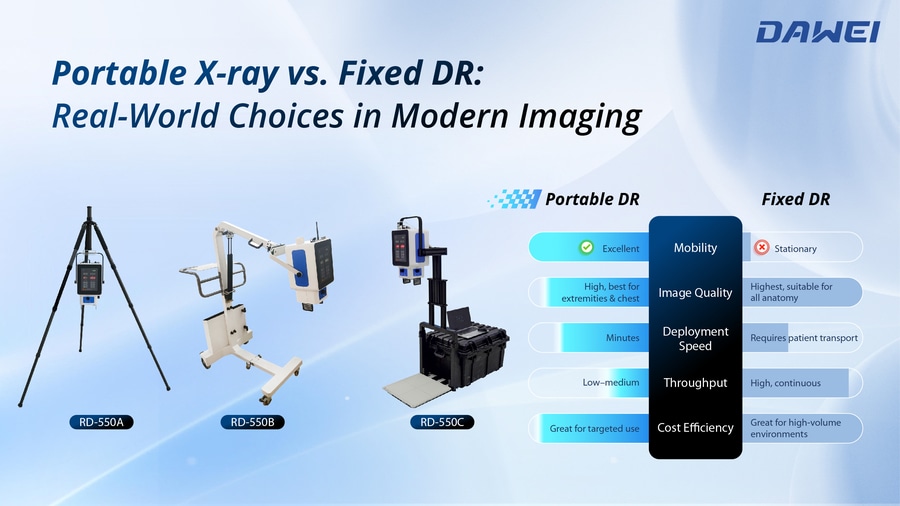
Portable X-ray vs. Fixed DR
Real-World Choices in Modern Imaging
In today’s fast-moving healthcare environment, speed and precision are both essential. Portable Digital Radiography (DR) units and Fixed DR systems each deliver these in different ways — the real question is which is right for your situation?
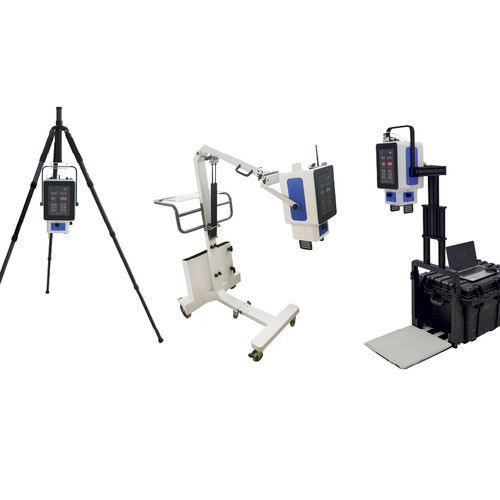
1. Portable DR – Imaging Without Boundaries
Think about this scenario:
An ambulance pulls up after a multi-car accident. Patients are immobilized, vital signs unstable. Instead of rushing them to the radiology suite, a portable DR unit is wheeled straight to their side. Within minutes, doctors have chest images in hand — ready to decide on life-saving interventions.
Key Advantages:
• Go anywhere: From rural clinics to ICU wards, portable DR works where patients are — no transfer needed.
• Fast deployment: In COVID-19 isolation wards, portable DR became a frontline tool, minimizing infection risk while maintaining diagnostic speed.
• Cost-effective reach: Mobile clinics in sub-Saharan Africa use portable DR to screen TB patients in remote villages, cutting travel time for both doctors and patients.
Best For: Emergency teams, military field hospitals, ICU and critical care, outreach programs, rural health networks.
2. Fixed DR – The Imaging Powerhouse
Picture this:
A large teaching hospital handles hundreds of imaging cases daily. From complex spinal surgeries to high-resolution orthopedic studies, every scan demands consistent clarity. Here, a fixed DR system runs all day, every day — producing crisp images at high throughput.
Key Advantages:
• Unmatched precision: High power and stability mean sharper images for challenging anatomy like the abdomen, pelvis, and spine.
• Continuous workflow: Handles 100+ scans daily without overheating or downtime.
• Advanced protocols: Supports fluoroscopy, stitching, and specialized orthopedic positioning with maximum reproducibility.
Best For: Tertiary hospitals, specialty clinics, research institutions, high-volume imaging centers.
3.The Smart Strategy
Many healthcare providers find the best solution is to have both:
- Portable DR for bedside, rural, or emergency work.
- Fixed DR for precision, heavy load, and complex imaging.
Case in point:
One regional hospital in Eastern Europe invested in a portable DR to cover their ICU and rural outreach van while keeping their fixed DR for main hospital use. Result? A 28% reduction in patient transfer times and faster diagnoses for trauma cases — without sacrificing the high-precision imaging needed for surgical planning.
Bottom line: Portable DR brings imaging to the patient. Fixed DR brings maximum precision to the diagnosis. Together, they give clinicians the flexibility to deliver the right care, in the right place, at the right time.