
#Product Trends
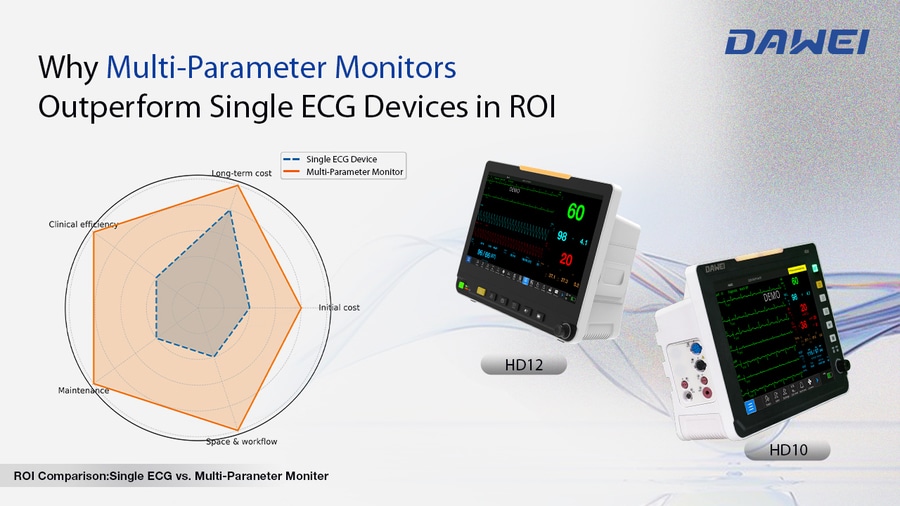
Why Multi-Parameter Monitors Outperform Single ECG Devices in ROI
Healthcare Technology Insights
When hospitals and clinics evaluate new equipment, the decision often comes down to a familiar dilemma: single-function vs. multi-function. At first glance, single ECG devices may seem like the cheaper choice. But when the total cost of ownership is measured—not just purchase price but also training, maintenance, efficiency, and long-term utility—the investment return of multi-parameter monitors becomes clear.
The Limitations of Single ECG Devices
Single-lead or multi-lead ECG machines are widely used for cardiac assessments. Yet, their role is confined:
- Limited scope: They only measure ECG signals, missing critical data like oxygen saturation, blood pressure, or temperature.
- Use case constraints: Suitable for quick screenings or outpatient settings but inadequate for emergency rooms, ICUs, or long-term monitoring.
- Hidden costs: To cover a full patient picture, hospitals must purchase additional devices (pulse oximeters, NIBP machines, thermometers), adding up to higher overall expenditure.
What looks like a budget-friendly option soon reveals itself as a fragmented and inefficient solution.
The Advantages of Multi-Parameter Monitors
By contrast, multi-parameter monitors consolidate ECG, SpO₂, NIBP, respiration, and temperature into a single platform.
- Cost savings: One monitor replaces three or more separate devices, reducing procurement and maintenance costs.
- Clinical efficiency: Real-time integration of multiple vital signs allows for quicker diagnosis and reduces misinterpretation risks.
- Streamlined training: A unified interface shortens learning curves, particularly important for resource-limited hospitals with high staff turnover.
- Lower maintenance burden: Centralized service contracts and unified consumables management minimize downtime and operational complexity.
- Future-proofing: Expandable modules (such as invasive blood pressure or EtCO₂ monitoring) mean facilities can scale functionality as their needs grow.
Real-World ROI Case: A Clinic in Latin America
To illustrate, let’s look at a real case from a private clinic in Guatemala, which initially relied on a mix of standalone ECG machines, NIBP monitors, and handheld pulse oximeters.
- Initial setup:
- 2 single ECG machines (~$2,000 each)
- 3 handheld oximeters (~$300 each)
- 2 NIBP monitors (~$500 each)
- Total: ~$5,900
- Challenges:
- Frequent calibration and servicing of multiple devices.
- Staff confusion with different user interfaces.
- Delays during emergencies when switching between devices.
- Transition to Multi-Parameter:
- The clinic replaced all seven devices with two multi-parameter monitors, each priced at an average market value of ~$3,500.
- Total investment: ~$7,000
- ROI outcome:
- Reduced training hours by 40% due to a unified system.
- Lowered annual maintenance contracts by ~30%.
- Improved ER response times, reducing critical event mortality by an estimated 12% (clinic’s internal audit, 2023).
- Within 3 years, the clinic saved more than $8,000 in maintenance, consumables, and staff training—exceeding the initial investment difference.
This example highlights how multi-parameter monitoring pays back quickly, particularly in settings where budgets are tight but efficiency is critical.
Conclusion
The verdict is clear: multi-parameter monitors provide a higher ROI than single ECG devices. While the initial cost may be higher, the long-term savings, improved efficiency, and enhanced patient safety outweigh the difference.
For healthcare providers in both developed and developing regions, the smarter choice is an integrated solution. Multi-parameter monitors combine reliability, cost-effectiveness, and clinical performance.
Invest once, save for years. That is the true value of multi-parameter monitoring.