
#Industry News
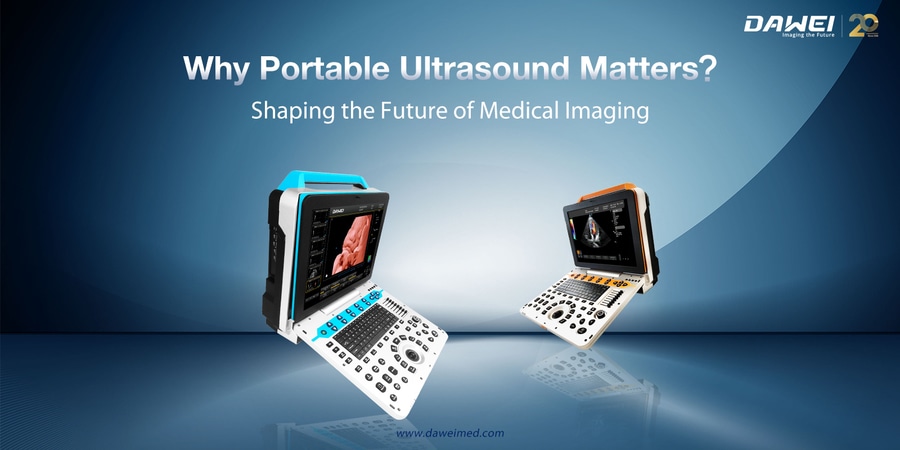
Why Portable Ultrasound Matters?
Shaping the Future of Medical Imaging
Healthcare is rapidly evolving toward more dynamic, patient-centered models, where diagnostic speed, clinical decision-making, and immediate intervention are becoming critical factors in improving outcomes.
In this transformation, Point-of-Care Ultrasound (POCUS) has emerged as one of the most important innovations in modern medical imaging workflow.
Instead of sending patients to a radiology department for conventional imaging, POCUS brings the ultrasound system directly to the patient’s bedside—whether in emergency medicine, anesthesia, intensive care units (ICU), musculoskeletal assessments, or even pre-hospital environments.
This shift from centralized imaging to bedside imaging and mobile healthcare is fundamentally reshaping how clinicians diagnose and act.
POCUS delivers:
Real-time diagnostic information
Faster clinical decision-making
Reduced waiting time for imaging results
More efficient use of healthcare resources
Improved patient safety through earlier intervention
As a result, it has become a key driver of healthcare efficiency and workflow optimization across multiple specialties.
The Traditional Imaging Model Is Reaching Its Limits
For decades, hospital imaging followed a fixed and centralized structure:
Patient → Transport → Imaging Department → Scheduling → Diagnosis → Report
While effective, this model is increasingly challenged by modern healthcare demands, including:
Rising global patient volume
Shortage of clinical staff and radiology capacity
Increasing emergency and critical care cases
Aging populations requiring continuous monitoring
Overloaded hospital infrastructure and workflows
In this traditional system, valuable time is often lost in patient transportation and scheduling delays, rather than in actual diagnosis and treatment.
In modern medicine, however, time-to-diagnosis directly impacts clinical outcomes.
The New Standard: Bringing Care to the Patient
Healthcare is now shifting toward a fundamentally different approach:
Instead of moving patients to imaging systems, we move imaging systems to patients.
This is the foundation of mobile ultrasound systems and point-of-care imaging solutions.
In environments such as:
Emergency rooms (ER)
Intensive Care Units (ICU)
Operating rooms (OR)
Ambulance and field medicine
Remote or rural healthcare settings
Clinical teams require:
Immediate diagnostic capability
Real-time visualization
Fast treatment decisions
Minimal workflow disruption
This is where portable ultrasound and mobile medical imaging technologies become essential.
Why Mobility Matters More Than Ever in Healthcare
1. Faster Clinical Decision-Making
Mobile ultrasound enables real-time bedside diagnosis, eliminating delays caused by traditional imaging workflows.In critical care environments, even minutes can change patient outcomes.
2. Improved Healthcare Workflow Efficiency
By decentralizing imaging access, hospitals can significantly reduce bottlenecks:
Less patient transportation between departments
Reduced dependency on centralized scheduling systems
Faster turnaround in emergency and inpatient workflows
More efficient use of clinical staff and imaging equipment
This leads to a more agile and responsive clinical workflow system.
3. Expanded Access to Healthcare Services
Mobile healthcare solutions extend diagnostic capability beyond hospitals.
They support healthcare delivery in:
Rural clinics and underserved regions
Community healthcare centers
Emergency field operations
Home healthcare and telemedicine environments
This expansion makes healthcare more accessible, distributed, and equitable.
4. Enhanced Patient Experience
From a patient perspective, mobility means:
Reduced physical movement and discomfort
Faster diagnosis and treatment initiation
Less waiting time for imaging
Improved experience for ICU, elderly, and post-operative patients
In modern healthcare systems, patient experience is a key performance indicator, not just a secondary outcome.
Portable Ultrasound: A Core Driver of Mobile Healthcare
Among all imaging modalities, ultrasound imaging technology is uniquely suited for mobility.
It offers:
Real-time imaging capability
Radiation-free diagnostics
High versatility across clinical applications
Rapid deployment in any clinical environment
From trauma assessment and vascular access to OB/GYN screening and cardiac evaluation, ultrasound has become a first-line diagnostic tool in point-of-care medicine.
True mobility in healthcare is not only about compact design
It is about clinical readiness, usability, and workflow integration.
Key requirements include:
Lightweight and portable system design for multi-department use
Long battery life for continuous clinical operation
Fast boot-up for emergency responsiveness
Intuitive user interface for rapid adoption
Multi-application adaptability across specialties
Ultimately, effective mobile imaging systems combine hardware innovation, workflow efficiency, and clinical trust.
The Future of Healthcare: Beyond Physical Boundaries
The future of healthcare will not be defined solely by larger hospitals or more complex machines.
Instead, it will be shaped by four core pillars:
Accessibility
Speed
Flexibility
Intelligence
And at the center of all four lies healthcare mobility and point-of-care imaging innovation. As global healthcare systems continue to evolve, portable ultrasound and mobile medical imaging solutions will move from optional tools to essential standards of care.