
#Product Trends
Understanding Patient Monitoring
Why Different Healthcare Settings Need Different Solutions
Patient Monitoring Is Not Just for the ICU
When people talk about patient monitoring, the first image that often comes to mind is an ICU filled with sophisticated equipment and multiple monitoring parameters.
But patient monitoring is much broader than critical care.
From primary healthcare facilities and general wards to emergency departments, anesthesia and intensive care, healthcare professionals rely on monitoring solutions to observe patients and support clinical workflows.
The key is that different healthcare settings have different monitoring needs. And this is why one patient monitor cannot necessarily fit every market.
Different Healthcare Settings, Different Monitoring Needs
Patient monitoring plays different roles across different levels of healthcare.
In a primary healthcare facility, the focus may be on essential and practical monitoring for routine patient care.
In a general hospital, monitors may need to support a wider range of patients and departments, while providing more comprehensive information and efficient bedside workflows.
In ICU, emergency and anesthesia settings, clinicians may require more advanced monitoring capabilities, more comprehensive clinical information and greater flexibility.
So while the fundamental purpose remains the same — monitoring the patient's condition — the requirements can be very different.
This creates a natural spectrum of patient monitoring needs:
Essential Monitoring → Versatile Hospital Monitoring → Advanced Critical Care Monitoring
What Does “Entry-Level” Really Mean?
The term “entry-level” is sometimes misunderstood.
In medical equipment, entry-level does not simply mean “basic” or “low-end.” Instead, an entry-level patient monitor can be designed around essential clinical requirements, practical deployment and accessible investment, making it suitable for healthcare facilities where advanced configurations may not be necessary.
This is particularly relevant in markets where healthcare systems include a wide range of facilities, from small clinics and primary healthcare centers to large hospitals.
For distributors, entry-level solutions can also play an important role in market expansion. They can help reach customers who may not need a premium monitor but still require dependable patient monitoring capabilities.
At the same time, other customers may require more comprehensive and advanced solutions. This is why a complete patient monitoring portfolio needs to address different levels of demand.
Three Levels of Patient Monitoring Needs
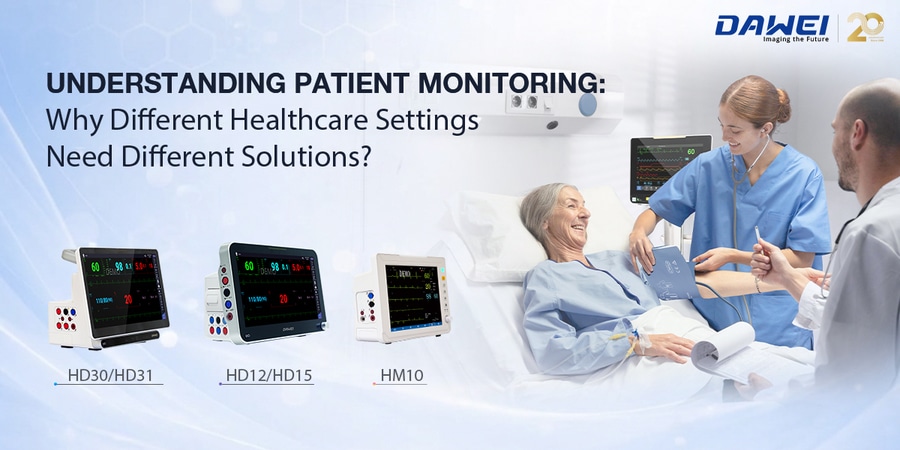
To address different healthcare settings, DAWEI offers a patient monitoring portfolio covering different levels of market and clinical requirements. Each model has a different role within the portfolio.
HM10 — A High-Value Entry Solution
For healthcare facilities looking for an accessible patient monitoring solution, HM10 is positioned as a high-value entry product.
Its role is particularly relevant to primary healthcare and broader market coverage.
In DAWEI's market strategy, HM10 serves as an entry product to help expand market share, cover primary healthcare facilities and build brand recognition.
HD12 — Versatile Monitoring for Broader Hospital Applications
When customer requirements move beyond entry-level monitoring, versatility becomes increasingly important.
HD12 is positioned as a key volume product for broader hospital bedside monitoring applications.
It supports wired and wireless central monitoring systems, with support for centralized monitoring of 64 or more beds, making it suitable for larger-scale hospital applications.
HD12 also incorporates a range of monitoring technologies and clinical functions, including:
· LowPulseStr™ SpO₂ monitoring
· iRealRESP respiratory technology
· MEWS / NEWS scoring
· GCS scoring
· Drug, hemodynamic, renal function and oxygenation calculations
· 24-hour ECG overview
· 24-hour ambulatory blood pressure analysis
· ≥32 arrhythmia types
· Up to 1,200 hours of historical data
· Patient history data export
· Code Marker functionality
LowPulseStr™ SpO₂ technology combines time-domain recognition, frequency-domain recognition and algorithm-based comprehensive decision-making to support accurate measurement under weak perfusion and motion conditions.
iRealRESP uses respiratory detection and calculation technologies together with anti-cardiac-interference and anti-motion-drift algorithms to help maintain stable respiratory waveforms.
HD30 — Advanced Monitoring for Critical Care
At the higher end of the portfolio, clinical environments such as ICU, emergency and anesthesia require more advanced solutions.
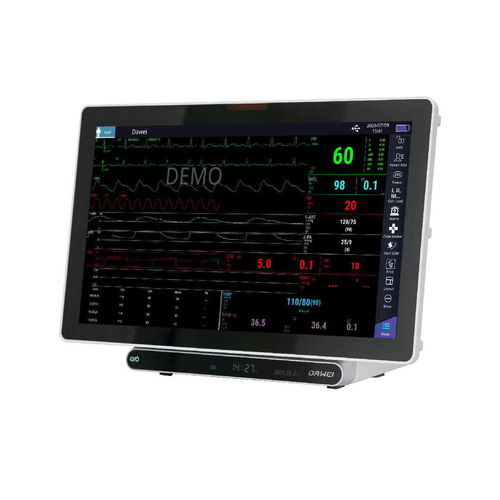
HD30 is positioned for secondary and tertiary hospitals, particularly ICU, emergency and anesthesia departments. DAWEI positions it as a premium solution and a technology benchmark.
One of its distinctive features is its dual-screen flagship design, combining a 15.6-inch main display with a 4.96-inch secondary display.
The HD30 also offers:
· 1920 × 1080 display resolution
· ≥3 expandable module slots
· HDMI output
· Type-C interface
· MEWS / NEWS scoring
· GCS scoring
· CCHD screening for newborns
· Advanced clinical calculations
· 24-hour ECG overview
· 24-hour ambulatory blood pressure analysis
· ≥32 arrhythmia types
· Up to 1,200 hours of historical data
· Patient history data export
· Screen capture
· Code Marker functionality
From One Product to a Complete Patient Monitoring Portfolio
Healthcare markets are rarely one-size-fits-all.
A primary healthcare facility may have very different requirements from a general hospital. A general ward may have different expectations from an ICU. And a value-focused customer may not need — or want to invest in — the same configuration as a premium hospital.
That is why understanding the different levels of patient monitoring needs matters.
For medical device distributors, a broader product portfolio can mean:
More customer segments · More applications · More market opportunities
With HM10, HD12 and HD30, DAWEI provides a flexible patient monitoring portfolio covering different levels of healthcare needs — from entry-level market expansion to advanced critical-care applications.
Looking to expand your patient monitoring portfolio? Talk to DAWEI about the right solutions for your market.