#Product Trends
Medical Tablet EHR Integration: DICOM, HL7 FHIR and Healthcare Interoperability
Bridging Bedside Workflows and EHR Systems with DICOM, HL7, and FHIR
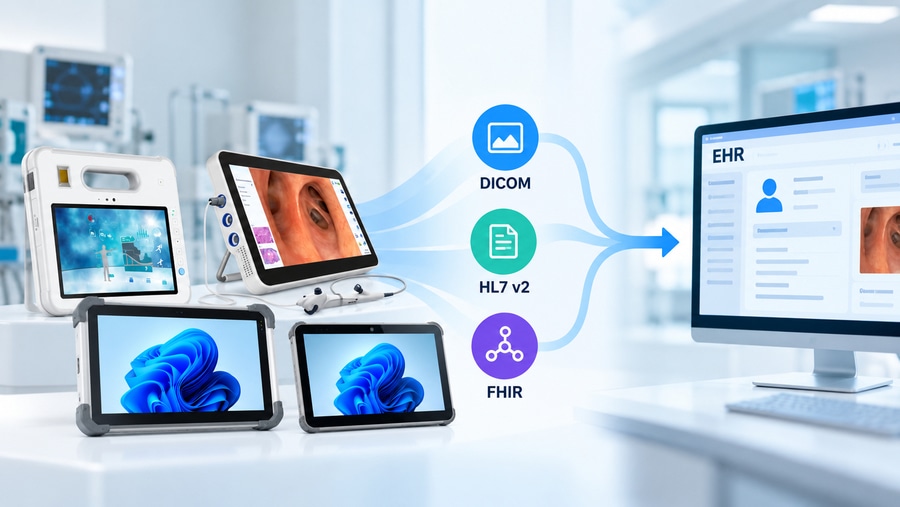
his article examines how Estone medical tablets integrate with electronic health record (EHR) systems through DICOM, HL7, and FHIR, and why healthcare interoperability depends as much on device-level workflow design as on the standards themselves. Rather than treating interoperability as an abstract software problem, the article traces how clinical data moves from bedside devices into patient records across real care settings.
The article first clarifies the division of labor among the three standards. DICOM governs medical imaging data and is essential for modalities, PACS, and diagnostic viewing. HL7 supports clinical information exchange, including admissions, orders, results, and medication-related messages. FHIR provides a modern API-based approach for accessing and exchanging healthcare data. In practice, these standards often work together: a tablet may capture an image via DICOM, retrieve patient context through HL7 or FHIR, and write structured clinical data back to the EHR.
The article then connects these standards to specific Estone devices and clinical workflows. The MD-100 is discussed in the context of mobile X-ray and imaging capture, where DICOM connectivity and PACS integration are central. The MW-100 is presented around bedside medication administration, using barcode scanning to verify patients and medications before documentation is sent to the EHR. The EN-150 is highlighted for DICOM storage and PACS access in imaging-oriented workflows. The MD-150 is positioned as a clinical workstation tablet supporting charting, review, and data entry across bedside and ward environments. Across these use cases, the common thread is that the tablet must fit the workflow — not force clinicians to adapt to a desktop-style EHR interaction.
A significant section addresses reliability when networks fail. The article argues that Wi-Fi coverage in hospitals is rarely perfect, and that an offline-first architecture is necessary for safe EHR integration. This includes local caching of patient context, encrypted storage, access controls, data validation, and synchronized write-back once connectivity returns. The goal is to ensure that clinical data is not lost, duplicated, or attributed to the wrong patient during network interruptions.
Finally, the article outlines a practical deployment path for medical tablet EHR integration, moving from workflow mapping and standard selection to device configuration, integration testing, and pilot rollout. It emphasizes that successful interoperability requires validation in the actual clinical environment, including barcode scanning accuracy, DICOM image handling, EHR session behavior, and offline synchronization.
The article concludes that the value of medical tablet interoperability is realized only when data moves securely and accurately from the device to the correct patient record. DICOM, HL7, and FHIR provide the technical foundation, but the outcome depends on how well the tablet, software, network, and clinical workflow are designed together.