


#Industry News
What the 2026 Refrigeration Cyberattacks Teach Medical Tablet PC Manufacturers About Cybersecurity
What Refrigeration Attacks Mean for Medical Tablet Security
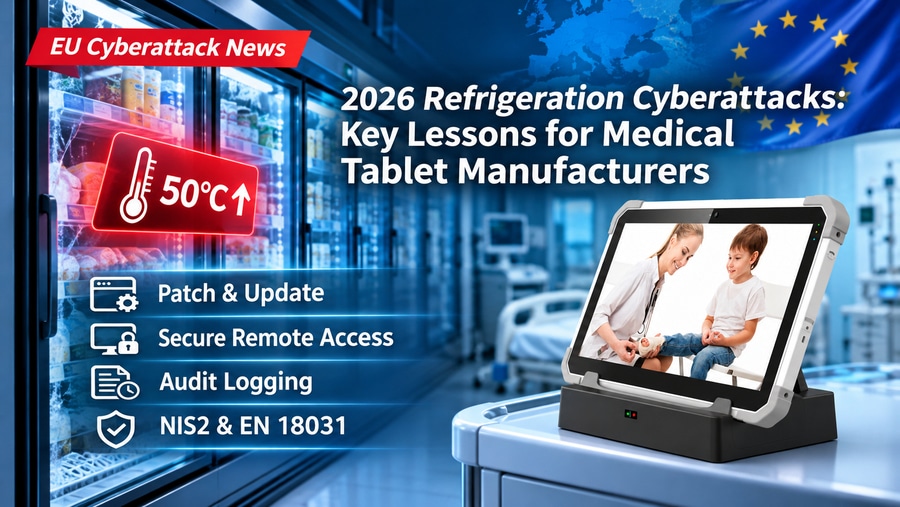
The 2026 refrigeration cyberattacks showed that connected devices can be manipulated to cause physical consequences, not just data loss or service disruption. Attackers exploited connectivity, end-of-life firmware, weak remote-access governance, and insufficient audit logging to alter operating parameters. The result was not a breach of information but a change in physical conditions—a distinction that matters far beyond the refrigeration sector.
Medical tablet PC manufacturers face the same security equation. Clinical tablets connect hospital information systems to bedside care, and they often share the same structural weaknesses: long firmware support gaps, remote maintenance channels with limited oversight, and audit trails that cannot reliably reconstruct who changed what, when, and through which channel. When these weaknesses converge, a medical tablet can become a physical-risk entry point rather than a trusted clinical tool. The consequences are heavier than in refrigeration: operational disruption, compromised clinical workflow, and potential patient safety impact.
The refrigeration attacks also expose a broader gap. Medical device cybersecurity has focused heavily on intrusion prevention—firewalls, authentication, patching—while paying less attention to traceability and incident reconstruction. But in connected clinical devices, the ability to explain what happened is as important as blocking the initial compromise. Regulatory frameworks such as NIS2 reinforce this shift by requiring timely reporting and evidence of the incident chain.
For manufacturers, the implications are concrete. Firmware lifecycle management must be treated as a core design requirement, not an afterthought. Remote-access governance needs explicit controls, logging, and periodic review. Auditability must be built into device architecture so incidents can be reconstructed with confidence. Supply-chain security must extend to firmware support commitments and end-of-life transparency. Security is no longer just a feature of the device; it is a condition of clinical trust.


 鄂公网安备42018502009510号