#Product Trends
Acoustics and lighting in the dental practice:
The two underestimated allies of patient comfort
Ask a patient what they hate most at the dentist: they will cite the dazzling light, the uncomfortable reclining position… and almost always, first or second, the noise. The characteristic whistle of the turbine, the crackle of the ultrasonic scaler, the continuous hiss of the suction. Yet, in the design of a practice, acoustics is one of the most regularly overlooked points. Wrongly so: it is one of the two most powerful levers — along with lighting — to reduce patient anxiety and improve the practitioner's working comfort.
Why noise weighs as much as light on patient comfort:
The human nervous system processes auditory and visual stimuli in parallel, and associates them with emotional states. Light that is too harsh + a noisy environment create a sensory summation: the patient's measurable stress (pulse, skin conductance) rises far more than the sum of each factor taken individually.
Conversely, a soft lighting ambiance combined with controlled acoustics triggers a parasympathetic response: slowing of the heart rate, muscle relaxation. This is the "spa" effect sought in premium practices — and it is obtained through precise technical choices, not by chance.
The real sources of noise in a dental practice: On a typical day, here is what the walls and ceiling of your treatment room absorb (or not):
- Air-rotor turbine: 70 to 85 dB depending on the model (equivalent to a busy street)
- Ultrasonic scaler: 65 to 75 dB, with a particularly irritating high-pitched whistle
- Surgical suction: 60 to 70 dB continuously
- Compressor (if not in a separate room): 50 to 65 dB
- Conversations between practitioner, assistant and patient
- In a classic room with smooth walls, a flat ceiling and a tiled floor, these sounds bounce. The reverberation time can reach 1.2 to 1.5 seconds — twice what is acceptable for a treatment room (NF S31-080 standard: RT < 0.8 s).
Simple test: clap your hands twice in the centre of your empty treatment room. If you hear an "echo" for more than 0.5 second, your acoustics are insufficient. You can correct it without renovating everything.
The hidden effect on the practitioner:
We often talk about the patient, but it is the practitioner who endures this exposure every day, for 8 hours. Over time:
- Cumulative auditory fatigue — less ability to discriminate sounds at the end of the day
- Increased automatic raising of the voice to be heard = vocal fatigue
- Hypersensitivity to ambient noise outside the practice (music in the car, conversations)
- Chronic stress and reduced concentration in the second half of the day
- Auditory fatigue and visual fatigue add up — which is why a well-lit and acoustically treated practice makes it possible to last a full day with the same quality of gesture as in the morning.
The classic solutions (and their limits)
When treating the acoustics of a practice, one first thinks of:
- Suspended ceilings with absorbent tiles — effective but visually poor, lowers the ceiling, not very hygienic in the long term
- Acoustic wall panels — effective but visually bulky, break up the design
- Carpets — prohibited in clinical areas (hygiene)
- Thick curtains — incompatible with a contemporary practice
All these solutions treat acoustics independently of lighting, which complicates the design and increases the budget.
The integrated solution: luminaire + acoustics in a single product
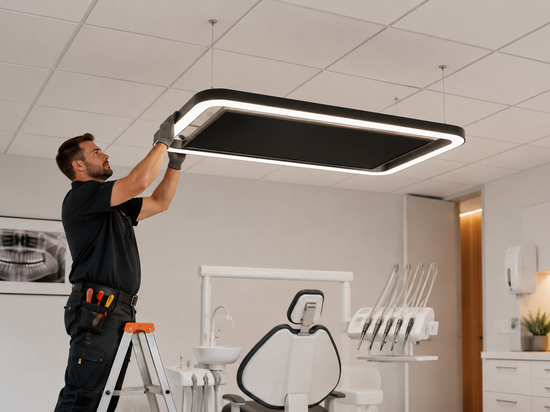
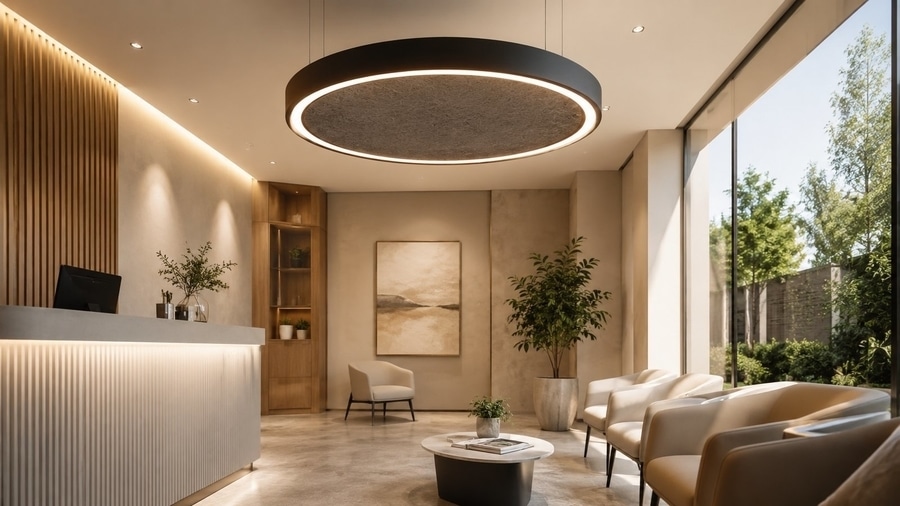
The innovation of LED acoustic suspensions is to combine in a single architectural object:
- A premium lighting function (high-quality LED, high CRI, flicker-free)
- An absorbing panel in high-density PET felt, which traps the sound waves above the chair
Concretely: the suspension floats above the patient — exactly where reverberation is most bothersome — and combines its two functions without taking up a wall or distorting the design.
The EVO-LIGHT acoustic range:
We offer three suspensions designed specifically for this use:
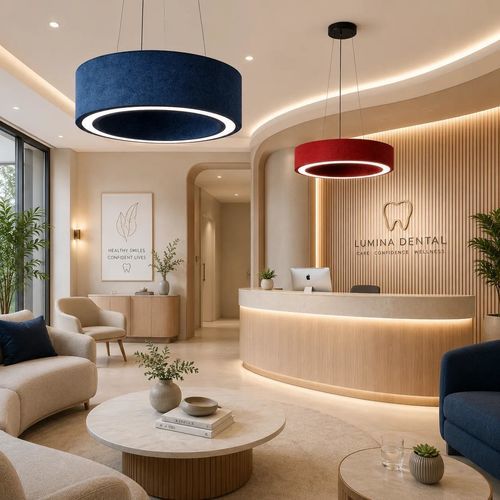
- EVO Acoustic — the compact version, single-sided felt panel. Ideal for standard treatment rooms, a perfect balance of performance / price. Format suited to a single chair.
- EVO Dual Acoustic — the premium version, double-sided acoustic. Higher absorption coefficient. For large rooms or practices with two chairs side by side.
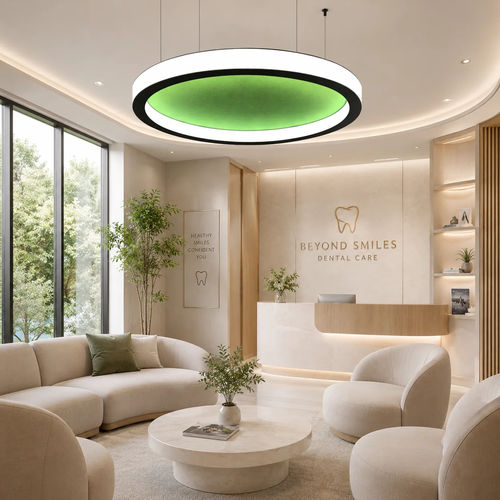
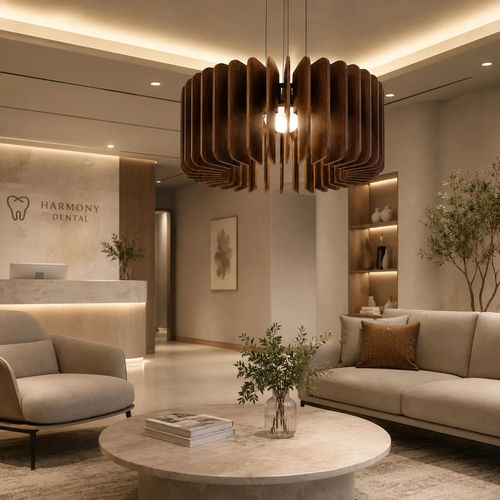
- EVO Cone — the conical format for reception areas or waiting rooms: a strong decorative element, with a localised absorption function.
Worth remembering: treating acoustics after the work is always more complex and costly than upstream. If you are in the design or renovation phase, this is the moment to plan for an integrated solution rather than chasing after it with panels. To combine if possible with a soft non-slip floor (acoustic linoleum) and treated partitions in internal circulation areas.
- Waiting room:
Acoustics matter a lot in reducing anxiety before treatment (see our article on waiting room lighting). An EVO Cone or several small wall absorbers are generally enough.
- Reception:
A transition zone. A discreet acoustic suspension considerably improves low-voice conversations between patients and the front desk. Practical for preserving medical confidentiality.
- Corridor and technical areas:
Often neglected but responsible for a lot of reverberation. A simple acoustic ceiling light or suspended baffles are enough to break the "hospital corridor" effect.
- Budget and payback:
An LED acoustic suspension is positioned between €1,000 and €3,000 excl. tax depending on the size — i.e. 20 to 40% more expensive than an equivalent LED luminaire without an acoustic function. But it replaces the separate investment in acoustic panels (often €500 to €1,500 excl. tax per room for proper treatment). The difference is largely offset, in addition to the aesthetic and hygienic gain.
In summary:
Acoustics and lighting are the two most powerful environmental parameters for transforming the experience of a dental practice — for the patient as much as for the practitioner. Treating them independently complicates the design and increases the budget. Treating them together, via an LED acoustic suspension, means obtaining an integrated, elegant and ultimately more economical solution. Absolutely to be considered if you are designing or renovating your practice.