#Product Trends
Lighting the waiting room of a dental practice:
Creating a soothing atmosphere
The waiting room is the first physical contact between the patient and your practice. Even before meeting the practitioner, the patient forms an opinion there about the quality of the care they are about to receive. And in this first impression, lighting plays a disproportionate role — far more than the furniture or the colour of the walls. Aggressive lighting instantly creates tension. Soft, architectural light, on the contrary, defuses anxiety and establishes calm. Here is how to light a waiting room like a professional.
1. Why the waiting room deserves as much attention as the treatment room
More than 60% of patients report feeling apprehension before a dental appointment. This anxiety is a measurable state: accelerated pulse, attention focused on the environment, hypersensitivity to noise and light. A cold, over-lit waiting room with harsh neon lights accentuates this state — to the point of hardening the perception of everything that follows. Conversely, a soft lighting envelope relaxes the patient physically (lowering of the heart rate) and psychologically (a feeling of attentive care). Care begins in the waiting room.
2. The characteristics of good waiting room lighting
Three criteria make the difference:
Diffuse light, without hot spots. No aggressive localised spotlights above the seats — we seek an enveloping light that leaves no stressful shadow zones.
Moderate intensity. Unlike the treatment room, a high illuminance is not needed. We aim rather for 200 to 300 lux — enough to read comfortably, not enough to tire the eye.
An assertive architectural design. The luminaire is an integral part of the visual experience. An elegant suspension instantly enhances the perception of the practice.
Worth remembering: in a waiting room, you don't light to see, you light to feel. The luminaire becomes an emotional tool, serving soothing and image.
3. Direct or indirect lighting?
This is probably the most structuring decision. Two schools:
Direct (diffusing) lighting
The light source is visible and emits downwards, with a wide diffuser that softens it, for square or rectangular waiting rooms with a natural central point.
Indirect lighting
The light is directed towards the ceiling or the walls, which return it diffusely into the space. No source is directly visible to the patient. Result: an incredibly soft, almost maternal light. This is the role of the EVO Indirect suspension, designed exactly for this use. Ideal for rooms with a low ceiling or ultra-cocooning atmospheres.
Our recommendation for most practices: combine the two. A softened direct-lit architectural central point, complemented by indirect lighting at the periphery. This is what creates the depth and serenity of a true premium waiting room.
4. Which colour temperature to choose?
For a waiting room, the ideal colour temperature is between 2700 K and 3500 K (warm white to warm neutral white). This is much warmer than the treatment room (4000-5000 K) — and it is deliberate.
Warm white is physiologically associated with fire, the hearth, the end of the day — it triggers a parasympathetic response. Conversely, cold white reproduces midday daylight and activates alertness — the opposite of the desired result.
If you want to go further on the science of colour temperature, read our dedicated article on how to properly light a dental treatment room — the principles are explained there in detail.
5. The luminaires that make the difference
Three centrepieces in our range are specifically suited to the waiting room of a dental practice:
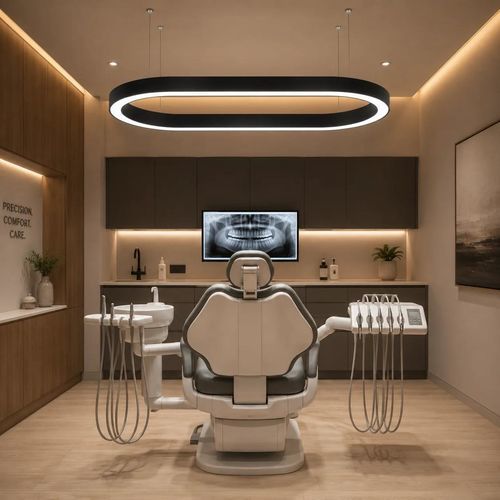
EVO Signature — premium architectural oval LED suspension. Its elongated shape structures medium to large spaces. Perfect above a central coffee table or a reception counter.
EVO Indirect — 100% indirect lighting, light exclusively diffused by the ceiling. Maximum soothing effect, recommended for premium practices that want a memorable luminous signature.
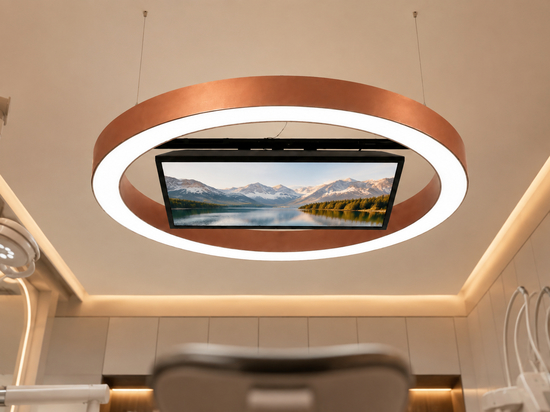
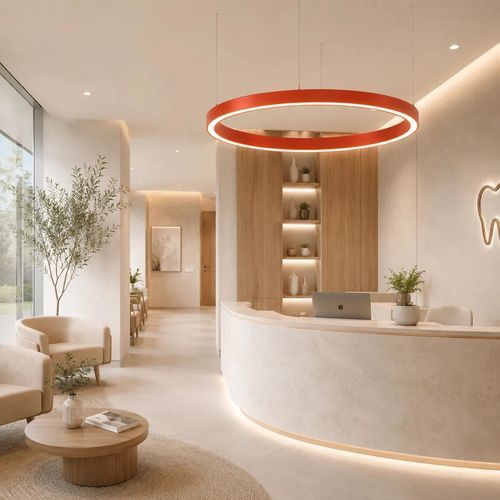
EVO Ring — architectural LED ring. Available in diameters from 450 mm to 5060 mm, it adapts to all configurations, from the small practice to the large clinic waiting room.
6. The classic mistakes to avoid
Keeping the old fluorescent neon lights. Cold light, imperceptible flickering, choppy lighting full of hot spots. An unwelcoming "airport hall" effect.
Over-lighting. 500 lux in a waiting room is too much. We want comfortable light, not office lighting.
Forgetting variation. A single central luminaire is more effective than ten scattered spots — but it is even better if you can modulate its intensity according to the time of day (dimmer or dimmable luminaires).
7. Coherence with the rest of the practice
Finally, the waiting room fits into a global luminous narration of the practice: reception, waiting, treatment, return. Each zone has its own lighting ambiance, but the whole must tell a coherent story — a gradual rise towards the moment of treatment (more technical, more clinical), then a descent towards the exit. This discreet dramaturgy is what distinguishes a practice "that lights" from a practice "that stages the patient experience".
To think about this coherence from the design stage, see our article on how to equip a dental practice in a coherent way.
In summary
Waiting room lighting is not a secondary detail — it is the first building block of the patient experience. Three golden rules: soft, diffuse light (no aggressive spots), warm temperature (2700-3500 K, never cold white), and an architectural luminaire that itself becomes a design element. Combine direct and indirect for depth, and allow yourself the luxury of a true central focal point — this is what transforms a functional waiting room into a truly soothing space.