#Product Trends
Sprint Timing Systems: Can Wearable Sensors Challenge Timing Gates?
A recent study suggests that hybrid wearable technology may offer a practical and accurate alternative for sprint testing in performance and rehabilitation settings.
Accurate sprint testing is essential for performance monitoring, return-to-play decision-making, and athlete profiling. For decades, timing gates have been considered the reference tool for field-based sprint assessment. However, they remain costly, time-consuming to set up, and can be affected by measurement errors linked to limb movement rather than true body displacement.
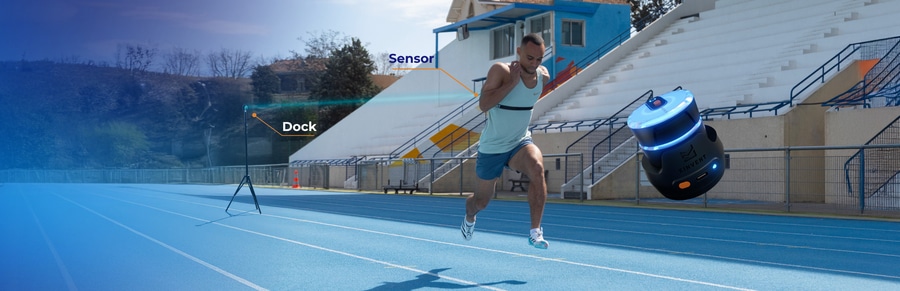
Today, new wearable technologies are reshaping how sprint performance can be assessed in applied settings. By combining inertial motion tracking and positioning data, hybrid wearable sensors make it possible to capture sprint performance directly from the athlete’s lower back, closer to the body’s center of mass, while simplifying field testing logistics.
A recent study investigated whether this type of wearable sprint timing system could provide a valid alternative to traditional timing gates. The results showed excellent agreement with timing gates, very low measurement error, and sufficient sensitivity to detect meaningful performance changes in trained youth sprinters.
In this article, explore how sprint timing systems are evolving, what this study reveals about the accuracy of hybrid wearable sensors, and why these technologies may offer a valuable solution for coaches, sport scientists, and clinicians looking to monitor sprint performance more efficiently.