
#Product Trends
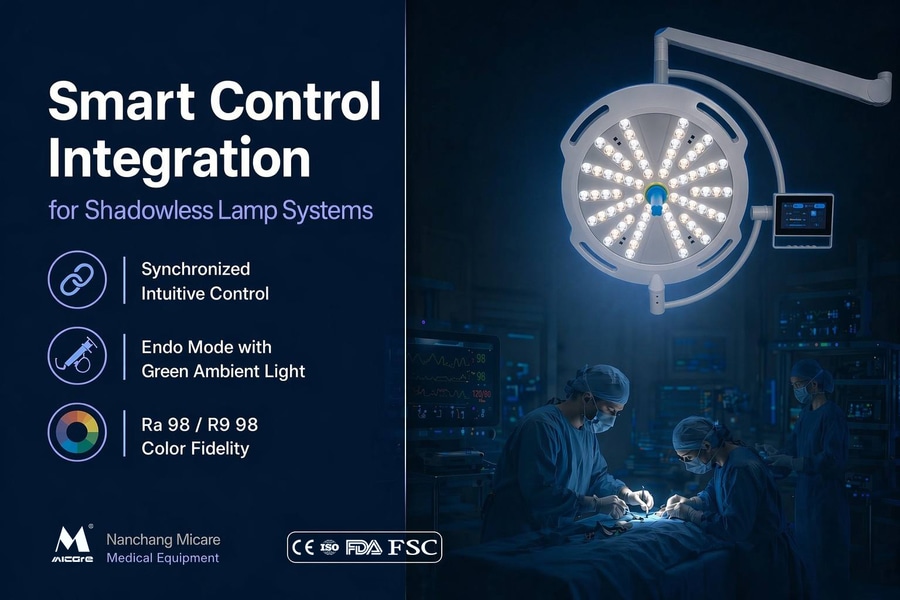
Micare's Smart Control Integration for Shadowless Lamp Systems
Five things procurement teams should check before believing a 'smart' surgical light claim
For years, the conversation around surgical lighting started and ended with one question: how many Lux? Procurement teams chased peak intensity figures while surgeons quietly dealt with the things that actually slow them down — manual re-adjustments between lamp heads, incompatible light conditions when switching between open and endoscopic phases, and the constant background friction of equipment that demands attention.
Smart control integration is changing that math. But "smart" means different things depending on who's selling it. Here's what to look for when evaluating claims — and what separates an integrated system from a lamp with a touch screen bolted on.
1. Synchronization Has to Be Real-Time
In a dual-head setup, the surgeon repositions the main dome over a new incision site. In most systems, someone — scrub nurse, circulating nurse, or the surgeon themselves — then has to manually bring the satellite lamp into alignment. This happens dozens of times per procedure.
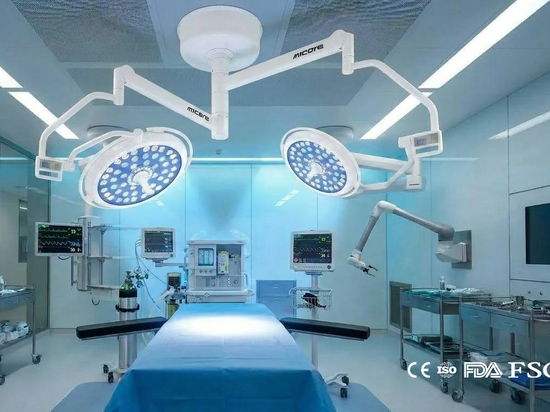
Real synchronized control means one adjustment triggers an automatic, zero-latency response on every linked head. Not via WiFi (interference risk) or Bluetooth (range and pairing issues), but through a dedicated wired communication protocol between lamp heads. Micare's GALAXY-LED series implements this as Synchronized Intuitive Control, handling intensity, color temperature, and focus simultaneously across all domes. For wall-side access — common in teaching hospitals and hybrid ORs — a wall-mounted control panel variant provides backup access without entering the sterile field.
2. The Interface Needs to Work With Gloves On
A sealed 4.3-inch TFT LCD touch screen on the lamp dome itself is the practical minimum. Four color temperature presets — 3,500K, 4,200K, 4,800K, and 5,500K — plus a 10-step focus range (14 cm to 35 cm spot diameter) and stepless dimming from 40,000 to 160,000 Lux should all be accessible without removing surgical gloves. If the panel requires a stylus or a bare fingertip, it doesn't belong in an OR.
3. Endo Mode Isn't a Dimmer Switch
Minimally invasive procedures now account for a growing share of surgical volume worldwide. The lighting problem they create is specific: a bright, high-color-temperature field causes glare on endoscopic monitors, and the constant refocusing between a dark cavity and a bright screen accelerates eye fatigue.
An endoscopy mode worth paying for does three things at once: dims the field, shifts to warmer color temperature, and activates a green ambient light in the lamp housing. The green light is functional — it reduces pupil strain during monitor-to-cavity transitions and serves as a non-verbal signal to the circulating team that the OR is in a scope phase, cutting unnecessary door traffic. Micare's Endo Mode executes all three on a single touch.
4. Color Accuracy Goes Deeper Than Ra
CRI (Ra) is the industry's go-to metric, but Ra only averages the first eight pastel test colors. It says nothing about saturated red (R9), which is what a surgeon uses to distinguish a small artery from surrounding muscle. Look for systems that disclose R9 and R13 (skin tone) alongside Ra. The GALAXY-LED series delivers Ra 98, R9 98, and R13 98 — numbers that come from phosphor formulation, not software processing.
5. The Sensor Should Be Autonomous
A Smart Sensor that detects obstacles — a surgeon's head, a C-arm, an instrument boom — and automatically compensates intensity to maintain target illuminance at the site eliminates dozens of manual corrections per case. In spine and orthopedic procedures where surgeon positioning shifts constantly, this feature moves from nice-to-have to workflow-critical.
Add to this Active Shadow Management via multi-angle LED placement and a proprietary lens array, and you get a depth of illumination that keeps peripheral tissue visible without repositioning: 85 cm at 60% center illuminance, 160 cm at 20%.
Engineering That Extends Lifecycle
Passive thermal management — an aluminum-alloy chassis profiled for heat dissipation without fans — pushes LED lifespan to 80,000 hours and contributes to a laminar flow obstruction of just 18.5%, measurable in ISO 14644-compliant ORs. No moving parts means no filter replacements and no maintenance-driven downtime.
The GALAXY-LED platform also supports an integrated HD camera module, routing feed to monitors, PACS, or telemedicine without additional ceiling booms. Light, camera, sensor, and control converge in a single ceiling footprint — and that's the direction the category is moving.
Micare's GALAXY-LED and Multi-color Plus series are manufactured under ISO 13485 in Nanchang, Jiangxi, and carry FDA and CE certifications.
Contact: [email protected]