#Product Trends
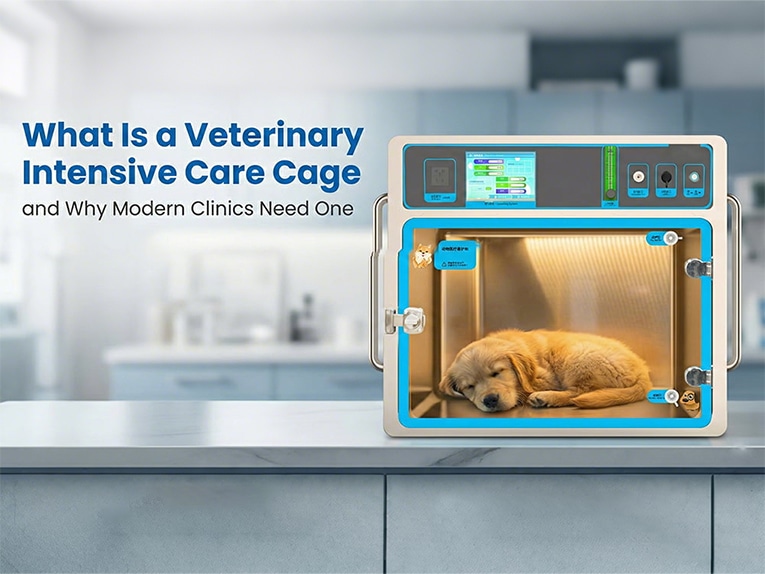
What Is a Veterinary Intensive Care Cage and Why Modern Clinics Need One
Veterinary Intensive Care Cage
Let me start with a real question.
Have you ever finished a difficult surgery and still felt uneasy about what happens next?
The procedure went well.
The patient is stable.
But the recovery phase feels like a gamble.
That’s where most clinics quietly lose outcomes.
Not in surgery.
Not in diagnosis.
But in post-operative care.
And that’s exactly why more clinics are now looking at a veterinary intensive care cage instead of relying on standard cages.
The real problem no one talks about
Most veterinary clinics weren’t designed for true intensive care.
They were designed for throughput.
You treat.
You monitor.
You move on.
That works until you deal with:
High-risk anaesthesia cases
Respiratory distress
Hypothermia after surgery
Infectious patients
Critical care that needs hours, not minutes
A standard veterinary ICU cage was never built for that.
And everyone working in a clinic knows it.
They just don’t say it out loud.
What is a veterinary ICU recovery cabin?
A veterinary ICU recovery cabin is not just a “better cage”.
It’s a controlled recovery environment.
Think less “holding space”.
Think more “mini intensive care unit”.
At its core, it’s part of modern veterinary intensive care equipment, designed to actively support recovery, not just observe it.
A proper ICU recovery cabin allows you to:
Control temperature precisely
Deliver oxygen safely
Isolate critical patients
Reduce stress during recovery
Monitor continuously without constant handling
That’s the difference.
Passive care versus active care.
Veterinary ICU recovery cabin vs standard ICU cages
This is where people get confused.
On the surface, they look similar.
In reality, they do very different jobs.
A standard veterinary ICU cage:
Holds the patient
Allows visual monitoring
Offers basic containment
That’s it.
A veterinary ICU recovery cabin:
Regulates body temperature
Supports oxygen therapy
Reduces heat loss post-anaesthesia
Minimises external stress
Improves survival odds during critical hours
Same space.
Completely different outcome.
Why temperature control matters more than you think
Here’s something clinics underestimate.
Post-operative hypothermia is common.
And it quietly causes:
Delayed recovery
Cardiovascular stress
Poor wound healing
Higher complication rates
A veterinary ICU recovery cabin allows:
Stable thermal environments
Gradual temperature adjustments
Consistent recovery conditions
That alone changes outcomes.
Not dramatically.
Reliably.
Oxygen support is no longer “nice to have”
Respiratory issues aren’t rare anymore.
Brachycephalic breeds.
Trauma cases.
Post-anaesthetic depression.
Oxygen access inside an enclosed ICU recovery system means:
Less patient handling
Faster response to distress
Safer recovery for compromised animals
This is why many clinics now see ICU recovery cabins as essential veterinary critical care tools.
Why modern clinics are switching to enclosed ICU recovery cabins
I’ll be blunt.
Client expectations changed.
They’re better informed.
They ask better questions.
They expect ICU-level care.
Clinics that invest in proper veterinary ICU equipment benefit in ways that aren’t always obvious.
Here’s what I see consistently:
Better post-operative survival rates
Less staff stress during night shifts
Clear differentiation from low-end clinics
Higher trust from pet owners
And trust converts.
Always.
Which clinics benefit the most?
Not every clinic needs ten ICU recovery cabins.
But most clinics need at least one.
They’re especially valuable for:
Small animal clinics performing surgery
Emergency and referral hospitals
Veterinary teaching hospitals
Specialty surgery centres
If you’re doing complex procedures, you’re already operating like an ICU.
Your equipment should match that reality.
How this fits into your overall ICU setup
A veterinary ICU recovery cabin isn’t a standalone solution.
It’s part of a system.
FAQs
What is the difference between a veterinary ICU cage and an ICU recovery cabin?
A cage is passive.
A recovery cabin actively supports temperature, oxygen, and isolation during critical care.
Do small clinics really need a veterinary ICU recovery cabin?
If you perform surgery or manage high-risk patients, yes.
Even one unit can significantly improve outcomes.
Is an ICU recovery cabin only for emergency hospitals?
No.
Routine clinics see major gains in post-operative recovery and client confidence.
Does an ICU recovery cabin replace staff monitoring?
No.
It supports staff by creating stable conditions and reducing constant intervention.
Final thoughts
Veterinary medicine has moved forward.
Recovery care has to move with it.
A veterinary intensive care cage isn’t about being fancy.
It’s about being prepared when things don’t go perfectly.
And that’s what modern veterinary care is really about.
Veterinary intensive care cage.