


#Industry News
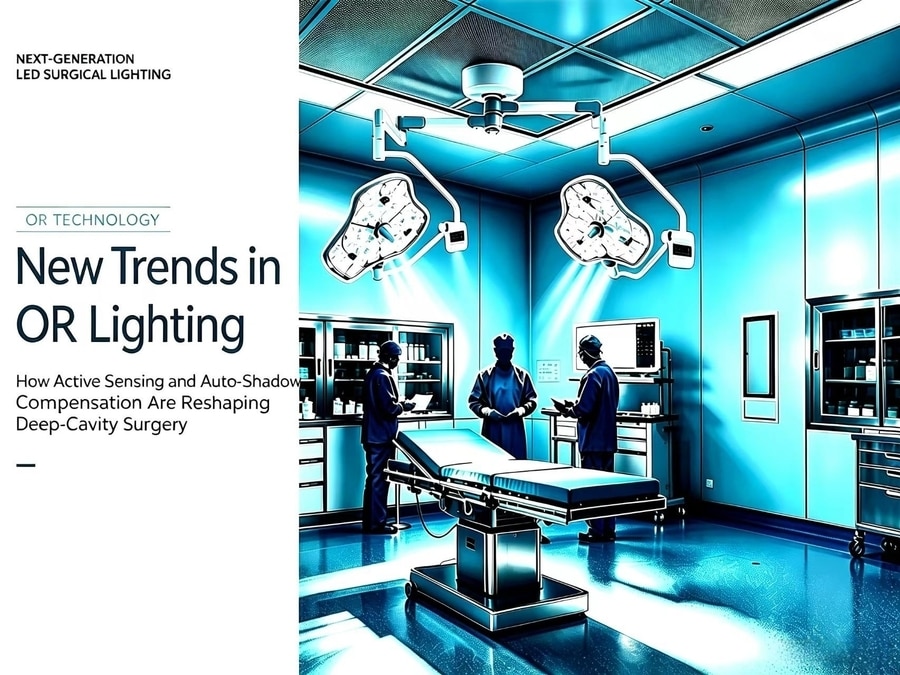
New Trends in Operating Room Surgical Lights
How Active Sensing and Automatic Shadow Compensation Technologies Are Reshaping Deep Surgical Illumination
[Introduction] As smart operating rooms (OR 3.0) surge in development, surgical lighting systems are evolving from simple “passive illumination” to “active intelligent sensing.” As the volume of complex surgeries and deep cavity procedures rises, shadows in the surgical field have become a significant and unignorable risk to surgical safety. This article provides an in-depth analysis of the technological advancements in next-generation LED surgical lights—including automatic shadow compensation, electronically controlled dual-lamp synchronization, and laminar flow-compatible design—to serve as a reference for medical institutions planning new operating room construction or equipment upgrades.
Surgical lighting quality directly impacts surgical safety. In clinical settings, shadows in the surgical field have long been a persistent challenge in operating room lighting. As the frequency of minimally invasive and deep cavity surgeries continues to rise, the limitations of traditional surgical lights have become increasingly apparent. Shadow interference mitigation, sterile and convenient operation, and compatibility with laminar flow environments are gradually becoming core considerations for equipment upgrades in mid- to high-end operating rooms.
As early as 2019, a Grade III Level A hospital reported a case where uneven illumination of the surgical field led to a surgeon misjudging tissue boundaries. Although this did not result in a major medical incident, the surgery was prolonged by 40 minutes, indirectly increasing the patient’s anesthesia risks.
Such incidents are not isolated cases. Clinical practice shows that when the shadow rate of a surgical light exceeds 10%, the risk of procedural errors during deep cavity surgeries increases significantly. Unintentional obstruction of the surgical field by the surgeon’s head, shoulders, or surgical instruments is the primary cause of shadows. Traditional surgical lights rely solely on the superposition of multiple light sources to reduce shadows; however, once the primary light source is extensively obstructed, the brightness of the surgical field rapidly declines, making it difficult to maintain a clear and stable lighting environment.
Three Major Technological Evolution Directions for the Next Generation of LED Surgical Lighting
With the continuous advancement of LED light sources, sensors, and electronic control technologies, mid- to high-end surgical lights are undergoing upgrades focused on three key areas: eliminating shadows in the surgical field, improving surgical efficiency, and adapting to laminar flow operating room environments. Automatic shadow compensation, coordinated control between dual lamp heads, and ultra-thin lamp heads designed for laminar flow environments have become representative technological features in the industry.
1. Automatic Shadow Compensation: Ensuring a Stable and Clear Surgical Field Despite Extensive Obstruction
Traditional shadowless surgical lights struggle to cope with extreme conditions where the light source is extensively obstructed. Modern lighting equipment equipped with automatic shadow compensation technology uses built-in sensors to identify areas where the light source is obstructed in real time. Even when up to 80% of the light source’s surface area is obscured by the surgeon’s body or instruments, the system automatically increases the output power of the unobstructed LEDs to dynamically compensate for brightness loss in the surgical field. Currently, some leading products can maintain a shadow rate of less than 1%, far exceeding the industry’s standard limit of 5%.
During surgery, changes in the surgeon’s position and the repeated entry and exit of instruments into the surgical field do not cause drastic fluctuations in surgical field brightness, providing continuous and reliable lighting conditions for deep surgical procedures.
2. Dual-Head Coordination and Electronic Focus Control: Optimizing the Intraoperative Experience
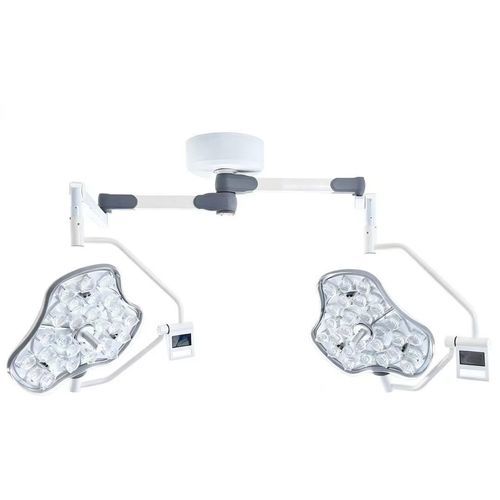
In large, comprehensive operating rooms, dual-head configurations are widely used for various complex surgeries. In the past, a circulating nurse had to adjust the brightness and color temperature of both lighting systems separately, which often disrupted the surgical workflow. Next-generation mutual control and synchronization technology enables coordinated operation between the two light heads: While remaining within the sterile field, the lead surgeon can use the control panel on either light head to simultaneously adjust the power, brightness, and color temperature settings of the other light head, without the need for external personnel intervention. This design not only enhances surgical efficiency but also reduces the risk of cross-infection caused by frequent movement of non-sterile personnel, aligning with the strict requirements of modern operating room infection control management.
At the same time, electronic focusing is gradually replacing traditional manual knob adjustments. Operators can adjust the light spot directly via a touch panel without needing to touch the lamp body. The device supports multiple preset light field modes, and the light spot can be continuously adjusted over a wide range, making it suitable for both the precise procedures of microsurgery and large-scale open surgeries.
3. Ultra-thin Lamp Head Design: Meeting the Strict Requirements of Laminar Flow Operating Rooms
Laminar flow operating rooms have stringent standards for the stability of internal airflow; an overly bulky lamp head can disrupt laminar airflow and compromise the operating room’s cleanliness level. New-generation products generally feature a slim-profile design (e.g., 80 mm thick) to minimize interference with laminar airflow—a key evaluation criterion for selection in Class 100 and Class 1,000 laminar flow operating rooms.
How to Choose Between the Two Main Configuration Approaches in the Industry
Based on differences in operating room cleanliness levels, average daily surgical volume, and the types of procedures performed, the industry currently offers two main configuration options: single-lamp head and dual-lamp head synchronized systems:
· Single-lamp head configuration: More cost-effective, suitable for outpatient operating rooms and small operating suites, and commonly used for routine surgeries in small- to medium-sized facilities.
· Dual-head synchronized configuration: Provides comprehensive, bidirectional lighting coverage to eliminate blind spots. It is better suited for large, general-purpose operating rooms and supports complex surgical scenarios in orthopedics, neurosurgery, general surgery, and obstetrics and gynecology. In new Class 100 and Class 1,000 laminar flow operating room projects, an increasing number of medical institutions are opting for the dual-head synchronized solution.
Key Evaluation Points for Equipment Upgrades
When purchasing or upgrading surgical lighting equipment, medical institutions should not rely solely on price as the primary criterion; the following points deserve special attention:
· Suitability for the Installation Environment: Distinguish between new operating rooms and retrofit projects for existing ones. Carefully verify the clear ceiling height to ensure the equipment is compatible with the installation height and adapts to varying on-site ceiling height conditions.
· Completeness of Compliance Certifications: Equipment used domestically must possess a Medical Device Registration Certificate; export models must hold relevant certifications such as CE and FDA. During the procurement phase, request registration documents and third-party test reports from suppliers.
· Long-Term Operation and Maintenance Costs: Prioritize modular light source designs. Compared to equipment requiring the replacement of the entire light source module, modular products allow for the replacement of only the faulty component when a single light source fails, effectively reducing long-term operational and maintenance expenses.
· Ceiling Boom Load-Bearing Capacity: Dual-lamp units are heavier; for retrofit projects, it is essential to verify the load-bearing capacity of existing ceiling booms and pre-embedded anchor points to avoid installation safety risks.
· After-Sales Response Mechanism: Clarify the warranty period and confirm the response time for remote technical support in the event of a malfunction to ensure the stable operation of operating room equipment.
Note: To access the complete procurement evaluation checklist and detailed product technical specifications, please visit the “Operating Room Lighting Selection Guide.”
Industry Summary
As surgical procedures evolve toward minimally invasive and increasingly complex techniques, operating room lighting is no longer limited to simply “illuminating the surgical field.” Features such as anti-shadow compensation, sterile electronic control, compatibility with laminar flow environments, and modular, low-cost maintenance are gradually evolving from high-end optional features into standard requirements for modern operating room infrastructure. When medical institutions undertake new construction or equipment upgrade projects, in addition to basic illuminance standards, it is recommended that they prioritize the aforementioned next-generation technologies to mitigate clinical safety risks caused by shadows in the surgical field at the source of illumination and to create a safer, more efficient, and smarter surgical environment.
 鄂公网安备42018502009510号