#Product Trends
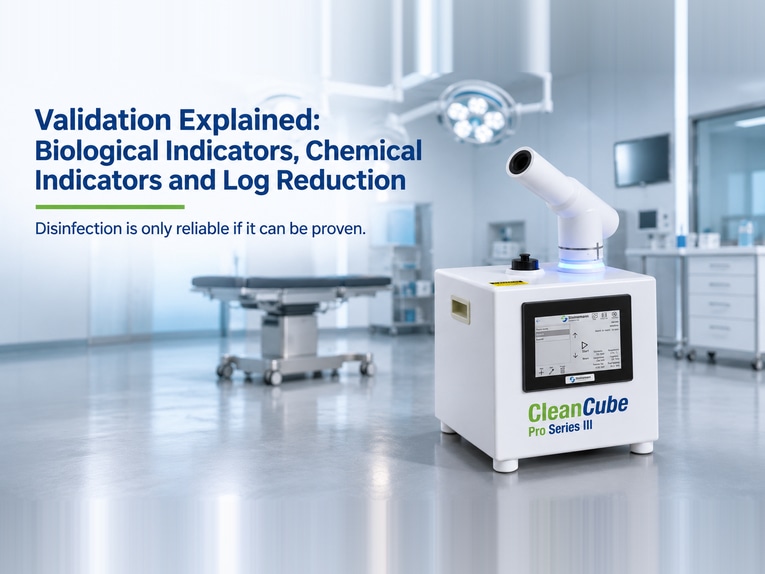
Validation Explained: Biological Indicators, Chemical Indicators and Log Reduction
Disinfection is only reliable if it can be proven.
A room can look clean and still not be disinfected. Whether microorganisms have actually been killed is shown only by validation: it demonstrates that a disinfection process achieves the same efficacy reproducibly under defined conditions, regardless of room, timing or operator. In 3D disinfection it relies on two measurement systems that answer two different questions.
Validation of the Overall Process
In automated room disinfection, neither the agent nor the device is assessed on its own; both are assessed together as a process. This is what the European test standard EN 17272:2020+A1:2025 requires. It covers non-porous surfaces and, alongside the efficacy test, mandates a separate distribution test [1]. What is validated is therefore always a specific combination of device, agent, dose, contact time and room conditions.
Chemical Indicators for Verifying Distribution
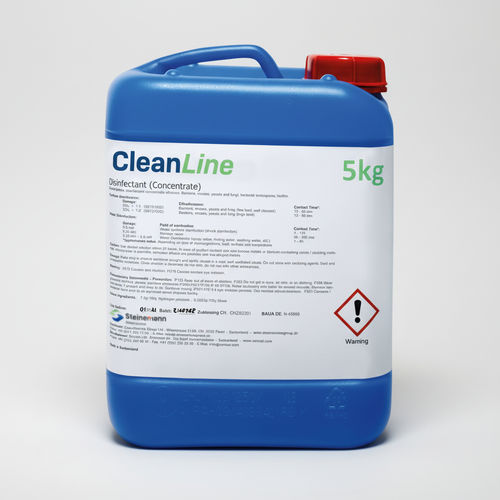
Chemical indicators react to the active substance itself, which for CleanLine 15 means hydrogen peroxide, present at 7.5% [8]. Their dye changes colour once contact has occurred. Because they are inexpensive and show the result immediately, they can be used at many positions at once: in corners, behind equipment, under shelves. This makes spatial coverage visible.
Their limit matters just as much. ISO 11140-1, developed for sterilisation processes, distinguishes six types of chemical indicator, including simple process indicators and integrating indicators; the classification explicitly implies no hierarchy [2]. A simple colour change proves contact, but not a sufficient concentration across the whole contact time, and certainly not a kill. A study of eight process and multi-variable indicators for vaporized-H₂O₂ sterilisation processes showed that not all of them detected a deliberately reduced concentration or contact time [3]. Chemical indicators therefore serve to check distribution, not to prove efficacy.
Biological Indicators as Proof of Efficacy
Biological indicators go one step further. They carry a defined number of highly resistant bacterial spores on a standardised carrier. For hydrogen peroxide processes this is usually Geobacillus stearothermophilus, often with around one million spores per carrier. How resistant a batch is, is described by the D-value: the time in which 90% of the spores are killed under defined conditions. General requirements for such indicators, including how population and resistance are determined, are set out in ISO 11138-1 [4].
The indicators are placed at exposed, concealed and hard-to-reach positions and incubated in the laboratory after the cycle. If nothing grows, the process is considered effective at that position. With one million spores, that corresponds to a reduction of at least 6 log. The choice of carrier matters too: a dry fogging study showed that commercial spore carriers have limitations for process control [5].
Log Reduction and EN 17272 Requirements
Results are expressed in logarithmic steps, and each step means a tenfold decrease in surviving organisms. 1 log corresponds to 90% fewer organisms, 4 log to 99.99%, 6 log to 99.9999%.
Which level is required is set by the standard. In the medical area, EN 17272 requires at least 5 log for bactericidal activity and at least 4 log for sporicidal, fungicidal, yeasticidal, virucidal and mycobactericidal activity. In the distribution test, at least 5 log must be achieved on every single carrier at defined positions [1].
Validation and Routine Monitoring
Validation does not accompany every cycle. It qualifies the process once and then at regular intervals. In daily operation, routine monitoring secures the result: documented parameters, quantity of agent per room volume, contact time, aeration and release measurement, supplemented by chemical indicators as a quick check. For hydrogen peroxide fogging, the German KRINKO additionally requires evidence of concentration across the contact time using continuously measuring sensors [6].
Process Stability with the CleanCube Systems
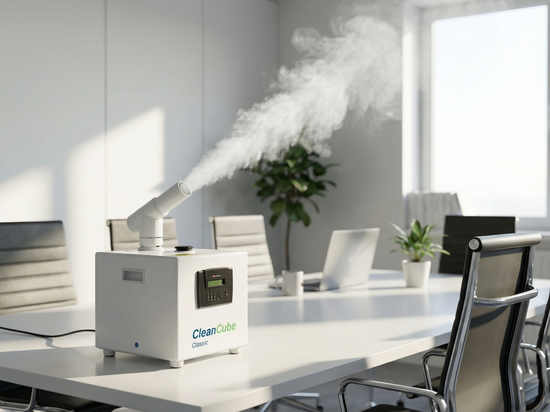
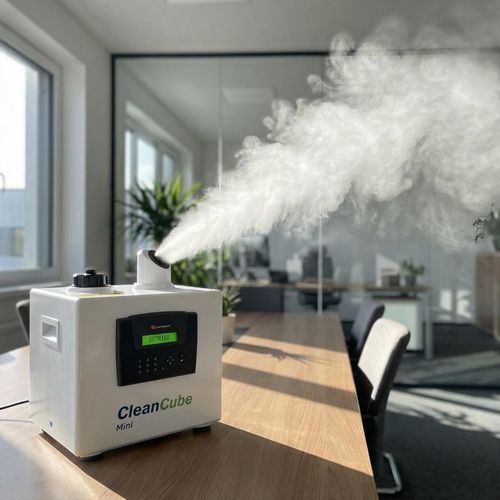
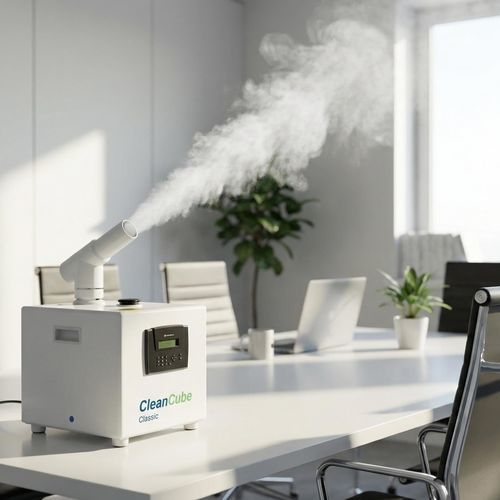
Validation only works with a stable process, and that is exactly what the CleanCubes are designed for. They dose CleanLine 15 by pump in a reproducible way and distribute it as a micro-fine aerosol in a vortex throughout the room volume. The CleanCube Classic calculates the disinfection parameters automatically from room size and selected solution and is designed for rooms up to 500 m³; the compact CleanCube Mini covers rooms up to 200 m³ and starts automatically 20 seconds after input, so the room can be vacated [8].
Validation itself follows the principle of this article: Steinemann Disinfection uses biological indicators at several room positions, including hard-to-reach zones, measures concentration, temperature and relative humidity, and documents every cycle in full [8].
Automated processes reduce reliance on the operator for the selection and formulation of the agent, its distribution and its contact time [7]. That is the precondition for indicators to deliver comparable results cycle after cycle, and for validation to be not a formality but part of a demonstrably safe hygiene concept. Talk to us: we will show you how the CleanCubes fit into your rooms and routines.
Conclusion
Validation means control instead of trust. Chemical indicators show where the agent arrived, biological indicators show whether it worked, and log reduction makes the result comparable. Combined with a stable, documented process, this becomes disinfection that is not just well-intentioned but demonstrably effective.
Securing Health. Steinemann Disinfection.
Sources
[1] EN 17272:2020+A1:2025. Chemische Desinfektionsmittel und Antiseptika. Verfahren der Raumdesinfektion durch automatisierte Verfahren. CEN/TC 216.
[2] ISO 11140-1:2014. Sterilization of health care products. Chemical indicators. Part 1: General requirements. ISO/TC 198.
[3] Kirk B. Evaluation of a number of chemical indicators for monitoring vaporized hydrogen peroxide (VH2O2) sterilization processes. Zentralsterilisation. 2020;28:214-224.
[4] ISO 11138-1:2017. Sterilization of health care products. Biological indicators. Part 1: General requirements. ISO/TC 198.
[5] Schinköthe J, Scheinemann HA, Diederich S, et al. Airborne disinfection by dry fogging efficiently inactivates SARS-CoV-2, mycobacteria and bacterial spores and shows limitations of commercial spore carriers. Appl Environ Microbiol. 2021;87(3):e02019-20. DOI: 10.1128/AEM.02019-20. PMID: 33158901.
[6] KRINKO am RKI. Anforderungen an die Hygiene bei der Reinigung und Desinfektion von Flächen. Bundesgesundheitsbl. 2022;65(10):1074-1115. DOI: 10.1007/s00103-022-03576-1.
[7] Otter JA, Yezli S, Perl TM, Barbut F, French GL. The role of ‘no-touch’ automated room disinfection systems in infection prevention and control. J Hosp Infect. 2013;83(1):1-13. DOI: 10.1016/j.jhin.2012.10.002. PMID: 23195691.
[8] Steinemann Disinfection. Technologie & Applikationen; Produktseiten CleanCube Classic, CleanCube Mini und CleanLine 15. Website, abgerufen November 2026.
Steinemann Disinfection | Clean Service Group AG · Wilerstrasse 2180, 9230 Flawil, Switzerland · +41 71 555 11 30 · [email protected] · steinemann-disinfection.ch