
#Industry News
Analyzing the Ergonomics of Workstations using Inertial Sensors (IMUs)
Is your workstation designed to protect your health?
Every day, millions of people spend hours in front of a computer, handling tools, or performing repetitive tasks without realizing that their work environment may be silently affecting their well-being. Ergonomics is not a luxury or a trend. It is a necessity.
Properly designing a workstation from an ergonomic perspective is essential to prevent injuries, improve productivity, and, most importantly, ensure workers’ health. But how can we know if a workstation is truly adapted to the human body’s needs? The answer lies in the objective data provided by biomechanics and inertial sensors.
Traditional ergonomics used to rely on visual observation and subjective risk assessment scales. Today, thanks to technological advances, it is possible to accurately and objectively measure how a worker moves, what postures they adopt, and which joints are under stress during their workday.
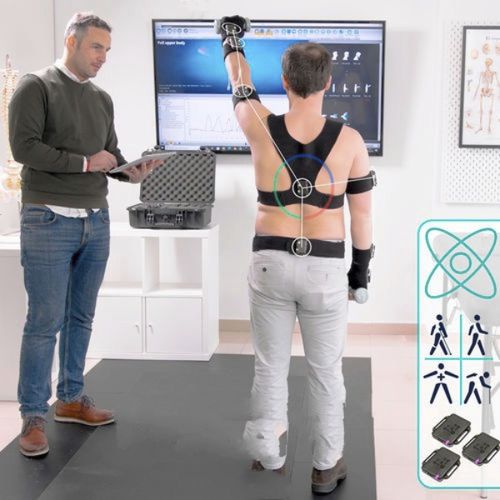
This is where inertial sensors come into play. These devices, such as accelerometers and gyroscopes, are placed directly on the human body to record posture, movement, and orientation of each body segment in real time. Connected to biomechanical analysis software, the collected data helps identify ergonomic risk factors like awkward postures, repetitive movements, or asymmetrical execution of tasks.
The goal is clear: detect what is not visible to the naked eye in time to redesign the work environment, modify workflows, or train new, healthier movement patterns.
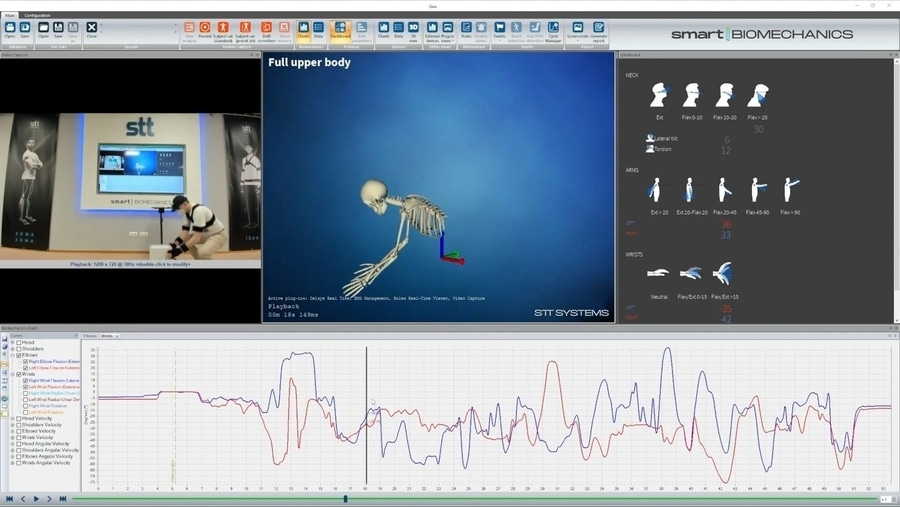
One of the most advanced systems for this type of analysis is iSen, a complete and portable biomechanical analysis solution developed by STT Systems. Its main advantage is that it brings together everything needed for a reliable, fast, and easy ergonomic study in one package: wireless inertial sensors, 3D analysis software, video module, and an automatic report generator.
Some of its most notable features include:
- Wireless communication via Wi-Fi
- Flexible use of sensors, from 1 up to 17 depending on the need
- High sampling frequency, from 25 to 400 Hz
- Precise synchronization with timestamped data
- Real-time 3D visualization of full or partial skeleton
- Easy video integration as reference
- One-click automatic report generation
- Compatibility with third-party devices and data export
The iSen ergonomics module allows personalized assessments of different body areas, including:
- Upper body evaluation (arms, shoulders, cervical spine)
- Lower body analysis (hips, knees, ankles)
- Individual joint analysis
- Full-body motion capture
Additionally, iSen can be integrated with video cameras for visual reference and with devices such as force plates or EMG systems, thanks to its synchronization and data integration capabilities.
Implementing this type of technology in the workplace has a direct impact on employee health and well-being. Some concrete benefits include:
- Prevention of musculoskeletal disorders (such as low back pain, tendinitis, or neck pain)
- Reduced absenteeism
- Increased performance and productivity
- Optimized workstation design
- Data-driven decision-making
In industries such as manufacturing, logistics, healthcare, or office settings, where repetitive tasks or prolonged postures are common, these studies can make the difference between an injured and a healthy worker.
Ergonomic analysis using inertial sensors not only provides data. It transforms how companies approach occupational health. It is no longer about fixing problems after they occur, but anticipating them. And tools like iSen make that possible.
In addition to the ergonomics module, iSen is also used in areas like rehabilitation, gait analysis, medical and forensic research. All within a portable, adaptable, and easy-to-use system.
Want to know more about how to apply ergonomic analysis with iSen in your company or clinical project?
Contact us and discover how technology can help you build a healthier, safer, and more productive work environment.