#Industry News
HIFU vs RF Microneedling vs Fractional CO₂: Understanding the Differences
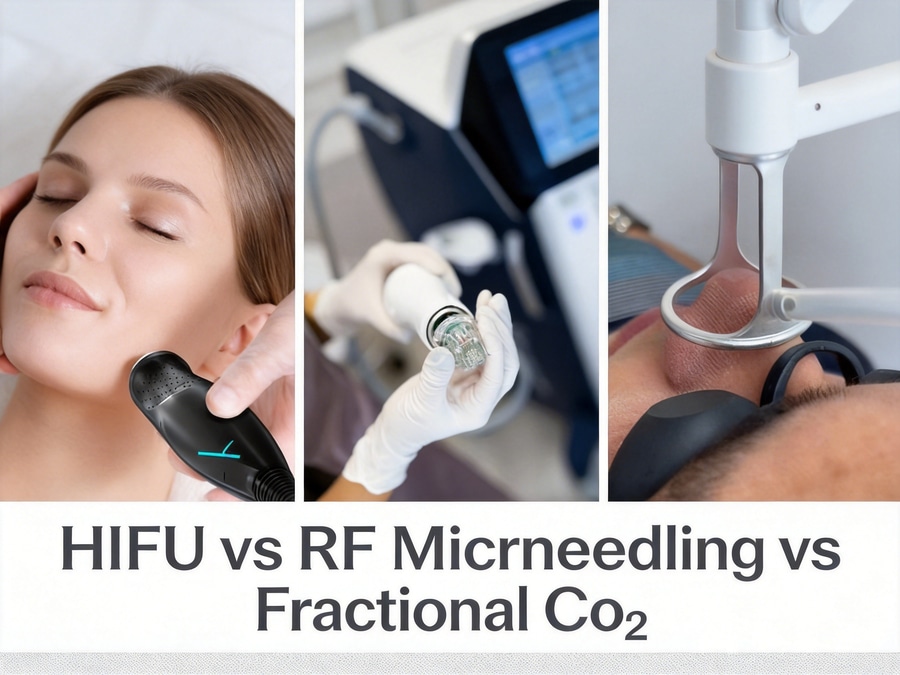
HIFU vs RF Microneedling vs Fractional CO₂
Modern aesthetic clinics have access to a wide range of technologies for skin tightening, rejuvenation, and resurfacing. Among them, HIFU, RF Microneedling, and Fractional CO₂ are commonly used for different treatment goals.
Although these technologies can all support skin rejuvenation, they use different energy sources and target different tissue layers. Understanding these differences can help clinics select the appropriate technology for specific treatment needs.
HIFU: Focused Ultrasound for Lifting and Tightening
HIFU, or High-Intensity Focused Ultrasound, uses focused ultrasound energy to create controlled thermal stimulation at selected tissue depths.
The technology primarily targets deeper tissue layers rather than the skin surface. This makes HIFU particularly suitable for treatments focused on:
1. Skin lifting
2. Skin tightening
3. Jawline definition
4. Neck tightening
5. Selected body tightening applications
Because HIFU does not rely on needles or surface ablation, clinics commonly position it as a non-invasive option for patients seeking lifting and tightening treatments.
RF Microneedling: Combining Needling and Radiofrequency
RF Microneedling combines controlled needle penetration with radiofrequency energy.
The needles reach a selected depth, while RF energy creates thermal stimulation within the targeted tissue. This combination can support collagen remodeling while also addressing certain texture-related concerns.
RF Microneedling is commonly used for:
1. Skin tightening
2. Enlarged pores
3. Acne scars
4. Fine lines
5. Uneven skin texture
6. Stretch marks
7. Overall skin rejuvenation
Compared with HIFU, RF Microneedling works more directly within the dermal layers and can provide a broader combination of tightening and texture-focused applications.
Fractional CO₂: Advanced Skin Resurfacing
Fractional CO₂ laser uses CO₂ laser energy to create controlled treatment zones within the skin.
Fractional delivery treats selected areas while leaving surrounding tissue untreated, supporting the skin's natural recovery process. Clinics commonly use Fractional CO₂ for more intensive resurfacing applications, including:
1. Acne scars
2. Fine lines and wrinkles
3. Uneven skin texture
4. Enlarged pores
5. Photodamage
6. Skin resurfacing
Compared with HIFU and RF Microneedling, Fractional CO₂ generally provides a more intensive resurfacing treatment profile and therefore requires appropriate patient selection and aftercare.
HIFU vs RF Microneedling vs Fractional CO₂
| Technology | Energy Type | Main Treatment Focus | Typical Positioning |
| ---------------- | ------------------ | ---------------------------------- | -------------------------- |
| HIFU | Focused ultrasound | Lifting and tightening | Non-invasive |
| RF Microneedling | RF + microneedling | Tightening and texture | Minimally invasive |
| Fractional CO₂ | CO₂ laser | Resurfacing and texture correction | More intensive resurfacing |
These technologies should not necessarily be viewed as direct alternatives. Instead, they can complement one another by addressing different treatment goals and tissue levels.
Which Technology Should a Clinic Choose?
The choice depends on the clinic's treatment menu, patient needs, and desired treatment profile.
Clinics focusing on non-invasive lifting and tightening may consider HIFU.
Clinics looking for a combination of skin tightening and texture improvement may consider RF Microneedling.
Clinics specializing in skin resurfacing, acne scars, and more intensive texture correction may consider Fractional CO₂.
For clinics building a broader skin rejuvenation platform, combining different technologies can provide more treatment options for different patient concerns.
PZLASER Skin Treatment Solutions
PZLASER offers platforms covering these three technology categories, including MFUpro® for micro-focused ultrasound, RFMStar™ for RF Microneedling, and Fractional Master™ for Fractional CO₂ treatments.
Rather than replacing one technology with another, clinics can select complementary platforms based on their treatment goals and overall service portfolio.
Conclusion
HIFU, RF Microneedling, and Fractional CO₂ each offer a different approach to skin rejuvenation.
HIFU focuses on lifting and tightening, RF Microneedling combines tightening with texture improvement, and Fractional CO₂ focuses on intensive resurfacing.
Understanding the differences between these technologies allows aesthetic clinics to build treatment programs around specific skin concerns instead of relying on a single technology for every patient.