#Industry News
Healthy Money: The Financial Advantage of Medical-Grade Computers
Medical-grade computers aren’t just safer and more reliable; they can also be more affordable than consumer-grade equivalents thanks to their superior design.
In the demanding world of healthcare, even something as basic as what clothing providers wear must be manufactured to extremely high standards. This is doubly true for medical computers, which have some of the most vital roles in a hospital.
Apart from ensuring their reliability and power, medical-grade designs can also make them more affordable in the long-term when compared to consumer-grade options. Despite a higher upfront cost, medical-grade features help save money over time.
How Sealed and Fanless Designs Reduce Costs and Improve Safety
Preventing the spread of disease is one of the top priorities for a hospital. Medical-grade PCs are designed with this in mind, which leads to fewer infections among both staff and patients.
IP65-Rated Designs: Easier Cleaning, Fewer Infections, and Lower Costs
Every piece of equipment in a hospital, including computers, must be frequently cleaned and sterilized. Failing to do so can spread bacteria and disease, leading to both patients and providers getting infected. When the former gets sick, it leads to treatment complications and further expenses for the hospital and insurance provider. When the latter gets sick, it leads to staffing shortages and a loss of efficiency. Ultimately, both cost the hospital more money.
That’s why it’s so critical for hospital computers to have IP65-rated cases and front bezels. These sealed and water-tight surfaces are easier for providers to clean and sanitize, preventing the spread of disease without worrying about damaging the computer itself.
Fanless Cooling: Reducing Contamination and Equipment Failures in Hospitals
Operating rooms are “clean rooms,” meaning there are strict laws and regulations dictating what’s allowed inside them, electronics included. Computers that use fans to provide cooling are typically banned from these rooms, as they can bring dust into the room and spread it throughout, potentially contaminating the area with infectious bacteria.
For this reason, all-in-one medical PCs will implement fanless cooling designs. These computers deliver computer support to the operating room without the threat of dangerous and expensive infections.
Hot-Swappable Batteries: A More Affordable and Reliable Power Solution
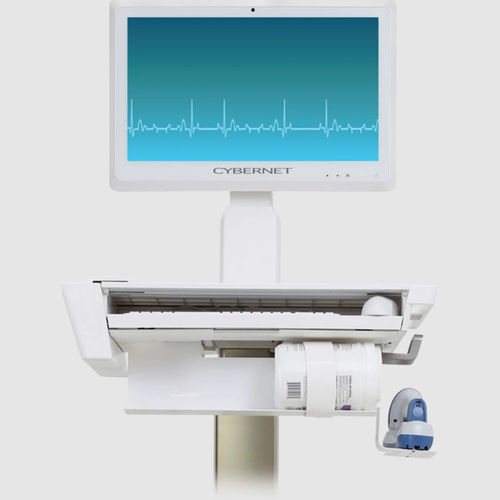
Healthcare providers often use medical computers mounted on carts for EMR access and charting duties. There are two computer-cart configurations available for this task: a normal computer mounted on a powered cart, or an unpowered cart paired with a battery-powered computer. Between the two, battery-powered medical computers are far more affordable.
Upfront Cost Comparison: Battery-Powered PCs vs Powered Carts
Right out of the gate, battery-powered computers and unpowered carts are more affordable than powered carts. On average, a battery-powered cart and unpowered cart combination costs $3,500 less than a powered cart. When multiplied by the dozens, perhaps hundreds, of units that a hospital must acquire to equip all of its wards, this can lead to hundreds of thousands or millions of dollars in savings.
Why Hot-Swappable Batteries Last Longer and Cost Less Over Time
Another key advantage of hot-swappable batteries is that they degrade much more slowly than cart-mounted batteries. The lithium-ion batteries in a battery-powered computer start with a 21-hour charge and begin to degrade after roughly 300 charge cycles. A powered cart’s battery lasts only 8 hours and degrades at a similar rate.
Because the powered cart’s battery drains faster, it must be recharged more frequently, accelerating its degradation. This means that cart batteries lose their effectiveness much faster than a battery-powered computer’s batteries, meaning they must be replaced sooner.
Hot-Swappable Batteries are Cheaper to Replace
Lastly, when it comes time to replace your batteries, smaller hot-swappable batteries are much cheaper to purchase. Hot-swappable batteries cost around $100-$300 per unit, compared to the $2,000 for a powered cart battery. Even if you were to purchase three hot-swappable batteries for every cart battery, that’s a savings of over $1000 per cart.
Reducing Maintenance Costs with Durable, 24/7 Medical Computers
Medical-grade computers operate under extremely demanding conditions, especially compared to consumer-grade models. The design choices that go into making medical computers more reliable also make them more affordable in the long run.
24/7 Operations For Constant Support
Patients in a hospital often need 24/7 monitoring, especially if they are in critical condition and might require a provider’s attention at a moment’s notice. Medical computers, such as medical box PCs, are engineered with fanless cooling, solid-state drives, and low-power-consumption components that maximize their ability to function without pause.
All of these design features also greatly enhance the computer’s reliability, reducing the likelihood of a breakdown requiring expensive repairs or replacement, and saving money in the long run.
Higher Mean Times Between Failure Means Fewer Replacements
The higher degree of engineering and design ensures that medical-grade computers have an extremely high mean time between failures (MTBF). MTBF indicates how often a computer encounters a glitch or mechanical breakdown that causes it to fail and require attention or repairs.
Medical-grade computers average 50,000 hours between failures, while most high-end consumer-grade computers average 20,000 - 30,000 hours between failures. This is even more impressive when you consider that most commercial computers do not operate 24/7 the way medical devices do. Fewer failures mean fewer repairs or replacements needed, meaning a higher ROI on your initial investment.
Cybernet’s Cost-Effective Medical Computing Solutions
Purpose-built medical computers are not only effective but also economical. Their design decisions help save money during the initial procurement and over years of deployment and usage.
If you’d like to learn more about the financial benefits of medical computers, you can read more about it, or contact our team to discuss with our experts how our solutions can benefit your hospital or practice.