#Product Trends
The Roles and Advantages of QR Codes in Healthcare
QR codes used in healthcare can help simplify inventory management and enhance public outreach efforts, ultimately creating a more informed populace.
Asset management and tracking are critical responsibilities in healthcare, as providers need to be able to access tools and consumables quickly and reliably. At the same time, healthcare providers need a way to easily share information, both with other providers as well as patients and the general public.
What if there were a technology that could do both of these things? By using QR codes in healthcare, the sector can achieve both of these objectives.
What Are QR Codes?
A Quick Response (QR) code is a two-dimensional barcode that stores information as black and white pixels within a square grid. When a device scans the QR code, it reads the information stored within it. This information could be a package's shipping instructions, a phone number, a website URL, or numerous other options.
QR codes were originally created in 1994 by the Japanese company Denso Wave, a subsidiary of Toyota. Denso Wave needed a method for tracking automobile parts that was more accurate than conventional barcodes. This is because barcodes can only be read from top to bottom, and can only store a limited amount of information. QR codes, on the other hand, can be read both top to bottom and left to right, and can store far more data. A QR code can store up to 4,000 characters of text, substantially more than conventional barcodes.
QR codes are an increasingly popular alternative to barcodes thanks to their depth of information. Logistics and shipping companies use them for package management, but QR codes are widely used in other industries. Modern smartphones with built-in cameras can read QR codes, making them a great way to deliver info to customers. For instance, a restaurant can print QR codes and place them on tables for customers to scan and access the menu, rather than hand out physical copies.
QR Code Use in Healthcare
QR codes have two major uses in healthcare: asset tracking and information sharing.
Inventory Management and Equipment Tracking
Healthcare relies heavily on consumable items such as medication, IV bags, blood thinners, and more. Providers typically rely on barcodes to track their usage. For example, a nurse will scan the label on a medication bottle with their medical computer's built-in scanner or tablet to verify that it is the correct medication and dosage.
Because QR codes can contain more information than barcodes, they can be more precise about a medication’s contents. This, in turn, helps prevent medical errors by assisting providers in identifying potential adverse interactions between different medications.
QR codes can also be used to track the expenditure of consumable items such as bandages and drugs. This provides hospitals with greater insight into their usage of a particular item and the frequency of supply replenishment. Asset tracking also becomes easier, as providers can scan QR codes to check out equipment such as X-ray machines and patient monitors.
Patient Tracking and Check-In
Whenever patients arrive at a clinic or hospital for an appointment, they often undergo a lengthy process of signing in and filling out paperwork to verify their identity. To avoid this, they can simply be issued an ID card with a QR code, which can be scanned at a patient kiosk. This card carries all of their critical identifying information and alerts providers that the patient has arrived, without requiring a receptionist’s time.
Public Engagement and Education
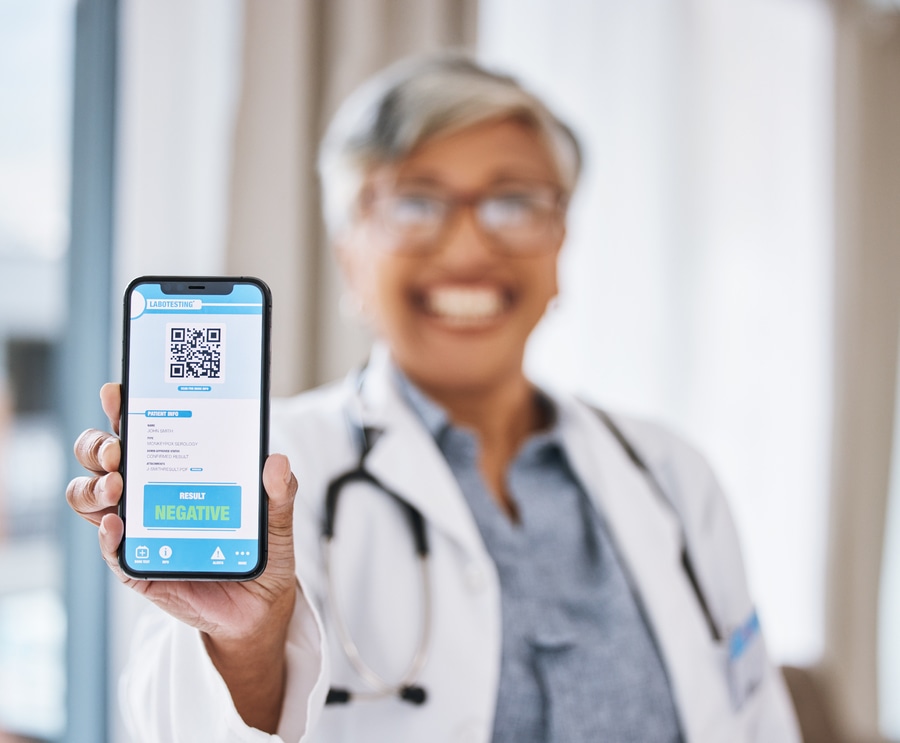
With an estimated 91% of all Americans owning a smartphone capable of reading QR codes, the healthcare sector has a massive opportunity to meet patients on a platform they’re comfortable with. Rather than hand a patient information files on their condition, they can have the patient scan a QR code with a link leading to a website hosting that info.
Similar techniques can be used to enhance presentations and public outreach. For instance, hospitals and clinics can utilize QR codes in their reception areas to provide information on pressing topics or public health issues. Presenters at health conferences can even embed QR codes in banners or within their presentations to link to specific videos related to their topic.
Benefits of QR Codes in Healthcare
By implementing QR codes in healthcare, the sector can reap numerous benefits for both patients and providers. The most immediate benefits of adoption are:
Better Inventory Management
The ability to manage inventory and track equipment is absolutely essential for a hospital. Without critical supplies such as the correct blood type or drugs, a patient’s life is at risk. Without QR code-based tracking, hospitals must rely on paper records, which can easily be misplaced, damaged, or simply left incomplete. Scanning QR codes, on the other hand, is easy, can be done while retrieving the supplies in question, and updates electronic records that are more reliable than pen and paper.
Better-Informed Patients
Keeping patients informed of their condition and treatment plan is a cornerstone for building trust between them and their providers. By using QR codes to enable easier access to informative material, providers can meet patients on their own terms, with information that is easily accessible at any time.
Accessible Education
Accessibility is also a critical factor in public outreach and education. With the spread of misinformation becoming increasingly problematic, especially in the healthcare sector, providers and educators need resources that are convenient and intuitive for their intended audience. By making information readily available and easily accessible, educators can help ensure the general populace isn’t misled.
Challenges for QR Code Use in Healthcare
While implementing QR codes in healthcare is relatively easy, there are still some factors you need to consider before making the transition.
Hardware Support
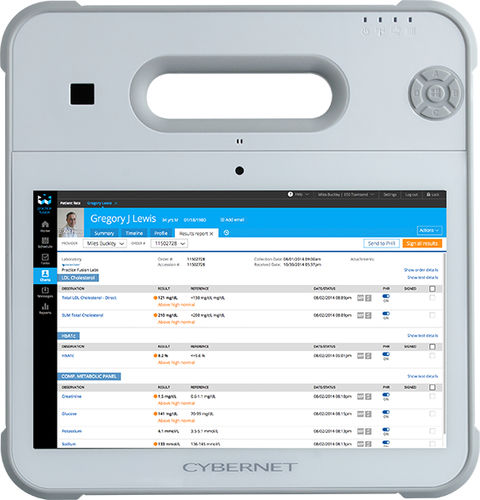
Obviously, using QR codes requires having hardware that can support them. Fortunately, QR codes are extremely easy to implement. Any modern medical tablet or computer with a built-in camera can scan QR codes, and virtually any printer with available ink can print them. This means that, as far as technology is concerned, QR codes are among the easiest to support.
Training and Implementation
Another concern with using new tools or resources is the time required to train and implement them. Again, QR codes are a nearly painless experience. Any workforce familiar with scanning barcodes is likely to know how to use QR codes, and the same techniques and workflows for using barcodes can also be applied to QR codes. Adding QR codes to equipment or a waiting area is a straightforward process that involves printing them, laminating the paper, and attaching them to the appropriate device or wall.
Cybersecurity
Sharing information via the Internet always carries the risk of malicious actors attempting to intercept or steal private data. If you decide to use QR codes in patient-facing roles, regularly check and make sure that your codes haven’t been stolen or replaced by ones leading to suspicious websites. This is a common tactic used by cybercriminals, and must be closely monitored against.
QR-Code Ready Computers and Tablets from Cybernet Manufacturing
The use of QR codes in healthcare is most likely a question of when, not if. Their ease of use and accessibility make them the ideal choice for any healthcare group seeking a straightforward way to manage inventories and communicate with patients.
If you’re interested in integrating QR codes into your workflow and need medical computers and tablets that can support this effort, contact the team at Cybernet Manufacturing. We’d be happy to explain how our products can help you utilize QR codes more effectively.