
#Product Trends
How to Choose Endoscope Equipment for Veterinary Surgery
How to Choose Endoscope Equipment for Veterinary Surgery
How to Choose Endoscope Equipment for Veterinary Surgery
Choosing endoscope equipment for veterinary surgery is rarely a one-line decision. The right system depends on what you actually do in the room, which patients you see most often, how far you want your endoscopy service to grow, and whether your team needs a compact, integrated workflow or a broader premium setup with more expansion headroom.
Some clinics buy around image quality alone and regret the channel size later. Others focus on price and discover that the scope diameter or working length limits their caseload. A few end up with equipment that looks impressive but feels awkward in real procedures. That happens more often than people admit. A better approach is to think like a clinician and a buyer at the same time.
Quick Answer: What Should You Look at First?
If you want the short version before the deep dive, start here:
Procedure Type: Upper GI, lower GI, biopsy, foreign body retrieval, or mixed endoscopy work.
Patient Size: Cats and small dogs need different scope logic than larger dogs.
Scope Diameter: Too large cuts you out of smaller cases; too small can reduce versatility.
Working Length: Especially important if you plan to reach deeper in larger dogs.
Working Channel: Critical if you want meaningful biopsy and accessory use.
Angulation and Handle Ergonomics: A scope that feels clumsy will slow every case down.
Tower Workflow: Monitor, light source, air/water, image processor, and storage all matter.
Support and Downtime: Warranty, training, repair speed, and loaner availability should not be afterthoughts.
1) Start with the Procedures, Not the Brochure
Before comparing brands, define what your veterinary surgery team actually needs the system to do. If your service is mostly gastroscopy, biopsy, and foreign body retrieval, then a flexible veterinary endoscope will be the center of the decision. If you also plan to do lower GI work, scope length and channel size become even more important. If your hospital performs broader minimally invasive work, you may end up evaluating both rigid and flexible platforms together.
That distinction matters. Flexible endoscopes are typically preferred for GI navigation. Rigid scopes remain useful for selected body cavities and specific indications, but they do not replace a true flexible GI endoscopy system. So ask the blunt question early: Are we buying for occasional diagnostics, or are we building a reliable veterinary endoscopy service line? Those are not the same purchase.
2) Scope Diameter Decides Who You Can Treat Comfortably
Diameter is not just a number on a specification sheet. It determines access, handling, patient fit, and how broadly the system can be used. Veterinary guidance has long suggested that a gastroscope under 9 mm is practical for many canine and feline patients. Separate GI guidance has also recommended choosing the largest diameter the patient can reasonably accommodate, because larger scopes may offer stronger handling and better accessory capability. Both statements are true, which is why buying a single “one size fits all” scope often becomes a compromise.
Practical Diameter Logic
Cats and Small Dogs: A slimmer insertion tube is preferred. This allows for easier passage and broader clinical usability across smaller patients.
Medium Dogs: A mid-size flexible scope often works well here. It strikes an ideal balance between patient access and working capability.
Large Dogs / Broader GI Service: A larger-diameter option is typically preferred. It significantly improves scope handling and often supports larger accessory pathways.
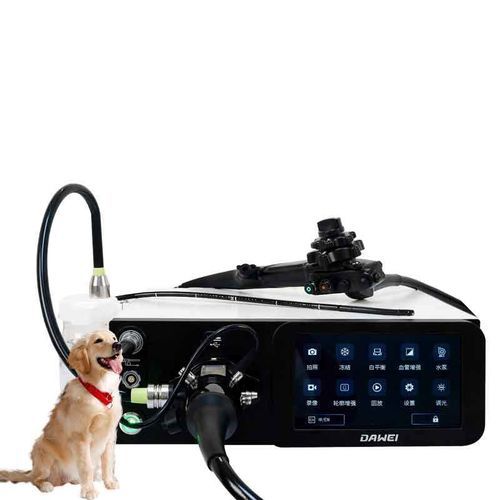
For clinics serving mixed companion-animal caseloads, a platform with more than one scope size often makes far more sense than trying to force every case through one diameter. This is one reason systems such as the AEG 200 Veterinary Endoscopy System can be practical in daily use: the availability of 6.0 mm and 8.8 mm gastroscope options gives hospitals a more flexible way to match equipment to patient size.
3) Working Length Becomes a Real Issue Faster Than Expected
Working length sounds technical until a bigger dog is on the table and you realize the scope you bought is simply not enough. Published veterinary references commonly place flexible endoscope working lengths in a broad range from roughly 55 cm to 170 cm, with many GI scopes falling between 100 cm and 170 cm. For large- and giant-breed dogs, lower GI guidance has noted that at least 140 cm may be needed to evaluate the ascending colon, cecum, or ileum. This should immediately change how you think about purchasing.
Working Length Guide
Routine Upper GI in Many Dogs and Cats: A length of 100–140 cm often covers common clinical needs.
Broader Upper GI Versatility: Opting for a longer scope adds vital procedural flexibility.
Large-Dog Lower GI Evaluation: A length of 140 cm or more may be necessary to complete the exam.
Growth-Focused Hospital: The baseline mindset should be to buy for tomorrow’s cases, not only today’s routine cases.
If your team plans to expand into more advanced or deeper GI work, under-buying on length is one of the easiest ways to limit your practice.
4) The Working Channel Matters More Than the Image Quality You Fall in Love With
This is where many purchases go sideways. A beautiful image can impress at a demo, but a cramped channel frustrates you every single week. The working channel determines what instruments can be passed through the scope, including biopsy forceps, retrieval tools, and other accessories. Guidance from veterinary GI sources has repeatedly emphasized that a channel of 2.8 mm or greater is highly desirable when meaningful biopsy work is part of the plan.
Working Channel Size Guide
Smaller Channels: May work fine for lighter-duty use or smaller cases, but they strictly limit accessory flexibility.
Around 2.8 mm: This represents a strong, practical target for the vast majority of biopsy and retrieval workflows.
Larger Channel Configurations: Provides much more room for accessory confidence, especially in bigger patients.
In other words, channel size is not a minor detail—it is a strategic choice. A system that pairs a smaller-diameter scope for narrower patients with a larger-channel option for bigger or more instrument-heavy work gives a hospital more freedom. That is why a 6.0 mm / 2.0 mm and 8.8 mm / 2.8 mm pairing is clinically easier to defend than a one-scope-only compromise.
5) Angulation and Handle Comfort Will Shape Every Procedure
A scope can have sharp imaging and still be annoying to use. That annoyance adds up over time. Flexible GI work depends on controlled tip deflection, smooth steering, stable visualization, and handle ergonomics that do not force awkward hand movements.
Four-way angulation remains a practical baseline, and the handle should feel intuitive. Control buttons should be placed where a clinician can reach them under pressure without breaking procedural flow. This includes:
Image freeze
Photo / video capture
Brightness adjustment
White balance
Zoom or image enhancement controls
A scope that feels right in the hand tends to get used with more confidence. Conversely, a scope that feels slightly off tends to expose that weakness in difficult clinical moments rather than easy ones.
6) Image Quality is More Than Resolution
People love to ask whether a veterinary endoscopy system is HD. Fair enough. But resolution is only one piece of the picture. Clinical image quality also depends heavily on:
Illumination stability
White balance behaviorBrightness adjustment
Image enhancement
Monitor output quality
How well the lens stays usable when irrigation is needed
You are not buying a television; you are buying clinical decision support. Clear mucosal detail, edge definition, vascular visibility, and dependable performance in less-than-perfect views matter more than a simple spec headline. In real use, the better question is this: Can the system keep the image clinically useful when the case is messy, not only when the demo is clean?
7) Buy the Tower, Not Only the Scope
A veterinary endoscopy system is not a scope floating in space; it is an operating ecosystem. If the monitor, host unit, light source, air pump, irrigation pathway, suction logic, image storage, and accessory compatibility do not work together smoothly, the whole room feels it.
What to Evaluate in the Full System
Monitor: Look for a clear image, good visibility, and reliable output signal.
Processor / Host Unit: Needs to deliver stable imaging, intuitive controls, and a dependable response.
Light Source: Must provide consistent illumination without fighting the operator for manual adjustments.
Air / Water / Suction: Must be practical, easily testable, and completely reliable during live procedures.
Recording / Storage: Look for a simple, streamlined capture and playback workflow.
Handle Design: Requires a natural grip and easy button access under standard working positions.
Cleaning Workflow: Must be practical for real-world staff under busy clinic schedules, not just ideal laboratory conditions.
This is where integrated systems often become highly attractive. A unit that combines core functions into a cleaner operational platform can significantly reduce setup friction and the staff training burden. That makes a meaningful difference in busy hospitals that do not want a room full of loosely connected boxes and tangled adapters.
8) Brand Comparison: What Buyers Usually Weigh
Not every hospital shops the same way, but the comparison conversation often circles around a few familiar groups: legacy premium brands, practical mid-market systems, and value-oriented platforms. Below is a simplified comparison framework to use as a buying lens.
Brand Ecosystem Overview
KARL STORZ: Perceived as a premium legacy brand. Buyers frequently note its stellar reputation, established ecosystem, and broad professional familiarity. The primary buying caution is its higher budget threshold and premium pricing logic.
VetOvation: Recognized as a practical, veterinary-focused option. Its key strengths include accessibility, highly flexible system offerings, and broad clinical relevance to veterinary practice. Buyers should note that configuration decisions still require close attention to ensure a correct fit.
Eickemeyer / Similar Integrated Systems: Highly regarded for multi-use and mobile workflow appeal. Strengths include general ease of use, bundled logic, and broader clinical coverage in specific setups. The main caution is that buyers must double-check the exact scope compatibility and workflow fit for their specific needs.
Mid-Market Integrated Systems (e.g., AEG 200): Perceived as a balanced choice combining clinical utility with highly accessible system logic. Noted strengths include an integrated workflow, multiple scope size options, and a highly practical feature set. The main buying caution is that users should still closely compare service, support, and long-term platform fit.
This is where the conversation should stay grounded. A premium brand may be the right answer for one hospital and an unnecessary financial overreach for another. A mid-market system may be the smartest choice for a clinic that wants reliable GI capability, manageable workflow, and room to grow without overspending on prestige alone.
9) What About Price?
Yes, price matters. The problem is that veterinary endoscopy pricing is often fragmented in public channels, as many manufacturers do not publish complete system pricing in a standardized way. Still, publicly visible listings and market commentary can give buyers a rough directional sense.
Publicly Visible Pricing Signals
Low-Thousands Range: Some individual accessory or partial flexible endoscope listings appear here, but be aware that these listings rarely represent a complete endoscopy tower.
Around $28,500: Complete veterinary flexible endoscopy systems can publicly list around this mark in certain online channels, proving that complete packages cost far more than a single accessory.
$7,000 to $30,000+ Range: Vendor market commentary suggests most veterinary endoscopy purchases broadly fall into this bracket depending heavily on scope type, inclusions, and configuration. Real-world cost depends on whether you are buying a complete tower, a scope only, pre-owned equipment, or a bundled package.
When comparing prices, ensure you are comparing the exact same scope of supply—do not mistake an individual accessory listing or a pre-owned scope for a complete tower with a monitor and processor .
Budget Tier Framework
Entry / Limited-Use Budget: Offers a narrower application range, fewer integrated features, and potential compromises in channel size or workflow ergonomics.
Mid-Market Budget: The best balance for many hospitals, offering highly usable imaging, practical tower logic, and clinically relevant scope choices. (For instance, the DAWEI AEG-200 system fits comfortably here, offering a comprehensive setup in the $3,200 to $6,000 price range, complete with a solid 2-year warranty).
Premium Budget: Delivers a strong brand reputation, a broader corporate ecosystem, and advanced upgrade paths, but carries a much higher acquisition cost.
The smartest buyers do not simply ask, "What is the cheapest veterinary endoscope?" They ask, "What system gives us the best clinical return for the next three to five years?"
10) A Structured Buying Checklist
Here is a clean checklist way to evaluate an endoscopy system before signing any purchase order.
What procedures will this system support in year one? (Why it matters: Prevents overbuying or underbuying equipment relative to true skills).
What patient sizes dominate our caseload? (Why it matters: Directly drives your diameter and length logic).
Is the channel large enough for our biopsy and retrieval work? (Why it matters: Protects the long-term clinical usefulness of the asset).
Is the scope easy to steer and comfortable to hold? (Why it matters: Has a direct, daily impact on your procedure workflow).
Are the monitor, processor, and controls intuitive? (Why it matters: Directly affects procedural speed, staff training, and clinical consistency).
How hard is it to clean, store, and maintain? (Why it matters: Impacts daily adoption and compliance by your nursing staff).
What warranty and service terms are offered? (Why it matters: Crucially reduces downtime and financial risk).
Is there loaner support if the scope goes down? (Why it matters: Protects the hospital's continuity of care and revenue stream).
11) Where a System Like the AEG 200 Fits Naturally
A system does not need to be oversold to belong in the conversation. If a veterinary hospital is looking for an endoscopy system that offers:
High-definition imaging
Integrated host unit workflow
Practical, responsive handle controls
IP67-rated insertion tube construction
Multiple gastroscope size options (e.g., 6.0 mm and 8.8 mm)
A tower setup that makes clinical sense for both small animal and large breed GI work
Then the AEG 200 Veterinary Endoscopy System fits naturally into a shortlist discussion. "Shortlist" is the key word here. It does not need dramatic marketing claims; it only needs to answer a fair clinical question: Does this platform match our caseload, our budget range, and the way our team actually works ? If the answer is yes, then it deserves serious attention.
Final Thought
The best endoscope equipment for veterinary surgery is not the one that looks most impressive in a glossy product flyer. It is the one that keeps proving useful once the room is busy, the patient is not straightforward, and the team needs clear imaging, reliable control, and tools that actually fit the job.
Choose for the cases you do every week. Choose for the service you want to build next. And choose with enough discipline to compare the scope, the tower, the accessories, the workflow, and the support as one single clinical system rather than as a stack of unrelated boxes.