
#Product Trends
Compact Brilliance: The Mini LED Examination Light Nanchang Micare Medical Equipment Co., Ltd.
Where Performance Meets Proportion
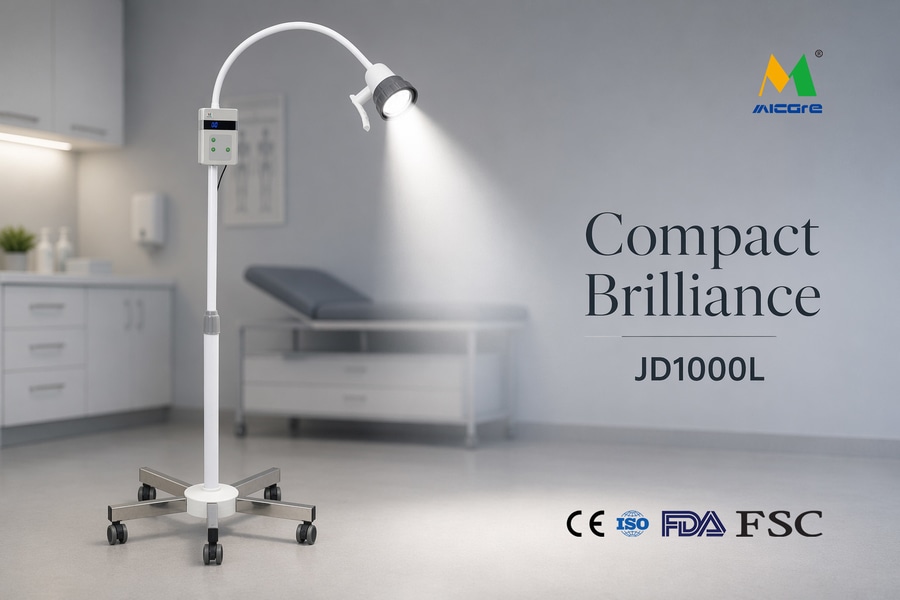
In clinical environments where examination rooms grow tighter and mobility defines workflow, the performance benchmark for a medical examination light is no longer raw output alone — it is the ratio of illumination quality to physical footprint. Micare's Mini LED Examination Light reflects a deliberate engineering choice: deliver diagnostic-grade lighting from a platform compact enough to move between consultation bays, yet stable enough to hold position without drift during extended procedures.
Illumination Performance
At the core of the device is a 7-LED array delivering a colour rendering index of Ra ≥ 90 across a neutral 4,300 K colour temperature — a spectral profile calibrated for accurate tissue discrimination, which is fundamental to dermatological inspection, wound assessment, and minor surgical visualisation.
Light intensity is measured at three clinically relevant working distances:
Distance Illuminance (Max) Light Field Diameter
30 cm 90,000 Lux Φ 10 cm
50 cm 60,000 Lux Φ 19 cm
100 cm 30,000 Lux Φ 35 cm
The figures describe a light field that transitions from tightly focused high-acuity examination at close range to broader procedural coverage at extended distance — a single mobile examination lamp serving two distinct clinical patterns without accessory changes.
Mechanical Design
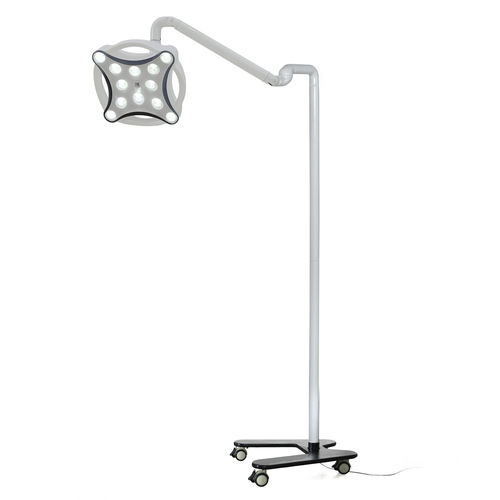
The stand structure follows a principle common to well-executed hospital examination lighting: the base must anchor the light head, not the other way around. A five-leg stainless steel base (520 × 520 × 100 mm) fitted with braked castors provides the mass and geometry to stabilise a maximum stand height of 1,815 mm. The 570 mm gooseneck arm offers single-handed repositioning with retention at any angle — a characteristic that distinguishes a clinical diagnostic light from a generic task lamp.
The light head itself measures 110 × 100 mm, housing the LED array behind a clear lens with an integrated positioning handle. Total assembled weight and the 15 W lamp power rating place the unit firmly in the category of an energy-efficient LED examination lamp: minimal heat at the head, no bulb replacement cycle, and a rated LED service life of 50,000 hours.
Control and Power Configuration
Two switch options are offered. The standard configuration uses a rotary knob control with integrated LED indicator. An optional digital control panel — featuring a blue LED readout and four tactile buttons — provides stepped intensity adjustment, allowing clinicians to match illumination precisely to the procedure rather than accepting a binary on/off state. This level of adjustability matters in settings where the same portable LED examination light may transition from a high-acuity ENT consultation to ambient-level gynaecological examination within a single shift.
Input power accepts a wide voltage range of 95–245 V at 50/60 Hz, making the device compatible with electrical infrastructure across most markets without external transformers. For facilities where uninterrupted examination lighting is critical, a 2-hour battery backup module is available as an optional upgrade, effectively converting the unit into a rechargeable examination light suitable for settings with unstable mains supply or mobile clinic deployments.
Material Selection and Infection Control
The primary construction pairs stainless steel with medical-grade polymer — a material combination selected for its balance of structural rigidity, corrosion resistance, and compatibility with standard clinical surface disinfection protocols. Sealed surfaces with minimal seam exposure reduce contamination catch points, a practical consideration for any adjustable examination light deployed across multiple patient encounters per hour.
Positioning in Clinical Practice
This device sits at the intersection of several overlapping product categories. It performs the function of a surgical examination light in minor procedure and wound care settings; it serves as an outpatient examination lamp in general practice and triage; and its mobile form factor qualifies it as a portable clinical examination light for ward rounds and bedside assessment. The common thread across these applications is the requirement for dependable, repositionable illumination that does not compete with the clinician for physical space.
Manufacturing Context
The Mini LED Examination Light is produced under Micare's ISO 13485-certified quality management system at the company's Nanchang, Jiangxi Province facility. Micare's vertically integrated manufacturing model — encompassing R&D, component fabrication, assembly, and final inspection within a single production campus — provides direct traceability from incoming materials to finished device, a structure that aligns with the documentation expectations of institutional procurement and group purchasing organisations.
Nanchang Micare Medical Equipment Co., Ltd.
Website: www.micare.cn
Email: [email protected]