
#Product Trends
Single vs Double Dome Surgical Lights: Which Configuration Fits Your OR?
Choosing between single and double dome surgical lights should follow your clinical workload — not the brochure. Here is the room-by-room decision framework, with the compliance checks (IEC 60601-2-41, EU MDR 2017/745) every buyer should run before s
Picture the moment: the OR is gutted, the ceiling survey is done, and the procurement file has one empty line left — the surgical light. A salesperson shows you a double-dome luminaire and says every serious hospital buys two heads. Another says modern single-head LED units outperform what a double head did five years ago. Both statements contain a grain of truth, which is exactly why so many buyers choose wrong: they buy the configuration, not the requirement.
This guide lays out the decision logic between single and double dome (double head) surgical lights — what each configuration genuinely solves, where it wastes money, and how to match the choice to your rooms rather than to marketing.
What a double head actually solves
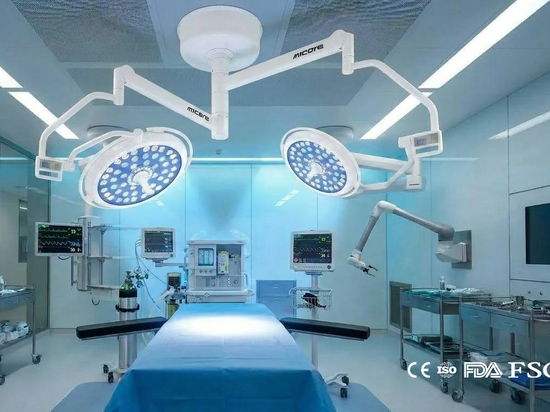
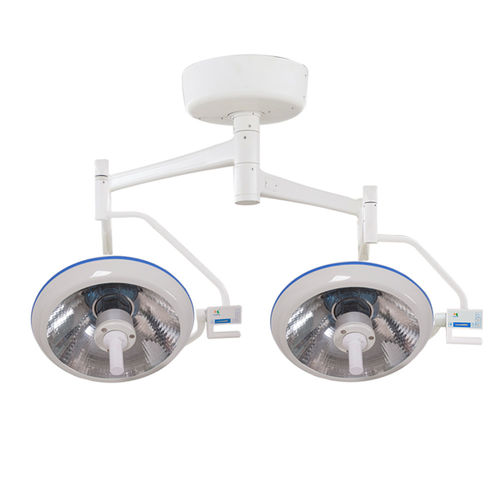
A double-dome surgical light is two lamp heads, usually mounted on one central arm, aimed at the same or adjacent surgical fields. It exists to solve four specific problems:
Shadow redundancy. In long, deep or heavily instrumented procedures, a single head gets blocked by hands, heads and equipment. Two heads approaching from different angles mean one beam usually keeps the field lit — this is the strongest clinical argument, not brightness.
Two fields, one room. Certain procedures need two working areas simultaneously — a harvest site and a recipient site in reconstructive work, for example. Two independently adjustable heads serve both without repositioning the patient or the light.
Two teams, two approaches. In major joint or trauma cases, the surgeon and the assistant may work from opposite sides. Individual head control lets each side have its own light.
Continuity when a head fails. If one head unit faults mid-list, the second keeps the case going while the first is swapped. For a single-OR facility that cannot afford downtime, this redundancy has real value.
None of these benefits is imaginary. The question is whether they describe your workload, because the same reasons that justify a double head in a university hospital quietly vanish in a day-surgery unit.
When a single head is the better engineering answer
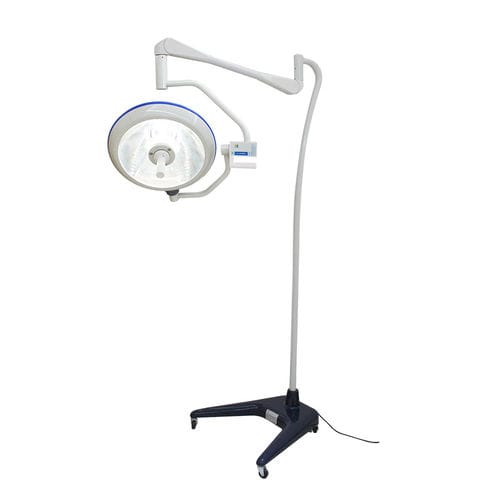
Modern single-head LED surgical lights have closed most of the performance gap that once pushed buyers toward double domes:
Deep cavity illumination. Current LED optics deliver strong depth of illumination — the ability to keep a usable field as the light-to-wound distance grows — which was the classic weakness of old single-head halogen units. A high-end single head today handles a surprising share of general and orthopaedic work.
Lower acquisition cost. Roughly speaking, you pay for a second head, a second control system and a heavier arm. A single-head budget buys a better single head — higher colour rendering, wider dimming range, better optics — rather than two average ones.
Less to maintain, less to sterilise. Two heads mean two sets of handles, two glass surfaces, two modules to clean and eventually service. In a small room these multiply the daily workload for zero clinical return.
Cleaner ceiling integration. One head, one arm, less visual and physical clutter above the team — a real consideration in compact ORs.
The honest summary: a single head is the right answer for most day-surgery, ophthalmology, ENT, urology and minor-procedure rooms. A double head earns its cost in general/major surgery suites, trauma-capable ORs, and facilities where the room is the only OR and cannot be taken offline.
A practical way to decide, room by room
Instead of comparing brochures, walk each room through four questions:
What is the deepest or longest procedure performed here? If the answer includes major abdominal, orthopaedic trauma or reconstructive work with heavy instrument traffic, shadow redundancy starts to matter. If the list is cataract surgery, scopes, or procedures under 90 minutes, a single head covers it.
How many people work around the field? Two surgeons or a surgeon-plus-assistant operating from opposite sides is a double-head signal. A solo operator with an instrument nurse is not.
Is this the only OR in the building? For a single-OR facility — clinic, day-surgery centre, small hospital — the continuity argument for two heads is genuinely stronger, because a head failure mid-list means cancelling the only operating room you have. Here the double head acts as insurance, and insurance has a price worth paying.
Can the room take the load? Two heads on a full arm assembly weigh more, and the ceiling structure must be verified before you specify. If the ceiling survey says no, the debate is settled regardless of preference.
One more recommendation we give every buyer: do not buy a double head hoping to use the second head "later for another room". These units are not designed to be separated across rooms, and the second head left angled at the wall for three years is the most expensive ornament in the building.
What to compare when the two configurations look equal
Whichever configuration you land on, judge shortlisted models on the same optical core:
Central illuminance and dimming range. A useful working range around 40,000–100,000 lx, with maximums up to roughly 160,000 lx on premium units, and stable dimming without colour drift.
Colour rendering (Ra). Look for Ra 90+ at minimum; 95–99 on premium models. Tissue discrimination depends on it.
Colour temperature. Fixed or selectable in the approximate 3,500–5,000 K band; selectable CCT earns its premium in multi-specialty rooms.
Depth of illumination and spot control. The parameters that determine whether the light keeps working in a deep field — ask the supplier to demonstrate, not just state them.
Compliance documentation. IEC 60601-2-41 test report (the surgical luminaire standard), CE marking under EU MDR 2017/745 with Declaration of Conformity, ISO 13485 certification, and — for US projects — FDA registration evidence, remembering that facility registration is not the same as device clearance.
FAQ
Q: Is a double-dome light twice as bright as a single dome?
A: No. Both heads are usually aimed at the same field, and the luminaire's output is still managed to safe, comfortable working levels. The value of the second head is redundancy and angle coverage, not raw brightness.
Q: Is a double head suitable for a small operating room?
A: Only if the room hosts procedures that genuinely need two angles or two fields. In a compact room doing scopes or minor surgery, a double head adds clutter and cost without clinical benefit.
Q: Can one single-head LED light handle deep cavity work?
A: Modern single-head units with strong depth of illumination handle a large share of general surgery. The limits appear in long, instrument-heavy cases where beam obstruction becomes routine — that is when a second angle earns its keep.
Q: Can the two heads of a double-dome unit be used independently for two different rooms?
A: No — they share one mounting arm and control system. If you need two rooms covered, buy two single-head units; that is usually the better value anyway.
Q: I have a limited budget. What should I not compromise on?
A: Colour rendering (Ra 90+), a genuine dimming range, and compliance documentation. Configuration (single vs double) is a workload decision; these three are quality decisions you cannot retrofit later.
Q: Can I add a second head later if my case mix changes?
A: In most installations, no — the arm, controls and ceiling mount are specified for the initial configuration. Choose based on a realistic five-year workload forecast, not today's list alone.
The single-versus-double decision is not about prestige or brightness; it is about matching redundancy and angles to the procedures your rooms actually run. Count the teams, measure the ceiling, forecast the workload — and let the configuration follow the clinical need.
Micare builds both configurations. The MAX-LED double-head surgical light — 160,000 lx LED engine, Ra 99 colour rendering, five selectable colour temperature levels — is a reference point for what a current-generation double-dome unit should state on paper, and our engineers will help you work out which configuration your room survey supports before you spend a single dollar.
Micare Medical Engineering Team