
#Product Trends
Micare Galaxy-LED E700 Series Surgical Light: Technical Specifications
Verified specifications, compliance documentation, and configuration guide for hospital and clinic procurement teams
Author: Micare Medical Engineering Team | Published: August 24, 2026
Product Overview
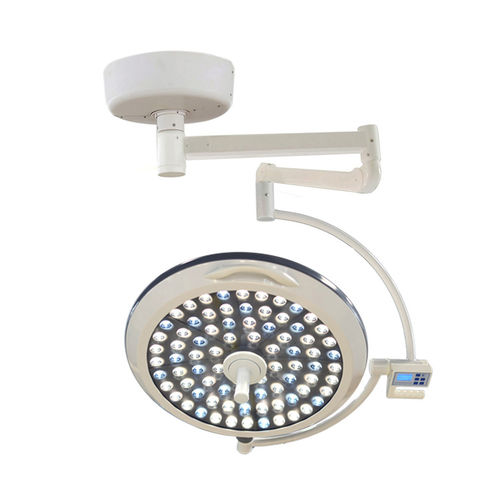
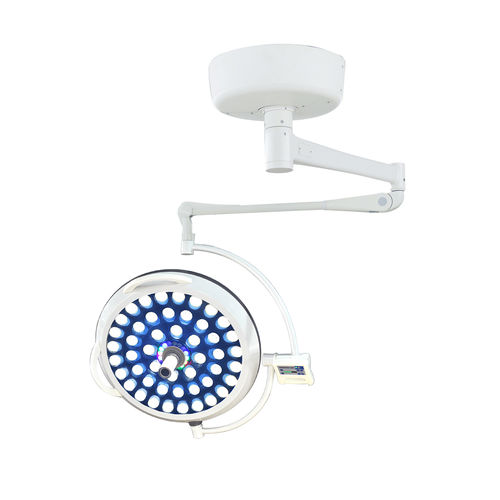
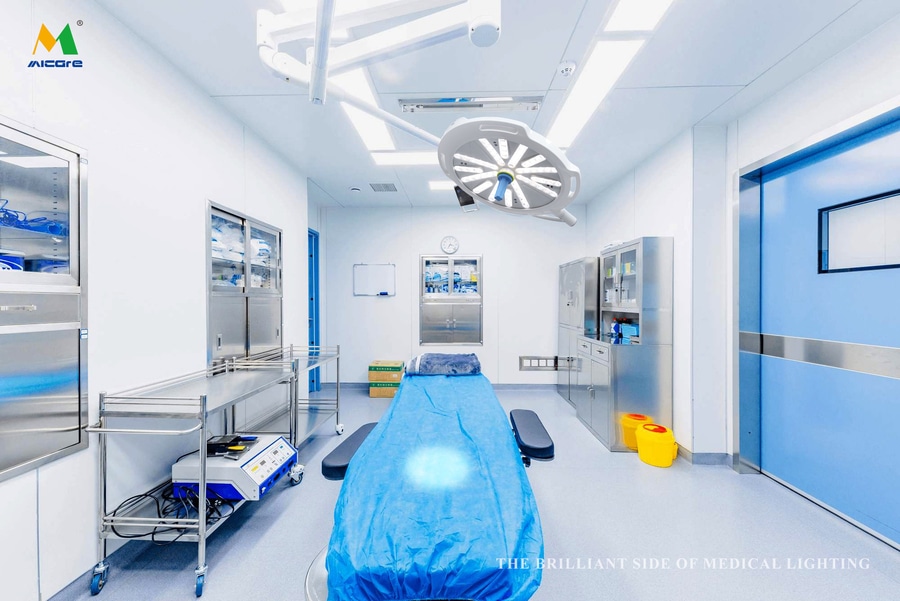
The E700 is a single-dome LED surgical luminaire built for general surgery, orthopedics, cardiac, and gynecology operating rooms. It is designed to run through 4–8 hour procedures without thermal drift, shadow buildup, or the colour fatigue that comes from poorly balanced LED arrays.
Manufactured at Micare Medical's ISO 13485:2016 certified facility in Nanchang, China. CE marked under EU Medical Device Regulation 2017/745.
Core Technical Specifications
Both the E700 (single dome) and E700/700 (dual dome) share the same core electrical and optical parameters. Working voltage is 95V–245V at 50/60 Hz, making both models compatible with hospital power infrastructure worldwide without adaptation.
Each lamp head is 740 mm in diameter and houses 72 LEDs. The E700 carries a single head; the E700/700 runs two independently positioned heads from the same arm system, each with its own 72-LED array.
Central illuminance (E₀) is measured at 1 m per IEC 60601-2-41 and runs adjustable from 40,000 to 160,000 lux on the single dome, and 40,000 to 160,000 lux per dome on the dual configuration. Light intensity control covers the full 10–100% range on both models.
Color rendering is Ra/R9/R13 = 99/99/99 on both configurations, verified by third-party test per IEC 60601-2-41. Color temperature is surgeon-selectable across five fixed steps: 3,500K, 4,000K, 4,500K, 5,000K, and 5,500K.
The adjustable light field size runs from 140 mm to 350 mm diameter per dome. LED lifespan is rated at 80,000 hours on both models.
Each dome includes a dedicated endoscopy ambient LED cluster — White + Yellow Remix, 8 PCS — which operates at 10% intensity in Endo mode to provide compatible ambient fill during minimally invasive procedures.
Temperature at the surgeon's head is ≤ 1°C above ambient, verified per IEC 60601-2-41. Illumination depth reaches 1,600 mm at L1+L2 set to 20% output, and 850 mm at 60% output. Protection rating is IP54X per EN 60529 on both configurations.
Lighting Performance
Lux Across the Adjustable Range
Light intensity runs from 10% to 100% of rated output. At full power (100%), the E700 delivers 160,000 lux at 1 m — the upper end of the IEC 60601-2-41 surgical luminaire range, suited to cardiac, thoracic, and neurosurgery. At 75%, output sits around 118,000 lux, which covers general abdominal surgery and orthopedics comfortably. The 50% setting produces approximately 80,000 lux — appropriate for ENT, gynecology, and day surgery cases. At 25%, the light drops to around 40,000 lux, which is where most teams run during wound closure and patient positioning.
The dimmer is continuous across this range with no step artifacts, so the team can fine-tune output during a procedure without jumping between preset values.
Color Temperature — 5 Steps, Surgeon-Selectable
Color temperature can be switched by the surgical team without touching sterile handles or interrupting the procedure. The five available settings cover the clinical range from warm to cool white.
Step 1 at 3,500K is warm white — most teams use this during wound closure or at the end of a case when maximum contrast is no longer needed and patient comfort becomes the priority. Step 2 at 4,000K is neutral warm, suited to general surgery and gynecology. Step 3 at 4,500K is the standard OR default for most procedures, including orthopedics and abdominal surgery. Step 4 at 5,000K moves into neutral cool territory, where tissue contrast improves — this is the preferred setting for cardiac and thoracic work. Step 5 at 5,500K is cool white, used in neurosurgery and fine dissection where maximum structural contrast matters most.
In practice, surgeons often shift between settings mid-case. A common pattern is running at 5,000K during active dissection, then dropping to 4,000K at closure — the colder light is valuable when you need it, and the warmer setting is easier on the team's eyes over time.
Color Rendering: Ra, R9, and R13 — Why All Three Matter
Ra 99 is often treated as a headline figure, but for surgical use the more important number is R9 — the deep red channel that governs how blood and vascular tissue appear.
Standard Ra calculations give R9 relatively low weighting. A light can score Ra 90 overall while R9 sits at 60 or below — which means arterial and venous blood look similar, and tissue viability at margins becomes harder to assess.
The E700 measures and verifies all three indices independently:
Ra (general color rendering): 99
R9 (deep red / saturated blood color): 99
R13 (human skin tone reference): 99
R9 ≥ 95 is the threshold that separates standard clinical lighting from genuinely high-fidelity surgical illumination. The E700 sits at 99 — confirmed by third-party test report, not derived from the general Ra average.
Regulatory Compliance
The E700 carries CE marking under EU MDR 2017/745 (Class IIa) and has been type-tested to IEC 60601-2-41, with the full third-party test report available on request. General electrical safety testing to IEC 60601-1 was conducted by TÜV Rheinland. EMC compliance to IEC 60601-1-2 is verified at Group 1, Class B. The Nanchang manufacturing facility holds ISO 13485:2016 certification for its quality management system. FDA Establishment Registration is active under Reg. No. 3023808059. The product is RoHS 2011/65/EU compliant with no restricted substances.
EU procurement note: Micare holds an EU Authorized Representative appointment under MDR 2017/745 Article 11. Declaration of Conformity, Technical Documentation summary, and EUDAMED UDI registration are available for tender documentation on request.
FDA note: Micare Medical is an FDA-registered facility under 21 CFR Part 807 Establishment Registration. The correct term for procurement documents is "FDA registered" — not "FDA approved" or "FDA cleared," which refer to product-level clearance pathways that do not apply here.
Suspension Arm and Installation
The E700 mounts on a double-articulating ceiling suspension arm built from powder-coated steel with aluminium alloy joints. The arm supports a maximum load of 35 kg including the head unit, with a ceiling plate footprint of 300 mm × 300 mm. Minimum ceiling height for installation is 2,800 mm. Handles are autoclavable and rated for 134°C × 18 minutes, compatible with standard OR sterilization cycles. A touchless IR proximity control is available as an option, with a ±10 cm activation range that lets the team reposition the light without breaking sterile technique.
On the installation side, the ceiling structure must handle a minimum 80 kg point load — accounting for the arm, head unit, and safety factor. Electrical supply is 95–245V AC, 50/60 Hz on a dedicated 10A circuit for the single dome. Earthing must follow IEC 60601-1 Section 8.6. The electrical supply cable comes pre-installed in the arm, with a 2 m accessible service loop at the ceiling plate.
Local certified electrician installation is required. Micare provides installation documentation and remote commissioning support.
Available Configurations
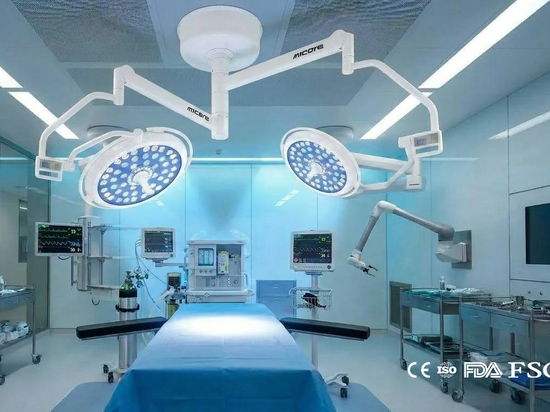
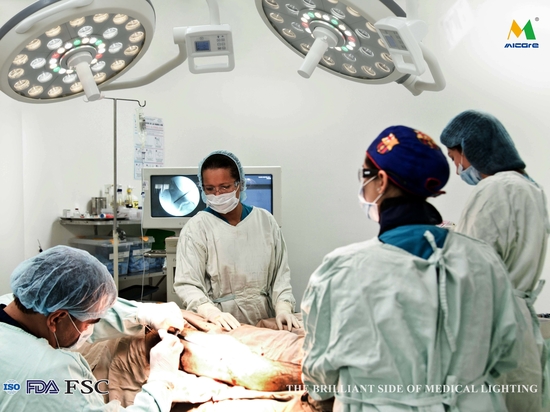
The E700 is available in two configurations. The single-dome E700 is suited to standard operating rooms and day surgery centres where one lamp head covers the procedure field. The dual-dome E700/700 is the better choice for larger OR teams, deep-cavity procedures, or rooms where shadow dilution is a specific requirement — two independently articulating heads illuminate the field from different angles simultaneously, which significantly reduces the shadow cast by the surgical team's hands and instruments.
Both configurations run the same five-step color temperature range (3,500K through 5,500K) and include the Endoscopy Ambient mode — White + Yellow Remix LEDs at 10% intensity — for minimally invasive cases where the ceiling light serves as ambient fill while the endoscope handles the surgical field.
Available accessories include a sterile drape handle kit, touchless IR sensor upgrade, and custom-length suspension arm extensions for non-standard ceiling heights or room layouts.
A Note on Ra 99 in Tender Specifications
Most hospital tender documents still specify Ra ≥ 85 — the IEC 60601-2-41 minimum. That floor was set to exclude genuinely poor lighting, not to define what good looks like.
For any room running general, cardiac, or neurosurgery, consider writing Ra ≥ 95 and R9 ≥ 90 into the specification. Here is why:
Blood discrimination: At Ra 85, the spectral gap in the red range makes arterial and venous blood harder to tell apart. At Ra 99, that distinction is clear and consistent across long procedures.
Tissue viability at margins: Identifying viable versus necrotic tissue relies on the pink-grey-yellow range — Ra 99 preserves that; Ra 85 collapses it.
Surgeon fatigue over time: Eyes adapt less under high-Ra light because colours appear stable and natural. In a 5-hour abdominal case, that accumulates.
Raising the Ra specification from 85 to 95 in a tender document costs the end user nothing if the supplier's product already meets it. It does meaningfully narrow the field to lights that will actually perform.
Documentation Requests
For tender submission, we can provide the IEC 60601-2-41 full type test report (third-party, TÜV Rheinland), CE Declaration of Conformity, ISO 13485:2016 certificate, EUDAMED UDI registration confirmation, and the product technical file summary covering non-confidential sections.
Contact: [email protected] | Subject: E700 Series — Tender Documentation Request