
#Product Trends
What to Check Before Importing Surgical Lights: A Distributor's Checklist
In surgical lighting, the documentation package — not the illuminance figure — is usually what decides whether an import order runs smoothly. A working checklist for distributors, covering regulatory status, test evidence, installation reality and co
Nanchang / Shanghai — For a distributor, the expensive mistakes in surgical lighting are rarely about the light itself. They surface months later: a tender that asks for a document nobody requested at the quotation stage, a ceiling-mounted surgical light that cannot be hung from the ceiling the hospital actually has, or a spare-parts conversation that happens after the first installation instead of before the first order.
The checklist below is written from the supplier side of that conversation. It is the sequence of questions Micare's export team is most often asked — and, in several cases, the sequence it has to raise itself, because the buyer's tender did not.
1. The regulatory status of the device — not just of the factory
The most common misunderstanding in this category is a single sentence: "our supplier is FDA registered." Establishment registration and device clearance are two different things, governed by two different parts of the same regulation.
Under 21 CFR Part 807, a manufacturer registers its establishment and lists the devices it makes. That registration is a statement about a manufacturing facility. It is not a finding that any individual device is cleared, approved or certified. A 510(k) premarket notification, by contrast, sits in 21 CFR Part 807 Subpart E and is a device-level pathway based on substantial equivalence to a legally marketed predicate.
For surgical lamps specifically, the situation is worth understanding before a tender is evaluated. 21 CFR 878.4580 classifies the surgical lamp as Class II (special controls) — and the same section exempts a defined list of device types, including operating room lamps, ceiling mounted surgical lights, surgical floor standing lights, endoscopic surgical lights and surgical light accessories, from premarket notification procedures, subject to the limitations in § 878.9. That provision was amended on 30 December 2019.
The practical consequence: the absence of a 510(k) number on a surgical light is not, on its own, evidence that a supplier is non-compliant, and a distributor who treats it as such will reject compliant manufacturers. The right question is not "do you have a 510(k)?", but "which classification regulation does this device fall under, and what is the basis for that position?" That question can be checked against the FDA's own product classification database before an offer goes out.
On the European side, CE marking under EU MDR 2017/745 is not a sticker to be taken at face value either. Ask for the Declaration of Conformity and read the device's risk class from that document rather than from a brochure. Check that the scope of the quality-system certificate covers the exact device family being quoted, and confirm the UDI information the supplier will place on the label and in the EU database. For markets outside the EU and the United States, ask which regime applies and who holds the registration — the answer is often not the same company that issues the invoice.
2. The evidence package that decides tenders
Tenders are evaluated by people who read documents, not catalogues. The package worth collecting before the first quotation includes:
A current datasheet in which the test conditions are stated, not just the headline numbers. In surgical lighting, a working distance, a spot size or a colour temperature quoted without its measurement condition is not a specification — it is a marketing figure. Ask for the condition alongside the number.
A test report to IEC 60601-2-41, the particular standard covering surgical luminaires and luminaires for diagnosis. Note the edition: the current edition of IEC 60601-2-41 is the 2021 edition, which cancels and replaces the second edition published in 2009 together with its 2013 amendment. If a supplier's file references only the 2009 edition, ask whether a report to the current edition exists.
The general safety standard IEC 60601-1 and the electromagnetic-compatibility collateral standard, as part of the same safety file.
An ISO 13485 quality-management certificate with its scope and expiry date visible — not a certificate for a different site or a different product family.
The instruction for use and the labelling in the language of the destination market. A translation of a product page is not a substitute; regulated labelling has a defined content list.
For a tender that requires it, the risk-management summary or a statement of conformity to the applicable general safety and performance requirements.
3. The installation reality in the destination market
Most renegotiations in this category happen after the technical offer is accepted, and almost all of them are about installation.
Electrical reality. Confirm voltage, frequency and the plug or connector standard for the destination market, and confirm that the variant quoted is the variant for that market rather than a domestic configuration with an adapter. Ask for the electrical safety report to match the variant.
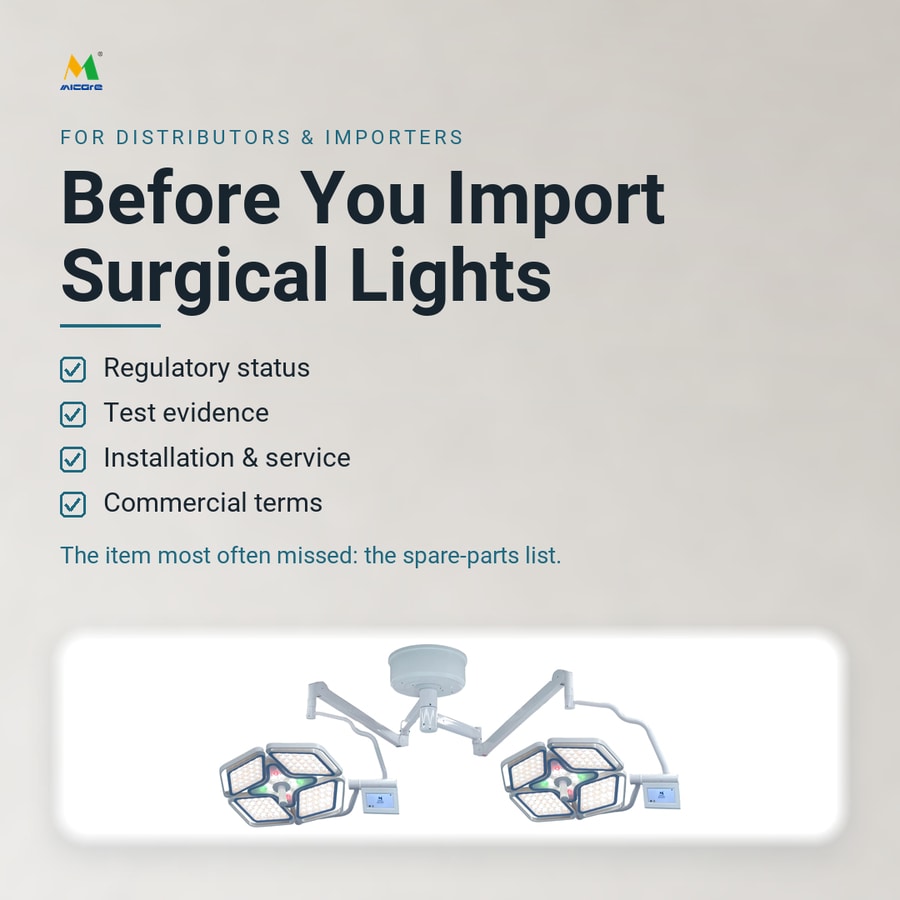
Ceiling-mounted units. For a ceiling-mounted surgical light, the interface with the building matters more than the light: ceiling structure and material, available mounting height, load capacity, and — most importantly — who is responsible for the structural interface and any reinforcement. Agree this in writing before the offer is signed.
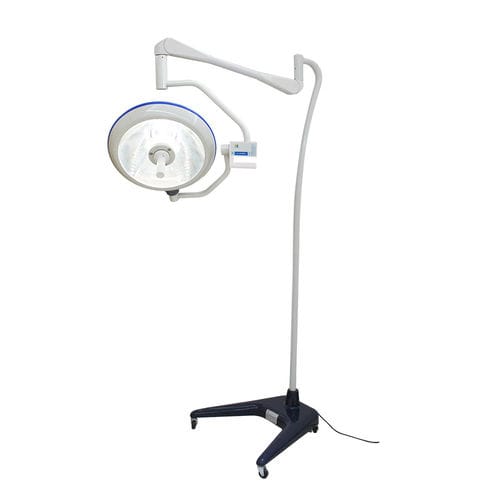
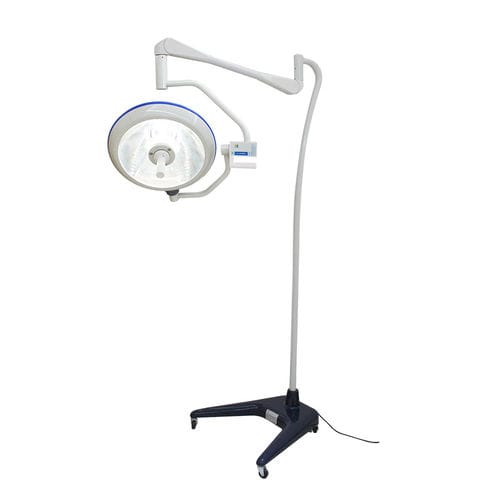
Mobile and floor-standing units. Confirm doorway widths, floor loading and storage footprint. A mobile unit that cannot be moved through the department is a returned unit.
Service model. Establish who installs, who maintains, what the spare-part lead time is, and whether a local service partner is required by the tender.
4. The commercial terms that decide the margin
Incoterms. Agree the Incoterm explicitly (and the named place). Quotations that say only "FOB" or only "CIF" without the place of delivery are the source of most landed-cost surprises.
Customs classification. Confirm the HS code with the supplier and with your own customs broker, and match it to the product description in the commercial invoice. Classification drives duty and, in some markets, conformity assessment requirements at the border.
Warranty. Ask what the warranty covers, what it excludes, and whether it is provided by the manufacturer or the local representative. Ask specifically about consumables, batteries and optics.
Spare parts. Request the recommended spare-parts list and the consumable replacement cycle before the first order, not after the first claim. For battery-powered equipment, this includes battery availability.
Minimum order quantity, lead time and packaging. Ask for the lead time that applies at your order size, and confirm that the packing specification is suitable for the transport mode you intend to use.
5. The short version: ask for it in writing
Before placing a first import order for surgical lights, request — in one email, and in writing — the current datasheet with test conditions, the IEC 60601-2-41 report with its edition date, the general safety and EMC reports, the ISO 13485 certificate with scope, the Declaration of Conformity for the EU (or the equivalent for your market), the labelling and instruction-for-use languages available, the UDI information, the spare-parts list, and the warranty terms.
A supplier who answers that email in full is a supplier whose installation you can plan. A supplier who answers half of it is a supplier whose problems will arrive with the shipment.
Frequently asked questions
What is the difference between FDA establishment registration and a 510(k)? Establishment registration under 21 CFR Part 807 registers the manufacturing facility and lists the devices it makes. It is a statement about the facility. A 510(k) premarket notification is a device-level pathway under 21 CFR Part 807 Subpart E, based on substantial equivalence to a legally marketed predicate device. A registered facility does not, by itself, mean an individual device is cleared or approved.
Does a surgical light always need a 510(k)? No. Under 21 CFR 878.4580 the surgical lamp is a Class II device with special controls, and a defined list of device types — including operating room lamps, ceiling mounted surgical lights and surgical light accessories — is exempt from premarket notification, subject to the limitations in § 878.9. Which category a specific device falls into should be confirmed against the FDA's product classification database rather than assumed.
What is the current edition of IEC 60601-2-41? The current edition is the 2021 edition, which cancels and replaces the second edition published in 2009 and its 2013 amendment. A test report citing only the 2009 edition is not automatically invalid, but it is worth asking whether a report to the current edition exists.
Should a distributor accept a CE certificate without the Declaration of Conformity? No. The Declaration of Conformity is the document on which the manufacturer states the risk class and the regulations applied. Read the class from that document, confirm that the quality-system certificate scope covers the device family being quoted, and check the UDI information.
What single item is most often missing from a first quotation? The spare-parts list. It is the item distributors most often request after the first installation, and the one that most often determines whether a repeat order is profitable.
Can Micare supply this package for a specific configuration? Yes. Micare's engineering and compliance team can provide the current datasheet, the applicable test documentation, the quality-system certificate and the compliance pack for a specific configuration, on request, before a quotation is issued.
About Nanchang Micare Medical Equipment Co., Ltd.
Nanchang Micare Medical Equipment Co., Ltd. designs, manufactures and exports surgical lighting and medical illumination equipment, including surgical lights, examination lights, surgical headlights, binocular loupes, X-ray film viewers and operating table accessories, with OEM and ODM capability. The company's manufacturing facility holds ISO 13485:2016 certification, and its products carry CE marking under EU MDR 2017/745. The facility is an FDA-registered establishment (facility registration no. 3023808059) — establishment registration, which is a statement about the manufacturing facility and not a clearance or approval of any individual device.
Distributors evaluating Micare for a tender or a first import order can review the product range at the company's MedicalExpo profile: https://www.medicalexpo.com/soc/nanchang-micare-medical-equipment-123592.html
This article describes regulatory frameworks as they apply to surgical lighting in general and is provided for commercial reference only. It is not legal, customs or regulatory advice, and it is not a statement that any specific product is cleared, approved or certified in any market. Classification, conformity assessment and labelling requirements depend on the device and on the destination market; confirm them against the issuing authority's current publications and against the manufacturer's documentation for the exact model you intend to import.
Micare Medical Engineering Team