
#Product Trends
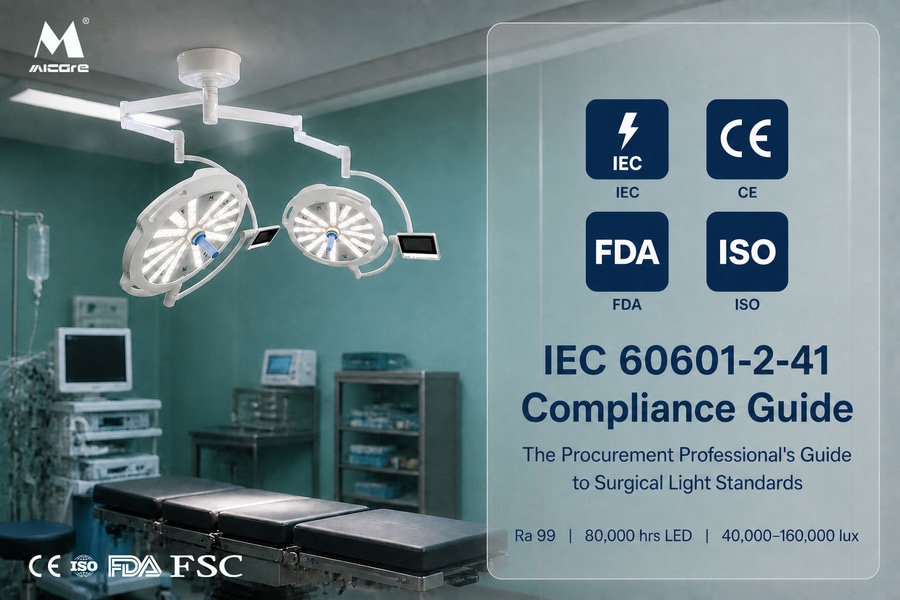
What Is IEC 60601-2-41? A Technical Guide for Surgical Luminaire Procurement
The Procurement Professional's Guide to Surgical Light Standards and Compliance Verification
Author: Micare Medical Engineering Team | Published: August 14, 2026
When evaluating surgical lights for a hospital or clinic, buyers frequently encounter the reference "IEC 60601-2-41" in product documentation. Understanding what this standard requires — and how to verify that a product genuinely complies — is one of the most important skills a procurement professional can develop.
This guide explains the standard in plain language, defines its key technical parameters, and provides a practical checklist for verifying compliance before purchase.
What Is IEC 60601-2-41?
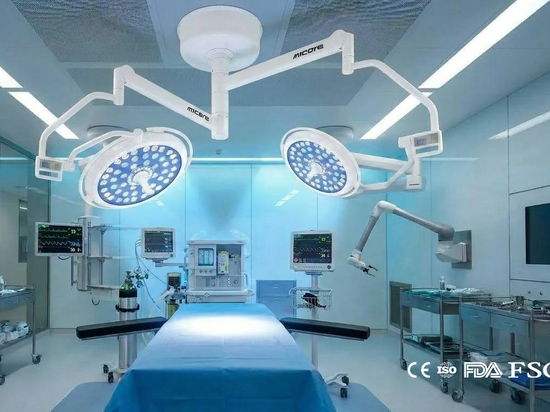
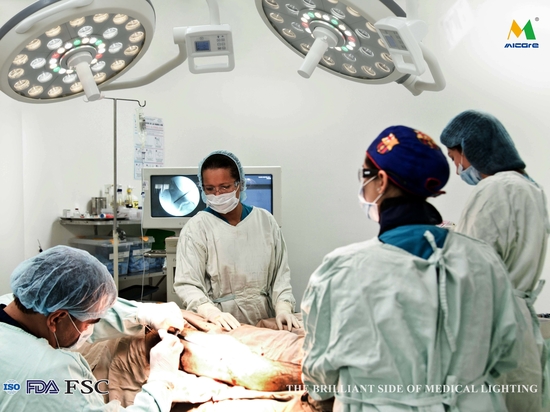
IEC 60601-2-41 is the international standard published by the International Electrotechnical Commission (IEC) that defines the safety and performance requirements specifically for surgical luminaires and luminaires for diagnosis — that is, surgical lights and examination lights used in medical procedures.
Its full title is:
"Medical electrical equipment — Part 2-41: Particular requirements for the basic safety and essential performance of surgical luminaires and luminaires for diagnosis"
The current edition is IEC 60601-2-41:2022, which superseded the 2009 edition. It is a "particular standard" within the broader IEC 60601 family of medical electrical equipment standards, meaning it specifies requirements that are additional to, or replace, those in the general standard IEC 60601-1.
Why It Matters for Procurement
IEC 60601-2-41 is referenced by every major regulatory framework for surgical lights:
FDA 510(k) (United States) — required testing standard for surgical light clearance
CE marking under EU MDR 2017/745 — the technical standard referenced in the Declaration of Conformity
UKCA marking (United Kingdom post-Brexit) — same technical content as CE/MDR
TGA (Australia), Health Canada, and most national regulatory bodies — accept or require testing to IEC 60601-2-41
A surgical light that has not been tested to this standard — regardless of how impressive its marketing specifications appear — has not been independently validated against the requirements that regulators and clinicians rely on.
Key Technical Parameters Defined by IEC 60601-2-41
1. Illuminance (Lux Output)
Definition: The amount of light reaching the illuminated field, measured in lux (lx), at a standard working distance of 1 metre from the light head.
Minimum illuminance (E_c): ≥ 40,000 lux
Recommended range: 40,000 – 160,000 lux
Measurement distance: 1 metre from light aperture
Measurement position: Centre of the light field
Why it matters: A manufacturer claiming "180,000 lux" without specifying the measurement distance or method is providing an unverifiable figure. Under IEC 60601-2-41, lux must be measured at exactly 1 metre under defined conditions. Always ask: "Is this lux value measured per IEC 60601-2-41?"
2. Color Rendering Index (Ra / CRI)
Definition: A measure of how accurately the light source renders the true colors of objects compared to a reference light source, on a scale of 0 to 100.
Minimum Ra: ≥ 85
Recommended for surgery: Ra ≥ 90
Why it matters: In surgery, accurate color discrimination between tissue types — healthy vs. ischemic tissue, arterial vs. venous blood — is clinically critical. A light with Ra 85 meets the minimum standard; lights with Ra 95+ are preferred for complex or color-sensitive procedures such as plastic surgery, hepatobiliary surgery, and oral surgery.
3. Color Temperature (CCT)
Definition: The color appearance of the light source expressed in Kelvin (K). Lower values appear warmer (yellower); higher values appear cooler (bluer/whiter).
Permitted range: 3,000 K – 6,700 K
Typical surgical preference: 4,000 K – 5,000 K
Why it matters: Color temperature affects how tissue appears under the light. Most OR teams prefer 4,000–4,500 K, which provides neutral white light without the yellow cast of lower temperatures or the harsh blue cast of very high color temperatures.
4. Shadow Dilution
Definition: The ability of the surgical light to reduce or eliminate shadows cast by the surgical team's heads, hands, and instruments into the surgical field.
IEC 60601-2-41 defines a standardized method for measuring shadow dilution using test cylinders of specific dimensions placed in the light field. The standard does not set a single minimum value but requires manufacturers to state and verify their shadow dilution performance.
Why it matters: Shadow dilution is particularly critical in deep-cavity procedures (abdominal, thoracic, pelvic surgery). Multi-module or multi-dome light systems provide superior shadow dilution compared to single-dome designs by illuminating the surgical field from multiple angles simultaneously.
5. Luminance Ratio of the Light Field
Definition: The ratio of illuminance at the centre of the light field to the illuminance at the edge.
Maximum luminance ratio: ≤ 5:1 (centre to edge)
Why it matters: A high luminance ratio (bright centre, dark edges) causes visual fatigue for the surgical team as their eyes must constantly readapt between the bright field and the surrounding environment. A well-designed surgical light maintains even illumination across the entire field.
6. Heat Output at the Illuminated Field
Definition: The maximum permissible temperature rise caused by the light at the surface of the surgical field.
Maximum temperature rise at field: ≤ 1°C above ambient
Why it matters: Excessive heat from a surgical light can cause desiccation of exposed tissue and discomfort for surgical team members working close to the field. LED surgical lights have largely eliminated this problem compared to halogen predecessors, but IEC 60601-2-41 testing verifies that heat output remains within safe limits.
7. Light Field Size and Adjustability
Definition: The diameter of the illuminated area at the working distance of 1 metre.
IEC 60601-2-41 requires manufacturers to specify the light field diameter and verify that the field can be adjusted (focused/defocused) across the stated range.
Why it matters: Different procedures require different field sizes. A laparoscopic port site requires a small, focused beam; open abdominal surgery requires a large field. A surgical light that cannot adjust its field diameter appropriately limits the surgical team's flexibility.
IEC 60601-2-41 vs. IEC 60601-1: Understanding the Relationship
IEC 60601-1 (All medical electrical equipment) General safety requirements — electrical, mechanical, and thermal safety.
IEC 60601-1-2 (All medical electrical equipment) EMC (electromagnetic compatibility) requirements — ensures the device does not interfere with other OR equipment.
IEC 60601-2-41 (Surgical luminaires specifically) Particular requirements — illuminance, color rendering, shadow dilution, heat output, and light field size.
A fully compliant surgical light must be tested to all three standards. IEC 60601-2-41 alone is not sufficient — the general and collateral standards also apply.
How to Verify IEC 60601-2-41 Compliance
Step 1: Request the Third-Party Test Report
A genuine IEC 60601-2-41 compliance claim requires a test report issued by an accredited CB (Certification Body) laboratory — not a test conducted by the manufacturer's own internal lab.
The test report should state:
The specific standard and edition tested (IEC 60601-2-41:2022 or :2009)
The CB laboratory name and accreditation body
The specific product model(s) tested
Test results for each parameter (illuminance, Ra, CCT, shadow dilution, heat)
Pass/Fail determination per clause
Step 2: Verify the CB Laboratory Accreditation
The CB laboratory should be accredited under the IECEE CB Scheme (the IEC System for Conformity Assessment to Standards for Electrical Equipment and Components). Verify the laboratory's accreditation at iecee.org.
Step 3: Confirm the Tested Model Matches What You Are Buying
Test reports are model-specific. Verify that the model number on the test report exactly matches the model number on your purchase order — not just the product family or series name.
Step 4: Check the Edition of the Standard
If a supplier provides a test report to IEC 60601-2-41:2009 (the previous edition), the product may not meet all requirements of the current :2022 edition, which introduced updated requirements for photobiological safety and LED-specific performance. Ask whether re-testing to the 2022 edition has been completed.
Procurement Checklist: IEC 60601-2-41 Verification
Before approving a surgical light for procurement, verify the following:
☐ Third-party test report — Issued by accredited CB lab; not the manufacturer's own lab
☐ Standard edition — IEC 60601-2-41:2022 (preferred) or :2009
☐ Illuminance at 1m — ≥ 40,000 lux, measured per IEC methodology
☐ Color rendering index — Ra stated and ≥ 85 ☐ Color temperature — Within 3,000–6,700 K range; specific value stated
☐ Shadow dilution — Performance stated and test method documented
☐ Heat output — ≤ 1°C temperature rise verified ☐ Model match — Test report model matches purchase order model exactly
☐ General standard — Also tested to IEC 60601-1 and IEC 60601-1-2
☐ Regulatory clearance — CE Declaration of Conformity references IEC 60601-2-41
About Micare Medical
Micare Medical has manufactured surgical lighting systems since 2007 from our facility in Nanchang, China. Our surgical luminaires are:
FDA registered — facility and surgical light product line registered with the U.S. Food & Drug Administration
CE certified under EU MDR 2017/745
ISO 13485:2016 quality management system certified
Tested to IEC 60601-2-41 — third-party test documentation available on request
Featured Product: Galaxy-LED E700/700 Surgical Light
The Galaxy-LED E700/700 is our flagship double-dome surgical luminaire, designed to meet and exceed IEC 60601-2-41:2022 requirements across all key parameters:
Illuminance (each dome) Galaxy-LED E700/700: 40,000 – 160,000 lux @ 1m IEC 60601-2-41 minimum: ≥ 40,000 lux
Color Rendering Index (Ra/CRI) Galaxy-LED E700/700: Ra 99 IEC 60601-2-41 minimum: ≥ 85
Color Temperature (CCT) Galaxy-LED E700/700: 3,500 K – 5,500 K (adjustable) IEC 60601-2-41 permitted range: 3,000 K – 6,700 K
Light Field Diameter Galaxy-LED E700/700: Φ140 mm – Φ350 mm (adjustable)
LED Lifespan Galaxy-LED E700/700: 80,000 hours
Ra 99 places the Galaxy-LED E700/700 among the highest color rendering surgical lights available — exceeding the IEC minimum of Ra 85 by 14 points, and the clinical recommendation of Ra 90 by 9 points. At this level, tissue color discrimination under the light is virtually indistinguishable from natural daylight conditions.
The adjustable color temperature range (3,500 K–5,500 K) allows the surgical team to select the optimal white balance for different procedure types and personal preference, without tools or interruption to the sterile field.
Procurement teams requiring the full IEC 60601-2-41 test report, Declaration of Conformity, ISO 13485 certificate, and product specification sheet for the Galaxy-LED E700/700 are welcome to contact us at [email protected].
Explore our full surgical light range at surgicallight.com.
References:
International Electrotechnical Commission. IEC 60601-2-41:2022 — Medical electrical equipment: Particular requirements for surgical luminaires. webstore.iec.ch
International Electrotechnical Commission. IEC 60601-1:2005+AMD1:2012+AMD2:2020. General requirements for basic safety and essential performance. webstore.iec.ch
IECEE. CB Scheme Laboratory Directory. iecee.org
U.S. Food & Drug Administration. 510(k) Premarket Notification Database. accessdata.fda.gov
European Commission. EU Medical Device Regulation 2017/745. Official Journal of the European Union.