
#Industry News
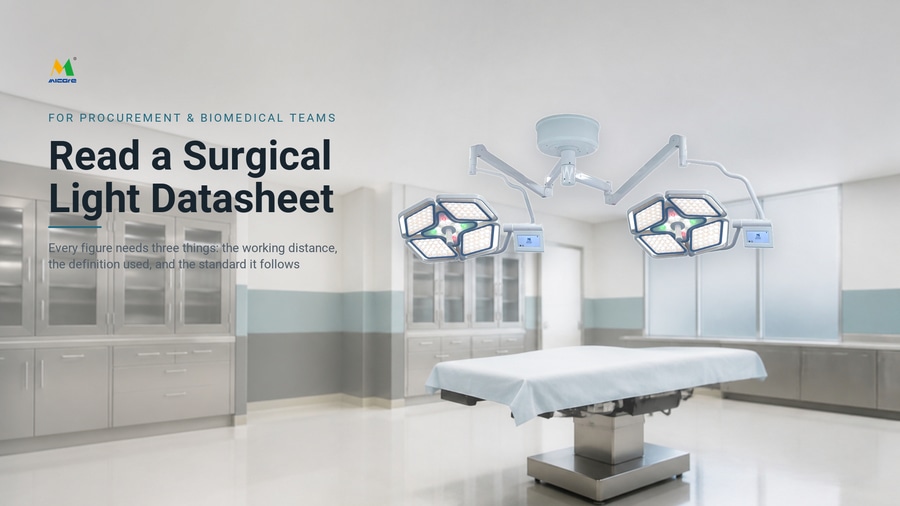
How to Read a Surgical Light Datasheet Without Getting Misled
Unqualified numbers, not false ones — a buyer's guide to reading surgical light specifications
Most surgical light datasheets are not wrong — they are unqualified. The number is real; the condition under which it was measured is missing. This guide sets out which entries mean something on their own, which mean nothing without their condition, and what to ask for when the condition is absent.
Nanchang / Shanghai — Two surgical light datasheets can both print 160,000 lux and describe two different products. One figure may have been measured at one metre, in the centre of the beam, on a production unit. The other may be the peak value taken closer in, or a figure carried across from a laboratory prototype. Neither claim is necessarily false. What makes the comparison worthless is that the measurement condition is missing — and the condition is the thing that turns a figure into a specification.
This guide is written for the people who have to compare those documents: distributors assembling a tender response, hospital biomedical teams running an evaluation, and procurement officers who will be asked to justify a shortlist. It covers what a usable datasheet contains, how to normalise two datasheets before you compare them, and which entries should be treated as stop signals.
The short answer
A surgical light datasheet is comparable when every photometric figure is accompanied by three things: the working distance at which it was measured, the definition used to derive it, and the reference standard the measurement follows.
If any of the three is missing, the figure cannot be compared with another supplier's figure. It can only be compared with another datasheet from the same supplier — which is precisely the comparison that does not help you decide.
1. Illuminance: the number that misleads most often
Illuminance, measured in lux, is the headline figure on nearly every surgical light datasheet, and the one most often quoted without qualification.
The difficulty is geometric. Illuminance decreases as distance from the light source increases. For a small source the falloff approaches the inverse square law; for a large-area LED array it is gentler, because the emitting surface subtends a wider angle — but it is still falloff, and it is still steep enough that a figure measured at 0.7 m and a figure measured at 1.0 m are not the same figure.
A datasheet that says "up to 160,000 lux" is therefore not telling you what the light will do in an operating room. It is telling you the highest value that could be stated. The two questions that resolve it:
At what working distance was this measured? The measurement distance should be stated in the datasheet, not supplied verbally after the fact.
Is it the central value, or an average across the light field? Central (peak) illuminance and average illuminance across the field differ, and mixing the two between suppliers produces a comparison that flatters whichever datasheet chose the larger definition.
2. The light field: d50 and d10 are not the same measurement
A surgical light's useful coverage is described by its light field diameter — the diameter of the illuminated area. The complication is that the field has no hard edge: it fades outwards, so the diameter depends entirely on where you draw the line.
The convention is to define the diameter at a percentage of maximum illuminance. d50 is the diameter within which illuminance is at least 50% of its maximum value. d10 is the diameter at 10%. On a typical luminaire d10 is substantially larger than d50 — often by a third or more.
That gap is the opportunity. A datasheet quoting "field diameter 300 mm" without stating d50 or d10 has used the flattering definition, and a buyer comparing it against another supplier's d50 figure is comparing two different measurements wearing the same unit. Ask which definition applies, and at which working distance.
3. Depth of illumination
Deep-cavity and open-abdominal work needs the light field to hold its size as the lamp is moved and as the surgeon's hands pass through the beam. Depth of illumination is the distance range over which the light field remains within a defined band — commonly expressed as a range such as 0.6 m to 1.2 m at a stated criterion.
The criterion matters as much as the range. "Large depth of illumination" is not information. A usable entry states the range in centimetres and the tolerance applied — for example, the distance over which the field diameter stays within a stated percentage of its value at the reference distance.
4. Shadow dilution: the entry that separates surgical lights from bright lamps
A surgical light is not simply a very bright lamp. Its job is to keep the operative site illuminated when the surgeon's head, hands and instruments are already in the beam. That property is measured as shadow dilution: the percentage of unshadowed illuminance the luminaire still delivers when a defined obstruction is placed in the field.
This is the most frequently abused entry in the category. A marketing claim of "shadowless" carries no measurement information at all. Suppliers who do measure it often publish more than one figure — performance with a single obstruction and with two, because a luminaire that holds up against one mask can degrade against the second.
Whatever the number, the test set-up decides its meaning: obstruction size and shape, its position in the beam, and the working distance all change the result. If the datasheet gives a shadow dilution figure but no set-up, the figure is not yet usable.
5. Colour temperature and colour rendering
Two separate properties are routinely conflated.
Colour temperature (kelvin) describes the appearance of the light. The questions worth asking are whether the figure is a single point or an adjustable range, what the tolerance is, and — if the luminaire is adjustable — at which setting the quoted figure applies. A range of "3,500–5,000 K" and a fixed "4,000 K" describe different products and suit different procedures.
Colour rendering describes how faithfully the light reveals colour. It is usually reported as Ra across a standard set of test colours. Ra alone has a known blind spot: because it averages across the palette, a luminaire can post a high Ra while rendering deep reds poorly — and deep red is exactly where tissue discrimination, blood and perfusion assessment happen. Where a datasheet reports Ra, ask for R9 (saturated red) as well. A high Ra with an unstated R9 is an incomplete answer.
6. LED lifetime: hours mean nothing without L and B
"50,000 hours" is not a lifetime. It is a number extracted from a two-part designation that the datasheet has omitted.
LED lumen output declines gradually rather than failing abruptly, so lifetime is specified in two dimensions:
L — the lumen maintenance threshold. L70 means output has fallen to 70% of initial; L80 to 80%; L90 to 90%.
B — the percentage of units expected to fall below that threshold by the stated hour figure. B50 means half of a population; B10 means 10%.
So L80B50 at 50,000 hours and L70B10 at 50,000 hours are different claims with very different implications for maintenance planning. Both are also conditional on drive current and ambient temperature, because LED degradation accelerates with heat — a figure quoted without its thermal condition is not transferable to a real operating room.
Ask for the L and B values together, the test condition, and whether the figure is projected or measured. In practice, lumen-maintenance claims are usually based on LM-80 test data projected using TM-21.
7. What a comparable entry looks like
Nine parameters carry most of the weight in a surgical light datasheet. For each, what follows contrasts the form commonly written with the form a comparable entry takes. The bracketed figures illustrate format only — they are not the specifications of any product, and should not be read as such.
Illuminance. Commonly written as "up to 160,000 lux". A comparable entry states a central illuminance value at a named working distance, and names the standard the measurement follows — for example, central illuminance [value] lx at [working distance] m, measured per IEC 60601-2-41.
Light field. Commonly written as "field diameter 300 mm". A comparable entry gives both diameters, at the same working distance — d50 [value] mm and d10 [value] mm, both at [working distance] m.
Depth of illumination. Commonly written as "excellent depth of illumination". A comparable entry states the tolerance first and the range second — the light field held within [x]% of its reference value over [a]–[b] m.
Shadow dilution. Commonly written as "shadowless". A comparable entry gives the measured percentages together with the obstruction set-up — [value]% with a single obstruction and [value]% with two, using an obstruction of [size] at [working distance] m.
Colour temperature. Commonly written as "4000 K". A comparable entry gives the value, the tolerance and the setting — [value] K ± [tolerance] K at [setting], adjustable across [a]–[b] K.
Colour rendering. Commonly written as "high CRI". A comparable entry gives both indices at a stated colour temperature — Ra [value] and R9 [value] at [colour temperature].
LED lifetime. Commonly written as "50,000 hours". A comparable entry gives the L value, the B value, the condition and the basis — L[value]B[value] at [hours] hours, at [drive and ambient condition], [projected or measured].
Ingress protection. Commonly written as "durable, easy to clean". A comparable entry gives the IP code against the standard it follows — IP[value] per IEC 60529.
Electrical. Commonly written as "220V". A comparable entry gives the range, the frequency and the variant that was actually tested — [a]–[b] V, [frequency] Hz; tested variant [identifier], for market [x].
Read the "comparable entry" half of each item above and the pattern is the same throughout: every figure names its condition. That is the whole discipline.
8. Normalising two datasheets before you compare them
Datasheets from different manufacturers will rarely use identical conventions. Five steps bring them onto common ground:
Same working distance. Ask for the measured illuminance curve rather than a single point, and read both products at the distance your operating room actually uses.
Same field definition. Compare d50 with d50 and d10 with d10. Never compare one supplier's d50 against another's d10.
Same colour-temperature setting. For adjustable luminaires, compare at the setting you intend to use, not at whichever setting each supplier prefers to publish.
Same lifetime basis. Compare L-to-L and B-to-B, and check that the thermal conditions match.
Same standard edition. Note which edition of the type-test standard each report references. IEC 60601-2-41 is the particular standard covering surgical luminaires; its current edition is Edition 3, published in 2021, which cancels and replaces the second edition of 2009 together with its 2013 amendment. A report referencing only the earlier edition is not automatically invalid, but the age of the evidence is a fair question — particularly where chromaticity requirements were revised.
9. Entries worth treating as stop signals
No measurement distance anywhere in the document.
Illuminance stated as "up to" with a single figure.
A colour-rendering claim with no Ra value, or Ra with no R9.
"Shadowless" with no shadow-dilution measurement.
LED life in hours with no L and B designation.
A type-test report citing only a superseded standard edition with no explanation.
No ingress-protection rating for equipment intended for an operating room.
Numbers that differ between the brochure, the website and the tender response.
No statement of which electrical variant was tested.
10. What to request — in one email
Before a shortlist is fixed, request in writing: a datasheet in which every photometric figure carries its working distance and definition; the light field at both d50 and d10; the shadow-dilution result with its obstruction set-up; Ra and R9 at a stated colour temperature; L and B lifetime values with their condition and basis; the ingress-protection rating; the electrical variants offered and the variant that was tested; and the edition of IEC 60601-2-41 that the type test follows.
A supplier who answers that list has a datasheet you can evaluate. A supplier who answers part of it has told you something useful about the documentation you will receive for the rest of the project.
FAQ
Q: Is a "160,000 lux" claim false? A: Not necessarily — but it is incomplete. A lux figure is meaningful only with the working distance at which it was measured and a statement of whether it is the central (peak) or average value. Without those, it cannot be compared against another supplier's figure.
Q: What does d50 mean? A: d50 is the diameter of the illuminated area within which illuminance is at least 50% of its maximum value. It is the conventional way to express usable light-field size. d10, the diameter at 10% of maximum, is the same idea applied to the outer edge of the beam and is a considerably larger number.
Q: What is shadow dilution, and why does it matter more than brightness? A: Shadow dilution is the percentage of unshadowed illuminance the luminaire still delivers when a defined obstruction is placed in the beam. It measures what happens to the operative site once the surgeon's head, hands and instruments are between the light and the patient — which is the normal condition in surgery. Brightness alone says nothing about it.
Q: If Ra is already high, why ask for R9? A: Ra averages rendering performance across a standard palette of test colours, and deep red carries comparatively little weight in that average. R9 reports saturated-red rendering specifically, which is where tissue and blood discrimination is judged. A luminaire can post a strong Ra while rendering deep red poorly.
Q: What does L80B50 actually tell me? A: It is a two-part statement. L80 means lumen output has fallen to 80% of its initial value; B50 means that threshold is expected to be reached in 50% of units by the stated hour figure. L80B10 at the same hours is a stronger claim than L80B50, because only 10% of units are expected to fall below the threshold.
Q: Which edition of IEC 60601-2-41 should a test report reference? A: The current edition is Edition 3, published in 2021, which cancels and replaces the 2009 second edition and its 2013 amendment. A report to the earlier edition is not automatically invalid, but it is reasonable to ask whether test evidence to the current edition exists.
Q: Can I compare two suppliers using their published datasheets alone? A: Only if both datasheets state working distance, definition and standard basis for every photometric figure — which is uncommon. In most evaluations the first step is not comparing, but requesting the missing conditions from both suppliers and then comparing.
This article describes documentation and measurement conventions for surgical lighting in general, and is provided for commercial reference only. It is not technical, regulatory or legal advice, and it does not state or imply any specification, performance figure or certification of any particular product. Always evaluate the manufacturer's datasheet and test documentation for the exact model you intend to purchase.
References
IEC 60601-2-41 — Particular requirements for the basic safety and essential performance of surgical luminaires and luminaires for diagnosis. Current edition: Edition 3 (2021), cancelling and replacing Edition 2 (2009) and its 2013 amendment.
IEC 60601-1 — Medical electrical equipment — Part 1: General requirements for basic safety and essential performance
IEC 60529 — Degrees of protection provided by enclosures (IP Code)
IES LM-80 — Approved method for measuring lumen maintenance of LED light sources
IES TM-21 — Projecting long-term lumen maintenance of LED light sources
21 CFR 878.4580 — Surgical lamp (Class II, special controls): https://www.ecfr.gov/current/title-21/part-878/section-878.4580
FDA — Overview of Device Regulation: https://www.fda.gov/medical-devices/device-advice-comprehensive-regulatory-assistance/overview-device-regulation
EN ISO 13485:2016 — Medical devices — Quality management systems — Requirements for regulatory purposes
About Micare Medical
Nanchang Micare Medical Equipment Co., Ltd. manufactures surgical lighting and medical illumination equipment, including surgical lights, examination lights, surgical headlights, binocular loupes and X-ray film viewers, with OEM and ODM capability. Our manufacturing facility holds ISO 13485:2016 certification, and our products carry CE marking under EU MDR 2017/745. Our facility is an FDA-registered establishment (facility registration no. 3023808059) — establishment registration, which is a statement about the manufacturing facility and not a clearance or approval of any individual device.
Datasheet requests that come with measurement conditions attached are the ones our engineering team can answer most precisely. For a specific configuration, our engineering and compliance team can provide the measured datasheet, the applicable type-test documentation and the compliance pack on request, before a quotation is issued.
Full company profile and product range: Nanchang Micare Medical Equipment on MedicalExpo
Micare Medical Engineering Team