#Industry News
Indoor air quality in healthcare facilities: why measure before taking action?
Hospitals, clinics, laboratories and medical practices face different indoor air pollutants. An indoor air quality assessment helps identify the sources and select measures suited to the actual situation.
What are the main sources of indoor air pollution in healthcare facilities?
In healthcare environments, indoor air quality is influenced by the building, occupancy and the activities carried out inside. Ventilation, materials, furniture, cleaning and disinfection products, equipment, clinical procedures and people moving through the space can all change conditions over the course of a day.
The issues therefore vary considerably from one area to another. A busy waiting room does not have the same profile as a laboratory using reagents, a treatment room where aerosols may be generated or a recently refurbished space. Even within a single facility, a uniform response may fail to address actual exposures.
This variability is why the choice of action should not begin with a device or technology, but with a question: what is actually happening in the air in this particular space?
Why carry out an indoor air quality assessment?
Persistent odours, a feeling of stuffiness, irritation or visible dust may provide warning signs. Yet the absence of discomfort does not necessarily mean that air quality is satisfactory. Some compounds are difficult to perceive, while a strong odour is not always proportional to the level of risk.
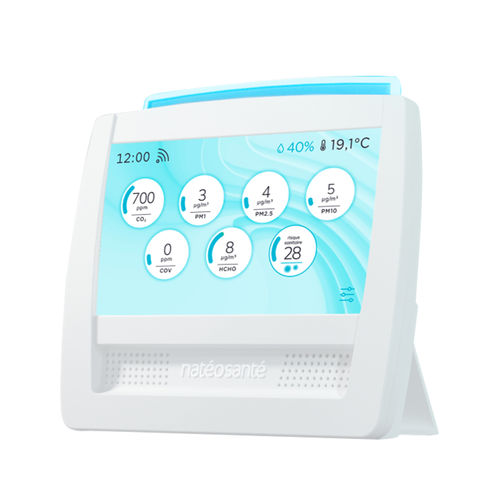
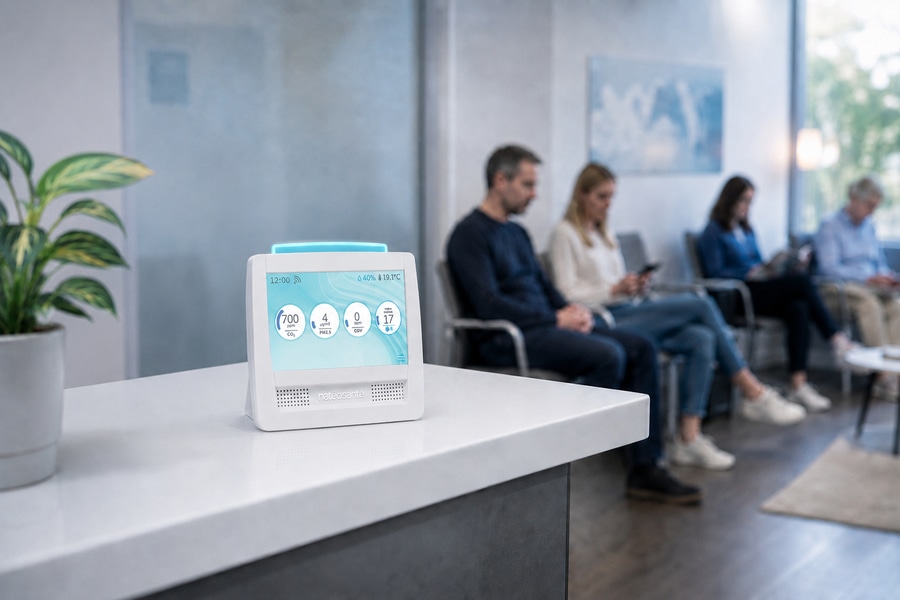
Measurement provides objective data. It can reveal when concentrations increase, relate those changes to specific activities and distinguish an isolated event from a recurring pattern. It also prevents the assessment from being reduced to carbon dioxide alone: CO₂ is useful for evaluating occupancy-related ventilation, but it does not directly indicate levels of fine particles, volatile organic compounds or formaldehyde.
An assessment carried out under real operating conditions therefore becomes a decision-support tool. The aim is not simply to generate charts, but to connect the data with how the space is used: occupancy periods, cleaning, clinical work, building work, window opening, ventilation operation and the use of specific products.
One-off testing or continuous indoor air quality monitoring?
The measurement method should reflect the question being investigated. Targeted sampling may be appropriate when looking for a particular compound or documenting a specific exposure. Monitoring over several days, by contrast, can capture activity cycles and variations that may not be visible during a short site visit.
In many cases, a week of monitoring under normal conditions provides a more representative picture than a single reading. The results must nevertheless be interpreted in context: room type, number of occupants, working hours, activities and any unusual events. A value without context can lead to premature conclusions.
A robust assessment therefore combines three elements: observation of the site, measurement of relevant parameters and discussions with the teams who understand day-to-day practices.
How can indoor air quality findings be turned into an action plan?
Measurement only creates value when the findings lead to decisions. Depending on the causes identified, initial measures may involve airing practices, ventilation operation or maintenance, product selection and storage, work organisation, source extraction, maintenance or supplementary air filtration.
The priority is to control the pollutant as close to its source as possible whenever it can be eliminated or reduced. Room air treatment can then provide an additional layer of control when emissions cannot be fully avoided or when the setting requires further protection.
This approach avoids two common pitfalls: installing equipment that does not target the relevant pollutant, or expecting one technology to compensate for inadequate ventilation, an uncontrolled emission source or an unsuitable procedure.
Indoor air quality assessment: measure first to select the right solution
At NatéoSanté, assessment is the first stage in a broader approach: assess, act and monitor. Our indoor air quality assessments combine multiparameter monitoring with an analysis of real operating conditions, followed by a review that helps prioritise the actions to be taken.
This approach helps healthcare organisations invest where it matters, document their decisions and develop a strategy suited to both their premises and operational constraints.
Would you like objective data on indoor air quality in a ward, laboratory or medical practice? NatéoSanté can support you with an assessment carried out under real operating conditions.