#Product Trends
Suture Anchor Fixation in Posterior Labral Repair | Orthosyn
Learn how suture anchors are used in arthroscopic posterior labral repair to restore shoulder stability, reattach the labrum to the glenoid, and support anatomical soft-tissue fixation.
Posterior labral tears are injuries affecting the back portion of the glenoid labrum, a fibrocartilaginous structure that contributes to shoulder stability. These injuries may occur following trauma, repetitive loading, or posterior shoulder instability.
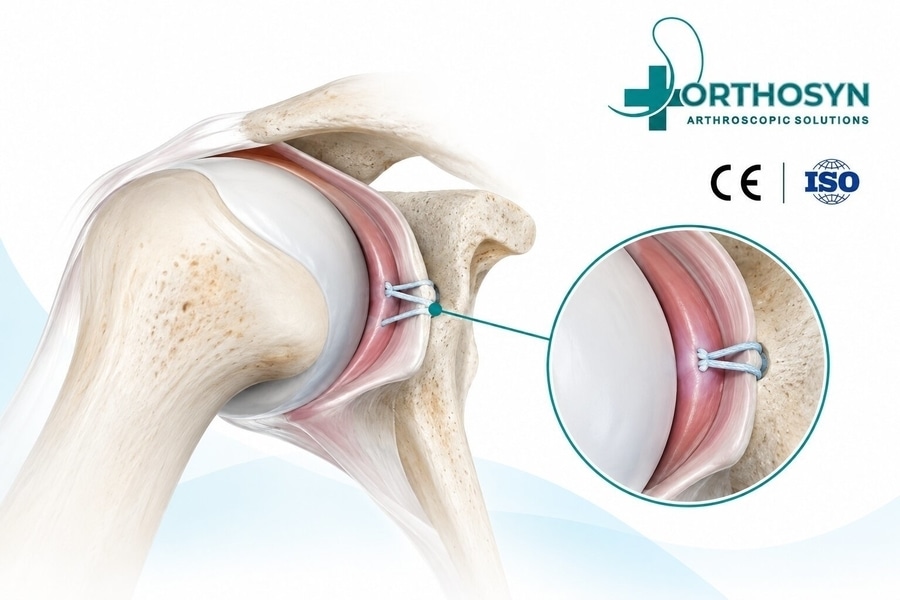
Arthroscopic posterior labral repair is a minimally invasive surgical procedure designed to reattach the damaged labrum to the posterior glenoid rim using suture anchors.
Suture anchors provide fixation points within the glenoid bone, allowing high-strength sutures to secure the detached labral tissue while biological healing develops.
What Is a Posterior Labral Tear?
The glenoid labrum is a ring of fibrocartilage surrounding the glenoid cavity. It helps deepen the socket and contributes to the stability of the shoulder joint.
A posterior labral tear involves damage to the back portion of this structure.
Common causes include:
- Traumatic posterior shoulder dislocation or subluxation
- Repetitive loading during sports
- Weightlifting and contact sports
- Repetitive posteriorly directed forces
- Shoulder instability
Patients may experience posterior shoulder pain, clicking, weakness, or a sensation of instability.
How Is Posterior Labral Repair Performed Arthroscopically?
Arthroscopic posterior labral repair is performed using a camera and specialized instruments inserted through small surgical portals.
The procedure generally involves five main steps:
1. Arthroscopic assessment: The surgeon evaluates the posterior labral tear and associated shoulder structures.
2. Labral mobilization: The detached labrum is carefully mobilized to allow anatomical repositioning.
3. Glenoid preparation: The posterior glenoid rim is prepared to create an appropriate surface for healing.
4. Suture anchor placement: Anchors are inserted into selected positions along the posterior glenoid rim.
5. Labral fixation: Sutures are passed through the labral and capsular tissue and secured to restore attachment and stability.
The fixation principle is:
Glenoid Bone → Suture Anchor → High-Strength Suture → Posterior Labrum
The goal is to restore the labrum's anatomical attachment while maintaining appropriate capsular tension.
Why Are Suture Anchors Important in Posterior Labral Repair?
Suture anchors provide mechanical fixation between the detached labrum and the glenoid bone.
Their primary functions include:
- Securing the labrum to the posterior glenoid rim
- Maintaining anatomical tissue positioning
- Supporting appropriate capsulolabral tension
- Providing initial stability during healing
- Allowing minimally invasive soft-tissue fixation
Anchor positioning is particularly important because the posterior glenoid has limited available bone in certain regions.
The surgeon must balance secure fixation with preservation of the surrounding bone and cartilage.
What Types of Suture Anchors Can Be Used?
Different anchor materials and designs may be used in arthroscopic labral repair, depending on the anatomy, surgical technique, and applicable product indications.
Titanium Suture Anchors
Titanium anchors provide metallic fixation within the glenoid bone. They are available in different designs and diameters for selected arthroscopic soft-tissue repair procedures.
Orthosyn Titanium Suture Anchors
PEEK Suture Anchors
PEEK anchors offer a nonmetallic fixation option. Their material properties and design characteristics differ from metallic anchors.
Orthosyn PEEK Suture Anchors
Soft All-Suture Anchors
Soft all-suture anchors use a textile-based fixation mechanism and can require smaller bone holes than certain conventional rigid anchors.
This may be advantageous when bone preservation is an important surgical consideration.
Orthosyn Soft Suture Anchors
Why Does Anchor Diameter Matter?
The diameter of a suture anchor influences the amount of bone removed during implantation.
Smaller anchors may allow fixation through smaller bone holes, potentially preserving more glenoid bone.
However, anchor selection must also consider:
- Bone quality
- Tear location and size
- Required fixation stability
- Anchor design
- Suture configuration
- Available glenoid bone stock
A smaller anchor does not automatically provide stronger fixation. The implant must be appropriate for the intended anatomical application.
Knotted vs Knotless Fixation in Posterior Labral Repair
Posterior labral repair may be performed using knotted or knotless suture anchor techniques.
Knotted fixation uses surgical knots to secure the sutures and maintain the labrum against the glenoid.
Knotless fixation uses an implant mechanism to secure the sutures without conventional knot tying at the final fixation point.
Knotless techniques may simplify certain aspects of suture management, while knotted techniques allow different suture configurations.
Neither method is universally superior. The selection depends on surgical requirements and implant compatibility.
Orthosyn also offers PEEK + PEEK Knotless Anchors and PEEK + Titanium Knotless Anchors within its arthroscopy portfolio.
What Factors Influence Successful Posterior Labral Repair?
Successful posterior labral repair depends on several anatomical, mechanical, and biological factors.
Important considerations include:
- Accurate identification of the labral injury
- Appropriate labral mobilization
- Correct glenoid preparation
- Anatomical anchor placement
- Adequate suture tension
- Stable capsulolabral fixation
- Preservation of surrounding cartilage and bone
- Postoperative rehabilitation
Suture anchors provide initial mechanical stability, but long-term repair integrity also depends on biological healing and appropriate rehabilitation.
Conclusion
Suture anchor fixation is an important component of arthroscopic posterior labral repair, allowing the surgeon to reattach the damaged labrum to the posterior glenoid rim and address selected forms of posterior shoulder instability.
Titanium, PEEK, soft all-suture, and knotless anchor technologies provide different fixation options. Their suitability depends on the anatomical requirements, tissue quality, surgical technique, and approved indications.
Orthosyn Medikal offers a range of suture anchor technologies for arthroscopic soft-tissue repair, including titanium anchors, PEEK anchors, soft all-suture anchors, and knotless fixation systems. Product selection should always follow the applicable instructions for use and professional surgical judgment.