#Product Trends
What Determines the Rheological Properties of Hyaluronic Acid? | Orthosyn
Understand how molecular weight, concentration, cross-linking, and molecular structure influence the viscosity, elasticity, and viscoelastic behavior of hyaluronic acid injections.
The rheological properties of hyaluronic acid (HA) describe how the material flows, deforms, and responds to mechanical forces. These characteristics are particularly important in intra-articular hyaluronic acid injections used for viscosupplementation.
Factors such as molecular weight, HA concentration, cross-linking, temperature, and shear rate influence the mechanical behavior of hyaluronic acid formulations.
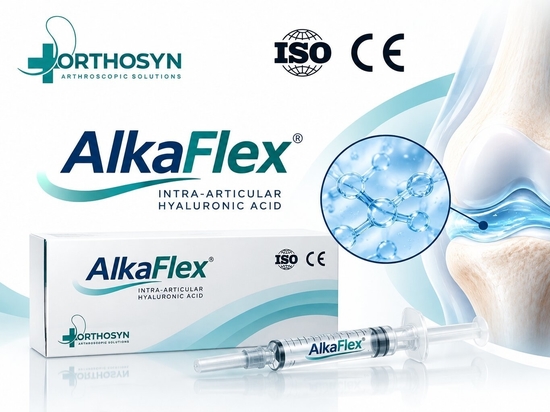
AlkaFlex hyaluronic acid injections, part of the Orthosyn Medikal product portfolio, include linear and cross-linked formulations with different molecular characteristics.
What Are the Rheological Properties of Hyaluronic Acid?
Rheology is the study of how materials flow and deform under applied forces.
Hyaluronic acid exhibits viscoelastic behavior, meaning it combines characteristics of both viscous fluids and elastic materials.
The main rheological properties include:
- Viscosity: Resistance to flow under applied shear.
- Elasticity: Ability to store mechanical energy during deformation.
- Viscoelasticity: Combined viscous and elastic response to mechanical loading.
These properties are relevant to the mechanical functions of synovial fluid, including lubrication and its response to dynamic joint loading.
1. How Does Molecular Weight Affect HA Rheology?
Molecular weight is an important factor influencing the rheological behavior of hyaluronic acid.
HA consists of long polymer chains. As molecular weight increases, these chains generally become longer and may interact or entangle more extensively.
Under comparable conditions, higher molecular weight HA can exhibit:
- Greater resistance to flow
- Increased polymer chain interactions
- More pronounced viscoelastic behavior
However, molecular weight alone does not determine the final rheological properties of a formulation.
Concentration, molecular weight distribution, and polymer structure must also be considered.
2. How Does Hyaluronic Acid Concentration Influence Viscosity?
HA concentration refers to the amount of hyaluronic acid present in a given volume of formulation.
Increasing concentration generally increases interactions between HA polymer chains.
This can result in higher viscosity and changes in elastic behavior.
For example, two HA injections with the same molecular weight but different concentrations may demonstrate different rheological profiles.
However, a higher HA concentration does not automatically mean better clinical performance.
Rheological characteristics must be evaluated alongside the formulation's intended use, approved indications, and supporting clinical evidence.
3. What Is the Effect of Cross-Linking on HA Rheology?
Cross-linking involves creating chemical connections between hyaluronic acid polymer chains.
These connections modify the molecular structure and can significantly influence how the material responds to mechanical forces.
Cross-linked HA formulations may demonstrate:
- Increased structural cohesion
- Modified viscosity and elasticity
- Different responses to deformation
- Rheological behavior distinct from linear HA formulations
The degree and type of cross-linking are important because not all cross-linked formulations behave identically.
Linear vs. Cross-Linked Hyaluronic Acid
Linear hyaluronic acid consists of polymer chains without an intentionally introduced chemical cross-linked network.
Cross-linked hyaluronic acid contains chemically connected polymer chains that modify the formulation's structural and mechanical characteristics.
Neither structure should be considered inherently clinically superior based solely on rheological measurements.
4. How Do Temperature and Shear Rate Affect HA Properties?
The rheological behavior of hyaluronic acid also depends on the conditions under which it is measured.
Temperature: Changes in temperature can affect molecular mobility and viscosity. HA formulations should therefore be compared under consistent testing conditions.
Shear rate: Many HA formulations exhibit shear-thinning behavior, meaning their apparent viscosity decreases as shear rate increases.
This behavior is relevant because joints experience different movement speeds and mechanical loading conditions.
Consequently, a single viscosity value cannot fully describe the rheological behavior of a hyaluronic acid injection.
5. How Do Molecular Structure and Formulation Affect Rheology?
Beyond molecular weight and concentration, several additional factors influence HA rheology.
These include polymer chain distribution, molecular interactions, cross-linking density, and other formulation characteristics.
Two hyaluronic acid products with similar concentrations or nominal molecular weights may therefore exhibit different rheological properties.
This is why direct rheological testing is essential when comparing HA formulations.
How Do AlkaFlex Formulations Relate to HA Rheology?
AlkaFlex, developed within the Orthosyn Medikal portfolio, includes linear and cross-linked hyaluronic acid injections intended for intra-articular use.
The AlkaFlex product range includes formulations with different HA concentrations and molecular characteristics.
Key molecular characteristics include:
Characteristic AlkaFlex Linear HA AlkaFlex Cross-Linked HA
Molecular structure Linear polymer chains Chemically cross-linked polymer structure
Reported molecular weight characteristics Approximately 2.4 MDa Approximately 5.65–6.0 MDa
Formulation options Different HA concentrations Different HA concentrations
Rheological behavior Depends on concentration and molecular characteristics Depends on cross-linking and formulation characteristics
For cross-linked HA, reported molecular-weight characteristics should not automatically be interpreted as directly equivalent to the molecular weight of individual linear polymer chains.
Although these characteristics help describe the formulations, they are not sufficient to establish exact viscosity or elasticity values.
Such comparisons require rheological measurements under standardized conditions.
How Are the Rheological Properties of Hyaluronic Acid Measured?
Rheological testing evaluates the mechanical response of HA formulations using specialized instruments called rheometers.
Common measurements include:
Viscosity (Pa·s): Describes resistance to flow and may be measured across different shear rates.
Storage modulus (G′): Represents the elastic component of the material's response to oscillatory deformation.
Loss modulus (G″): Represents the viscous component associated with mechanical energy dissipation.
Frequency-dependent behavior: Evaluates how the material responds to different rates of oscillatory deformation.
Together, these measurements provide a more complete description of the formulation's viscoelastic properties.
However, rheological measurements alone cannot establish clinical effectiveness or demonstrate superiority between products.
Conclusion
The rheological properties of hyaluronic acid are determined by several interacting factors, including molecular weight, concentration, cross-linking, molecular structure, temperature, and shear rate.
These factors influence viscosity, elasticity, and the overall viscoelastic behavior of HA formulations.
AlkaFlex linear and cross-linked hyaluronic acid injections offer different molecular and formulation characteristics within the Orthosyn Medikal portfolio.
Understanding HA rheology helps explain the mechanical behavior of viscosupplementation products, while direct rheological testing and appropriate clinical evidence remain essential for evaluating individual formulations.