#Product Trends
What Does Viscoelasticity Mean in Joint Injections? | Orthosyn
Understand how viscoelasticity influences the mechanical behavior of hyaluronic acid joint injections, including lubrication, shock absorption, and joint movement in osteoarthritis treatment.
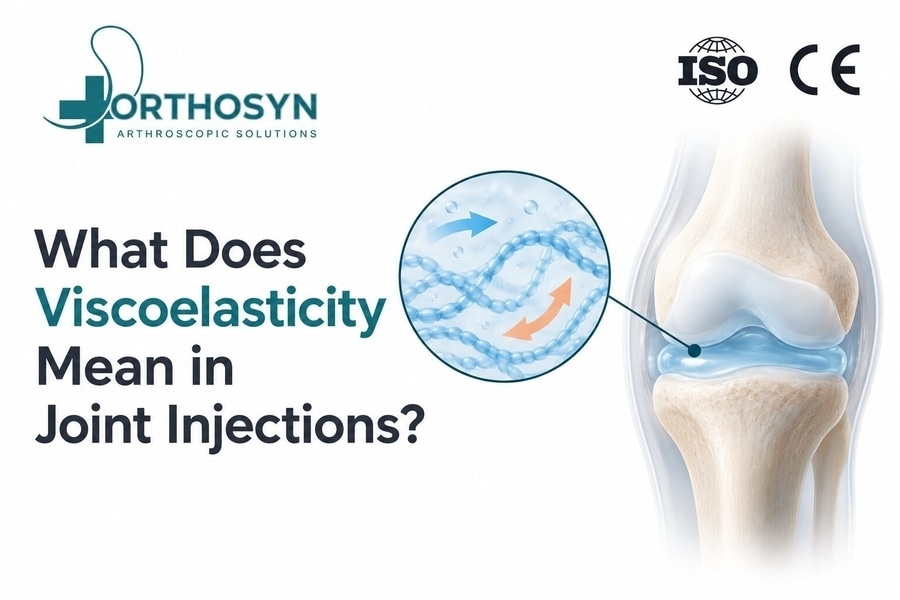
Viscoelasticity is an important physical property of hyaluronic acid (HA) used in intra-articular joint injections. It describes how a material behaves as both a viscous fluid and an elastic substance when exposed to mechanical forces.
In healthy joints, synovial fluid contains naturally occurring hyaluronic acid that contributes to lubrication and shock absorption during movement.
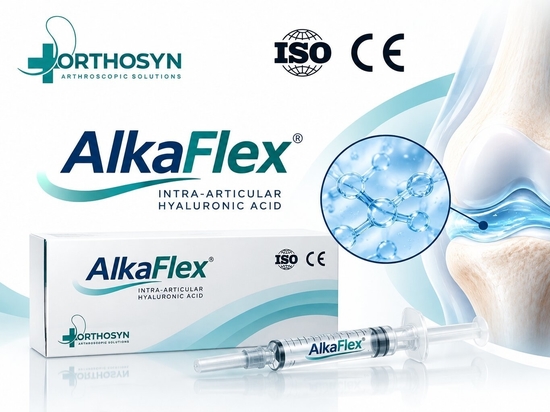
Understanding viscoelasticity in hyaluronic acid injections helps explain how viscosupplementation products, including AlkaFlex hyaluronic acid injections, are designed to supplement the mechanical properties of synovial fluid.
What Is Viscoelasticity?
Viscoelasticity combines two mechanical properties: viscosity and elasticity.
Viscosity describes a fluid's resistance to flow. A highly viscous material flows more slowly and resists deformation under continuous force.
Elasticity describes a material's ability to temporarily deform under mechanical stress and recover part of its original shape when the stress is removed.
A viscoelastic substance exhibits both characteristics.
In joint injections, these properties influence how hyaluronic acid responds to different types of movement and mechanical loading.
Why Is Viscoelasticity Important in Synovial Fluid?
Synovial fluid is a specialized biological fluid found inside synovial joints, including the knee, hip, and shoulder.
Its mechanical properties help support normal joint function.
The viscoelastic behavior of synovial fluid contributes to:
- Joint lubrication: Reducing friction between moving joint surfaces.
- Shock absorption: Helping distribute mechanical forces during loading.
- Smooth movement: Supporting the movement of joint structures.
- Mechanical protection: Contributing to the mechanical environment of cartilage and surrounding tissues.
Hyaluronic acid is one of the main components responsible for the viscoelastic properties of synovial fluid.
How Does Viscoelasticity Change During Joint Movement?
Joint movement involves different speeds and mechanical forces.
At relatively slow movement rates, the viscous characteristics of synovial fluid contribute to lubrication and resistance to flow.
During faster movements or rapidly changing loads, its elastic characteristics become increasingly important in the mechanical response.
This behavior allows synovial fluid to respond differently depending on the frequency and type of mechanical stress.
However, joint lubrication is complex and also involves cartilage surfaces, boundary lubricants, and other biological components.
What Happens to Viscoelasticity in Osteoarthritis?
Osteoarthritis is a degenerative joint condition involving changes in cartilage, synovial fluid, and other joint tissues.
In osteoarthritic joints, changes in the concentration and molecular weight distribution of naturally occurring hyaluronic acid can reduce the viscoelastic properties of synovial fluid.
These changes may affect its ability to provide lubrication and respond to mechanical loading.
Viscosupplementation involves injecting hyaluronic acid into the joint space to supplement synovial fluid.
The clinical effectiveness of hyaluronic acid injections varies among patients and formulations, and symptom improvement is not guaranteed.
How Does Molecular Weight Affect Viscoelasticity?
Molecular weight is an important factor influencing the mechanical behavior of hyaluronic acid.
Higher molecular weight HA generally forms more extensive interactions between polymer chains, which can increase viscosity and elasticity under appropriate conditions.
Lower molecular weight HA typically demonstrates different flow and mechanical characteristics.
However, molecular weight alone does not determine the viscoelastic performance of an injection.
Other important factors include:
- Hyaluronic acid concentration
- Molecular weight distribution
- Cross-linking technology
- Polymer structure
- Formulation characteristics
- Temperature and mechanical loading conditions
Therefore, two HA injections with similar molecular weights may exhibit different viscoelastic properties.
Linear vs Cross-Linked Hyaluronic Acid: What Is the Difference?
Hyaluronic acid injections may contain linear or cross-linked HA.
Linear Hyaluronic Acid
Linear HA consists of polymer chains without an intentionally introduced cross-linked network.
Its viscoelastic properties depend on molecular weight, concentration, and interactions between polymer chains.
Cross-Linked Hyaluronic Acid
Cross-linked HA contains polymer chains connected through chemical bonds, creating a modified polymer structure.
Cross-linking can alter the material's mechanical behavior, including its elasticity, viscosity, and resistance to deformation.
However, cross-linked formulations are not automatically clinically superior to linear HA products. Performance depends on the specific formulation and clinical evidence.
How Does AlkaFlex Relate to Viscoelasticity?
AlkaFlex, part of the Orthosyn Medikal hyaluronic acid portfolio, includes linear and cross-linked formulations developed for intra-articular use.
The AlkaFlex product range includes formulations with different HA concentrations, molecular weight characteristics, and polymer structures.
These characteristics are relevant to the rheological behavior of the injection, including viscosity and elasticity.
For example, the linear AlkaFlex formulations have a reported molecular weight of approximately 2.4 MDa, while cross-linked formulations have reported molecular weight characteristics of approximately 5.65–6 MDa.
These values should not be interpreted as direct measurements of viscoelastic performance or as proof of superior clinical outcomes.
Actual viscoelastic properties are evaluated using rheological measurements under defined testing conditions.
How Is Viscoelasticity Measured?
Viscoelasticity is commonly evaluated using rheological testing.
Two important parameters are:
- Storage modulus (G′): Represents the elastic component of a material's mechanical response.
- Loss modulus (G″): Represents the viscous component of its mechanical response.
These parameters help researchers understand how an HA formulation behaves under oscillating mechanical forces.
Viscosity measurements and frequency-dependent rheological testing can provide additional information about the formulation's physical properties.
Conclusion
Viscoelasticity describes the combined viscous and elastic behavior of hyaluronic acid in joint injections. It is an important concept for understanding how HA formulations respond to joint movement, loading, and mechanical stress.
Molecular weight, concentration, polymer structure, and cross-linking can all influence the viscoelastic properties of a formulation.
Orthosyn Medikal offers AlkaFlex linear and cross-linked hyaluronic acid injections with different formulation characteristics for intra-articular applications.
Understanding these differences can help healthcare professionals evaluate the physical properties of HA products while considering their approved indications, clinical evidence, and patient-specific requirements.