#Product Trends
How the Seamaty SMT-Qt3 Supports Veterinary Chemistry Workflows
Small Samples, Smarter Testing
In veterinary medicine, sample volume can be a practical limitation—particularly when working with small dogs and cats, exotic pets, or patients from whom blood collection needs to be minimized. At the same time, veterinarians often need access to multiple biochemical parameters to support clinical assessment.
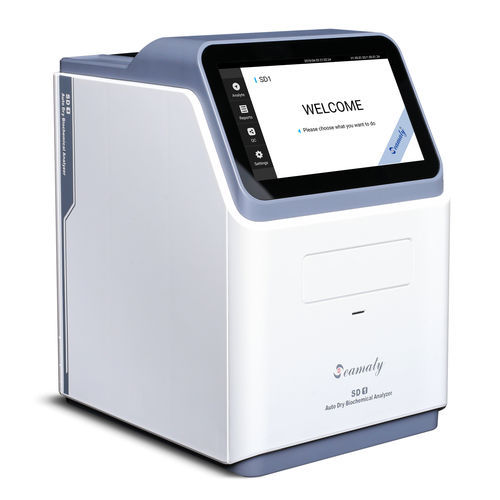
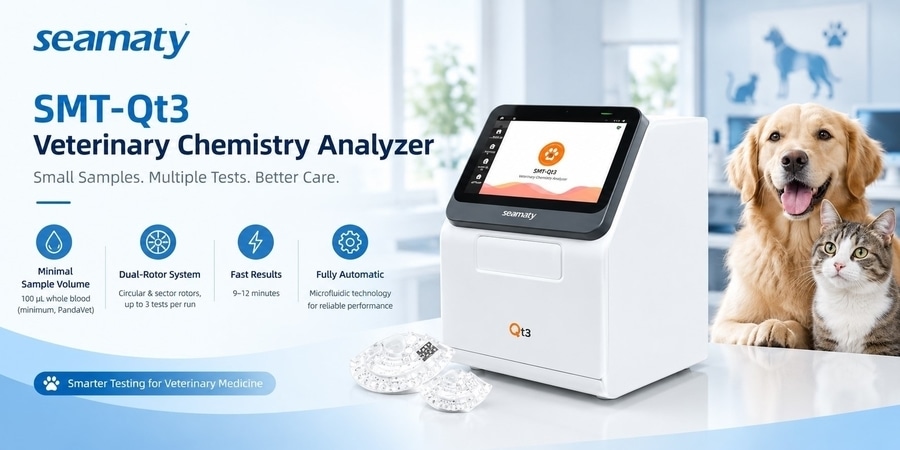
The Seamaty SMT-Qt3 Automatic Veterinary Chemistry Analyzer is designed around this balance between sample efficiency, testing flexibility, and operational simplicity. By combining microfluidic technology with a dual-rotor system, the analyzer supports different testing configurations while maintaining a compact and automated workflow.
1、The Challenge of Veterinary Blood Chemistry Testing
Veterinary practices may encounter several limitations when using conventional chemistry analyzers.
● Limited Testing Flexibility
Some conventional systems are designed around fixed test configurations, which can make it difficult to adapt testing to different clinical situations. A routine health check, preoperative assessment, and a patient with nonspecific clinical signs may require different combinations of biochemical parameters.
● Sample Volume Constraints
Blood collection can be particularly challenging in small or exotic animals. When multiple tests require relatively large sample volumes, obtaining sufficient blood may become inconvenient or increase the burden associated with sample collection.For point-of-care veterinary testing, therefore, reducing sample requirements without compromising the testing workflow can be particularly valuable.
● More Complex Laboratory Procedures
Traditional laboratory workflows may involve multiple preparation steps, reagent handling, and instrument operations. These processes can increase the need for trained personnel and make testing less convenient in busy veterinary environments.
● Manual Handling and Contamination Risks
Manual sample and reagent handling can introduce opportunities for operational errors and cross-contamination. Standardized, automated workflows can help reduce unnecessary manual intervention and support more consistent testing procedures.
2、SMT-Qt3: Designed for Flexible Veterinary Chemistry Testing
The SMT-Qt3 Automatic Vet Chemistry Analyzer approaches these challenges through a combination of automated operation, microfluidic technology, and a flexible reagent-rotor design.
One of its key features is the dual-rotor system, which supports both circular and sector reagent rotors.
The sector rotors use a fan-shaped configuration and can be combined into a circular arrangement. This design provides greater flexibility when selecting tests according to the clinical requirements of the patient.
Depending on the selected rotor configuration, the system can support individual or combination testing, with up to three tests performed in one run using the corresponding sector rotor configuration.
3、Small Sample Volume for Veterinary Applications
Sample efficiency is particularly important in veterinary diagnostics.
The SMT-Qt3 supports whole blood, plasma, and serum workflows. According to the specified PandaVet campaign materials, the minimum sample volume for a whole-blood workflow is 100 µL. The actual required volume should always be determined according to the selected reagent rotor and the current manufacturer's instructions.
This low-volume workflow can be useful when testing smaller patients where blood collection needs to be carefully managed.
Rather than requiring a large specimen for every testing situation, a small-volume approach can help veterinary teams obtain biochemical information while minimizing unnecessary sample collection.
4、Automated Testing Through Microfluidic Technology
The SMT-Qt3 uses microfluidic technology to integrate key testing processes into an automated workflow.
Once the appropriate sample and reagent rotor are prepared according to the manufacturer's instructions, the analyzer carries out the testing process automatically. Results can be available in approximately 9–12 minutes, depending on the selected test.
This automation can help reduce repetitive manual operations and make blood chemistry testing easier to incorporate into routine veterinary consultations.
For clinics where testing needs to take place close to the patient, a compact automated chemistry workflow can also help shorten the time between sample collection, testing, and clinical decision-making.
5、Why the Dual-Rotor Concept Matters
The dual-rotor design is more than a hardware feature. It provides a way to adapt the testing workflow to different clinical requirements.
5.1. Greater Testing Flexibility
Veterinary patients do not always present with the same diagnostic requirements. The ability to select different rotor configurations allows the testing strategy to be adjusted according to the case.
For example, a veterinarian may need a single biochemical parameter for a focused assessment, while another patient may benefit from a combination of parameters.
5.2. Efficient Use of Samples
When sample availability is limited, particularly in small animals, efficient sample utilization becomes an important consideration. The SMT-Qt3's small-volume workflow can support testing where collecting larger blood samples may be undesirable.
5.3. Multiple Tests in One Run
The sector-rotor configuration can combine multiple fan-shaped reagent rotors into a circular arrangement, supporting up to three tests in a single run.
This can help veterinary teams obtain multiple pieces of biochemical information without necessarily running each test as a completely separate workflow.
5.4. Reduced Manual Intervention
Automation reduces the number of repetitive steps that staff need to perform during the testing process. A more standardized workflow can also help reduce opportunities for manual handling errors.
5.5. Designed for Routine Veterinary Workflows
The combination of compact testing, automated operation, and flexible reagent configurations makes the SMT-Qt3 suitable for veterinary practices that need chemistry testing to fit naturally into everyday clinical workflows.
6、Beyond the Analyzer: Building a Reliable Testing Workflow
An analyzer is only one part of a successful point-of-care testing system.
Reliable veterinary chemistry testing also depends on correct installation, appropriate operator procedures, documented protocols, quality-control practices, and preventive-maintenance planning.
Before testing, veterinary teams should ensure that the analyzer is installed and operated according to the manufacturer's current guidance. Staff should also follow the instructions associated with the selected reagent rotor, including requirements for sample type, sample volume, storage, handling, and testing procedures.
A standardized workflow can help ensure that the advantages of automation and small-volume testing are translated into consistent day-to-day performance.
7、Supporting Better Decisions with Practical Chemistry Testing
Veterinary blood chemistry provides important information for assessing physiological status and supporting clinical decision-making. However, the practical value of testing depends not only on the analytical capability of the instrument but also on how easily the testing process can be integrated into clinical practice.
The SMT-Qt3 combines a dual-rotor testing concept, microfluidic technology, automated operation, and small-volume sample workflows to address several practical challenges associated with veterinary chemistry testing.
For small patients, flexible testing requirements, and clinics looking for a streamlined point-of-care workflow, these design considerations can make a meaningful difference.
Ultimately, the goal is not simply to perform more tests—it is to make appropriate biochemical testing more practical, efficient, and adaptable to the needs of veterinary patients and clinical teams.