#Product Trends
Trandomed MN-02-08 Urological Endoscopy Training Model: Making Endoscopic Skill Training More Practical and Standardized
Trandomed MN-02-08 Urological Endoscopy Training Model: Making Endoscopic Skill Training More Practical and Standardized
With the continuous advancement of minimally invasive urological procedures, endoscopic surgery has become increasingly precise and technically demanding. However, many critical skills still rely on clinical experience, while training opportunities are limited and patient safety must always be prioritized.
To shorten the learning curve and transfer procedural risks away from patients, simulation-based training has become an essential approach. Simple anatomical demonstrations or video-based learning cannot fully reproduce the complex relationships between anatomy, tissue feedback, and instrument manipulation.
Developed by Trandomed (Trando 3D Medical Technology), the MN-02-08 Urological Endoscopy Training Model provides a high-fidelity simulation solution for comprehensive urological endoscopic training. The model focuses not only on anatomical appearance, but also on realistic operation experience through accurate reconstruction, optimized materials, and practical applications.
Accurate Anatomical Reconstruction Based on CT Data
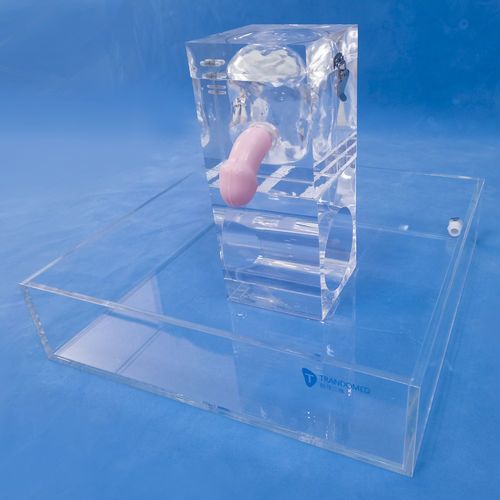
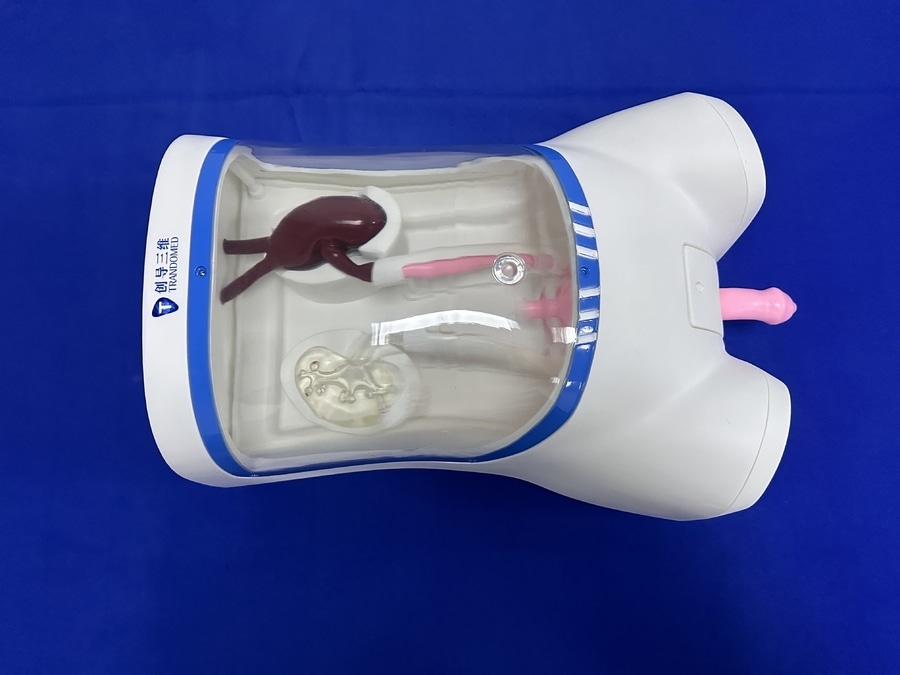
The MN-02-08 model is developed based on adult urinary system CT imaging data and manufactured using advanced soft silicone materials. Instead of simply reproducing external anatomy, the model reconstructs key anatomical pathways and spatial relationships based on clinical data.
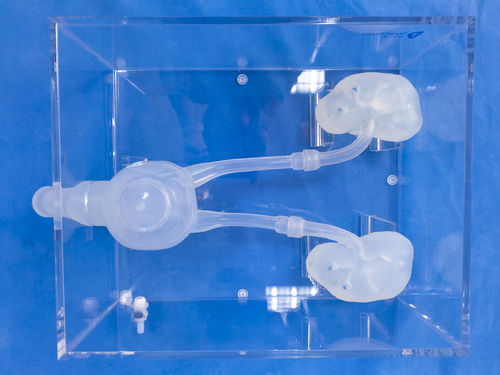
The integrated structure includes male external genitalia, urethra, prostate, bladder, ureter, kidney, renal pelvis, and renal calyces, covering the complete pathway from external access to upper urinary tract intervention.
This integrated design enables continuous procedural training rather than fragmented practice. Trainees can experience the complete endoscopic pathway, including anatomical restrictions within the urethra, prostate region, bladder cavity exploration, ureteral orifice identification, and navigation through the renal pelvis and calyceal system.
By maintaining realistic anatomical relationships, the model helps trainees connect endoscopic views with three-dimensional anatomical understanding, improving procedural orientation and navigation skills.
Realistic 40 Shore A Silicone for Tactile Feedback
In urological endoscopy training, visual recognition is only one part of skill development. The ability to judge resistance, contact pressure, and instrument response is equally important.
The MN-02-08 model uses high-fidelity soft silicone with an approximate hardness of 40 Shore A, providing realistic elasticity and mechanical feedback similar to human tissues.
The material performance enables users to experience:
Smooth advancement and resistance changes during guidewire and catheter manipulation;
Realistic tactile response during cystoscope advancement and angulation;
Improved understanding of when to apply force, rotate, withdraw, or adjust instrument direction.
Stable material properties ensure consistent training experiences, allowing repeated practice and standardized skill assessment.
Replaceable Stone Simulation for Progressive Training
To support different training levels, the MN-02-08 model can be equipped with simulated stones placed in the renal pelvis or urinary tract.
With replaceable stone modules, trainees can practice:
1.Flexible ureteroscopy and laser lithotripsy training;
2.Stone localization and retrieval;
3.Renal pelvis stone management;
4.Ureteral stone intervention procedures.
The replaceable design transforms the model from a fixed anatomical simulator into an adjustable training platform. Beginners can first practice navigation, visualization control, and instrument handling before progressing to more complex stone-related procedures.
A Multi-Functional Platform for Training and Device Evaluation
The MN-02-08 Urological Endoscopy Training Model is designed for clinical education, procedural demonstration, and medical device testing.
For training institutions, it supports procedures ranging from basic skills, such as male catheterization and bladder irrigation, to advanced endoscopic techniques involving ureteroscopy and stone treatment.
For medical device companies, the model provides a realistic and repeatable environment for evaluating urological instruments, including endoscopes, guidewires, catheters, and related devices. It enables assessment of device navigation, compatibility, maneuverability, and operational performance under realistic anatomical conditions.
From Experience-Based Learning to Standardized Training
A major challenge in urological endoscopy education is that many critical skills depend on individual experience and tactile judgment, making them difficult to transfer and evaluate.
The Trandomed MN-02-08 Urological Endoscopy Training Model combines CT-based anatomical reconstruction, high-performance silicone materials, and adjustable procedural scenarios to transform fragmented learning into a structured and repeatable training process.
For teaching hospitals, medical schools, and training centers, the model provides a safe environment where residents can practice confidently, instructors can provide objective feedback, and procedural skills can be developed in a measurable way.
By combining clinical accuracy with engineering innovation, Trandomed continues to advance medical simulation technology and provide high-fidelity solutions for urological education, procedural training, and medical device development worldwide.