#Industry News
The Science of UV-C Disinfection: Dose, Air Changes and Safety in Clinical Settings
For over 140 years, scientists have discovered that ultraviolet light can disinfect drinking water, wastewater, air, pharmaceuticals, food, and surfaces. UV-C light is incredibly effective in deactivating pathogens, including bacteria and viruses.
UV-C inactivation depends on lamp power, distance and exposure time and follows the inverse-square law. In healthcare, UV-C can reach the high equivalent air-change rates that ECDC recommends, entirely chemical- and ozone-free. Correct dosing and coverage are what turn UV-C into a validated clinical tool.
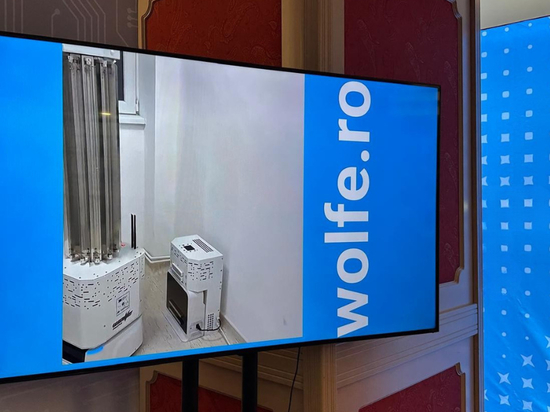
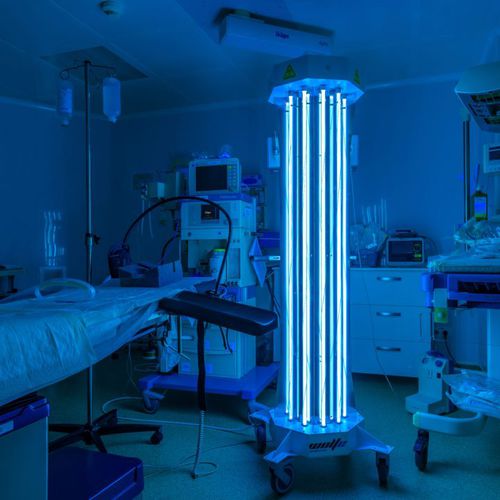
UV-C germicidal light at 253.7 nm destroys the DNA and RNA of bacteria and viruses, stopping them from reproducing. Its effect scales with three variables: how close the surface is to the source, how long it is exposed, and lamp power. Because radiation efficiency falls with the square of the distance, a 4×4 m room needs roughly four times the exposure of a 2×2 m room. Dose therefore cannot be a fixed number of seconds; it must be calculated from room characteristics, device type (unidirectional or omnidirectional), tube power (8, 15, 30, 55, 200 or 325 W per tube) and tube count — the reasoning behind Wolf-e Robotics' UV-C exposure-time calculator. Surfaces that are shaded or out of direct line of sight are not fully treated, which is why mobile robots emitting from several positions are used to guarantee coverage, compliance and per-cycle traceability.
Air is as important as surfaces. With aerosols a major route of SARS-CoV-2 transmission, indoor air disinfection has become essential. Natural ventilation delivers only 1–2 equivalent air changes per hour (eqACH) and mechanical ventilation 2–5 eqACH, whereas UV-C can exceed 10 eqACH. The ECDC recommends 15–20 eqACH in healthcare settings to protect vulnerable patients — a level most mechanical systems cannot reach but UV-C can, for example through upper-room Wolf-BEAM fixtures.
On safety, UV-C disinfection is a physical, chemical-free process. Enclosed air units from reputable manufacturers emit no significant ozone and can operate around people; exposed-lamp surface units are safe only with presence sensors and trained operators working in vacated rooms. Any faint odour after a cycle is not ozone but thiols formed when UV-C reacts with dead skin cells in dust (up to 80% of indoor dust; keratin and cysteine break down into thiols detectable at one part per billion), so treated rooms are safe to enter immediately.
Use the Wolf-e Robotics exposure-time calculator and speak to the team on MedicalExpo to design a dose- and air-change strategy for your clinical spaces!
***
/UV-C dosimetry, equivalent air changes per hour, upper-room UVGI, hospital air disinfection, ozone-free disinfection/